Engineering Digital Twins: How to Tell a Useful Model from a Convincing Animation
Evaluate an engineering digital twin through its intended decision, sensor quality, verification, validation, uncertainty, and maintenance—not visual realism alone.
Reviewed October 12, 2026. This article discusses engineering decision support using NIST publications. Its thermal example and acceptance limits are synthetic teaching choices, not guidance for operating a real plant or safety-critical system.
A factory manager sees an impressive screen: machines rotate in three dimensions, temperature readings glow above them, and a dashboard predicts the next maintenance event. The demonstration is persuasive. But the most important question remains unanswered: would acting on that prediction improve the decision, and under which operating conditions?
That question is central to engineering digital twins. NIST's Digital Twins Workshops Summary Report, published July 21, 2026, identifies verification, validation, uncertainty, interoperability, cybersecurity, and workforce readiness as continuing challenges. The report is a useful recent anchor for a topic that often attracts futuristic marketing. It describes priorities and barriers, rather than certifying any product or promising a universal return on investment.
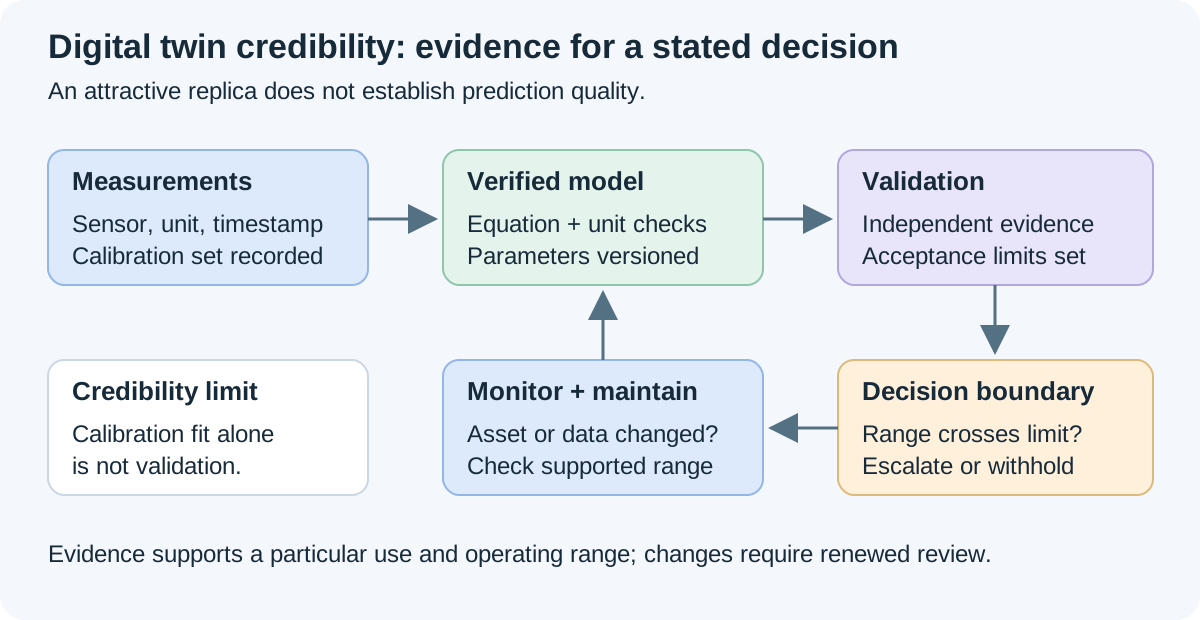
Start with the decision the twin is meant to support
Suppose a workshop wants to schedule a cooling interval before unloading a heated component. A digital model might estimate temperature from a starting measurement, elapsed time, and surrounding conditions. Its usefulness depends on the unloading decision. A visually realistic replica can still miss the thermal behavior that matters, while a modest model can be useful if its error is understood and fits that decision.
Write the intended use in operational terms. Identify the physical asset, the output required, the time horizon, the operating range, and the person who acts on it. “Optimize the factory” is too broad to test. “Estimate the component temperature ten minutes ahead during the documented cooling process” creates a question that measurements can address.
NIST's definitions and state-of-the-art page notes that digital-twin definitions differ across industries. Therefore, specify what is actually connected rather than arguing from the label. Does the system receive measurements automatically? How often does it update? Does it make recommendations, or directly change equipment settings? Each connection introduces a different responsibility.
The business case should reflect that scope. A system that helps an operator compare scenarios has different costs and consequences from an automatic controller. Count integration, model maintenance, staff training, and data-quality work alongside the software license. Benefits should be measured against the existing decision process, using comparable conditions and a clear outcome.
Separate verification, calibration, and validation
These activities answer different questions. Verification checks whether the implementation follows the specified model and calculations. Calibration adjusts parameters using observations. Validation examines whether the resulting model is adequate for its stated physical use, with evidence that is suitable for that purpose. NIST's digital-twin credibility paper places verification, validation, and uncertainty quantification within a wider credibility assessment.
Imagine fitting a cooling coefficient to three temperature readings. Matching those same readings is evidence that fitting worked, but it gives limited information about a new component tomorrow. Measurements from additional runs, conditions, or equipment configurations can expose weaknesses that the calibration data conceal. Reserve appropriate evidence for evaluation before adjusting the model repeatedly to match it.
| Activity | Practical question | Example evidence | What it does not establish |
|---|---|---|---|
| Verification | Did we implement our intended equations correctly? | Unit checks and a known analytical case | Agreement with the physical asset |
| Calibration | Which parameters fit the selected observations? | Documented fit on calibration runs | Accuracy on unseen conditions |
| Validation | Is performance adequate for this intended use? | Independent physical comparisons | Universal validity outside the tested range |
| Uncertainty analysis | How much might the result vary or be wrong? | Sensitivity and justified uncertainty estimates | A guarantee that every unknown was included |
| Monitoring | Does the supported use still hold? | Drift checks and operating-range records | Permission to ignore a changed process |
Verification can include simple invariants. For the cooling model below, temperature should start at the initial value, remain above ambient under its assumptions, and move toward ambient over time. Checking those properties can catch a sign error or a unit mistake. Passing them says the code follows this simple equation; it does not prove that the equation represents a real industrial component.
Follow the measurement before trusting the model
A temperature reading is not simply a number. It has a location, measurement method, unit, timestamp, calibration history, and relationship to the quantity of interest. A sensor attached to the exterior of a thick component may respond differently from its core temperature. A model that uses one as a substitute for the other needs evidence for that relationship.
Consider a timestamp mismatch. A sensor reading collected at noon might arrive in a dashboard several minutes later. If the model treats arrival time as measurement time, it can appear to disagree with physical behavior even when both the sensor and equation work as specified. Missing readings, duplicate records, and unit conversions create similar problems.
A practical data record therefore preserves the original measurement time, arrival time, sensor identifier, unit, and quality status. Define what happens when data are late or unavailable. Should the display show an older estimate with its age, refuse a recommendation, or fall back to a documented process? Leaving that choice implicit transfers a data problem to the operator.
NIST's advanced-manufacturing digital-twin program emphasizes architectures, interoperability, lifecycle data, and traceability. Those priorities matter because a twin combines multiple subsystems. A trustworthy output depends on the whole route from measurement to decision, including the interfaces between components.
A small calculation makes the boundaries visible
The following standalone Python program uses a simplified cooling equation. All readings, parameters, thresholds, and uncertainty ranges are synthetic. The fixed coefficient represents a parameter selected earlier, before the held-out readings shown here. The example demonstrates checks and a decision boundary; it does not construct a complete digital twin or validate a real thermal process.
from math import exp
from statistics import mean

def temperature(minutes, initial=80.0, ambient=20.0, coefficient=0.08):
    return ambient + (initial - ambient) * exp(-coefficient * minutes)

assert temperature(0) == 80.0
assert 20.0 < temperature(20) < temperature(10) < 80.0

# Synthetic held-out observations; not used to set coefficient=0.08.
observations = [(5, 61.0), (10, 48.0), (15, 39.0)]
errors = [temperature(t) - measured for t, measured in observations]
mae = mean(abs(error) for error in errors)
assert mae < 1.2  # An illustrative criterion chosen for this lesson.
print(f"Synthetic held-out MAE: {mae:.2f} degrees Celsius")

# Sensitivity envelope across chosen parameter bounds, not a confidence interval.
scenarios = [
    temperature(15, initial, ambient, coefficient)
    for initial in (78.0, 82.0)
    for ambient in (19.0, 21.0)
    for coefficient in (0.07, 0.09)
]
lower, upper = min(scenarios), max(scenarios)
threshold = 40.0  # Synthetic unloading threshold, not a safety recommendation.
assert lower < threshold < upper
print(f"Chosen-parameter envelope at 15 minutes: {lower:.2f} to {upper:.2f}")
print("The envelope crosses the threshold: this lesson's model cannot decide alone")
The mean absolute error looks small under the chosen illustrative criterion. Yet the sensitivity envelope crosses the synthetic unloading threshold. A model can perform well on an average-error measure while offering insufficient certainty for a specific action. That is why the decision rule must be defined alongside the validation measure.
The envelope is not a statistical confidence interval. Its endpoints come from chosen parameter bounds, not a fitted probability model or demonstrated coverage rate. Calling it “95 percent certain” would add information the calculation does not contain. Real engineering work must justify the parameters, measurement uncertainty, model discrepancy, and acceptance procedure with domain expertise and evidence.
Choose validation conditions that can reveal failure
A useful validation plan covers the conditions that matter for the intended decision. For the hypothetical cooling process, these could include starting temperatures, component sizes, airflow conditions, and sensor positions. Testing many repeats of one easy condition may estimate repeatability there while telling you little about the rest of the operating range.
Set the evaluation criteria before looking at the final comparison. Describe acceptable error, any important bias, the relevant time horizon, and how the system should behave near a decision threshold. Keep calibration runs separate from evaluation runs where that separation serves the question. If measurements share a common sensor or production batch, account for that dependence rather than treating every reading as an independent experiment.
Inspect errors against operating conditions. An overall average can hide systematically wrong predictions for heavier components or after a maintenance change. Also examine the situations where the model declines to issue a recommendation. A system that avoids every difficult case may have good reported accuracy but limited coverage of the actual workflow.
Record unsupported conditions explicitly. If the model was examined only for a particular material, geometry, and temperature range, a new combination requires additional assessment. The appearance of a familiar object on screen does not establish that its behavior falls within the validated domain.
Keep the twin credible after the demonstration
An engineering asset changes. Components wear, sensors are replaced, control settings move, and production materials vary. A twin that was useful during a trial can become less reliable without a visible software error. Assign an owner for reviewing these changes, and define which ones require recalibration, renewed validation, or temporary withdrawal of a recommendation.
Version the model, its parameters, important input transformations, and the supporting evidence. A decision record should make it possible to reconstruct which model and measurements produced an estimate. NIST's ISO 23247 use-case publication provides manufacturing implementation scenarios; it should inform architecture discussion rather than substitute for application-specific validation.
Security also belongs in the credibility discussion. Altered measurements or unauthorized parameter changes can distort an otherwise well-tested calculation. Separate viewing permissions from authority to change models or equipment settings, and keep a traceable change process. A useful first deployment may remain advisory while the team learns how data quality, model limitations, and human interpretation behave in practice.
Does a digital twin need a photorealistic 3D model?
The required representation follows the intended use. Spatial layout may matter for collision analysis or operator training. A temperature forecast may depend more on measurements and thermal relationships. Visual detail should help the decision rather than act as a proxy for validated behavior.
Can a model validated today be trusted indefinitely?
Validation supports a specified use under documented conditions. Continued trust requires checking whether those conditions, the asset, and the data pipeline still match the evidence. Treat the model as maintained decision support with a review process, especially when the consequences of error are substantial.
Primary sources and interpretation limits
The practical workshop scenario and calculation are original teaching examples. NIST publications support the discussion of definitions, credibility, lifecycle integration, and implementation priorities. No performance saving, product certification, or operational safety threshold is inferred from them.