Heat Pumps in Cold Weather: How to Read COP Without Being Misled
Understand why heat pumps can deliver more heat than the electricity they consume, why performance changes with temperature, and how sizing and backup systems affect bills.
Reviewed October 12, 2026.
Understand why heat pumps can deliver more heat than the electricity they consume, why performance changes with temperature, and how sizing and backup systems affect bills.
| Concept | What it means | Important limit |
|---|---|---|
| COP | Heat delivered divided by electricity used | A test-point value is not annual performance |
| Capacity | Maximum heat output at stated conditions | Can fall as outdoor temperature drops |
| Heating load | Heat the building loses at a temperature | Depends on insulation, leakage, and weather |
| Backup heat | Supplement when load exceeds capacity | Fuel and controls determine cost and emissions |
1. A heat pump moves energy instead of creating all of it
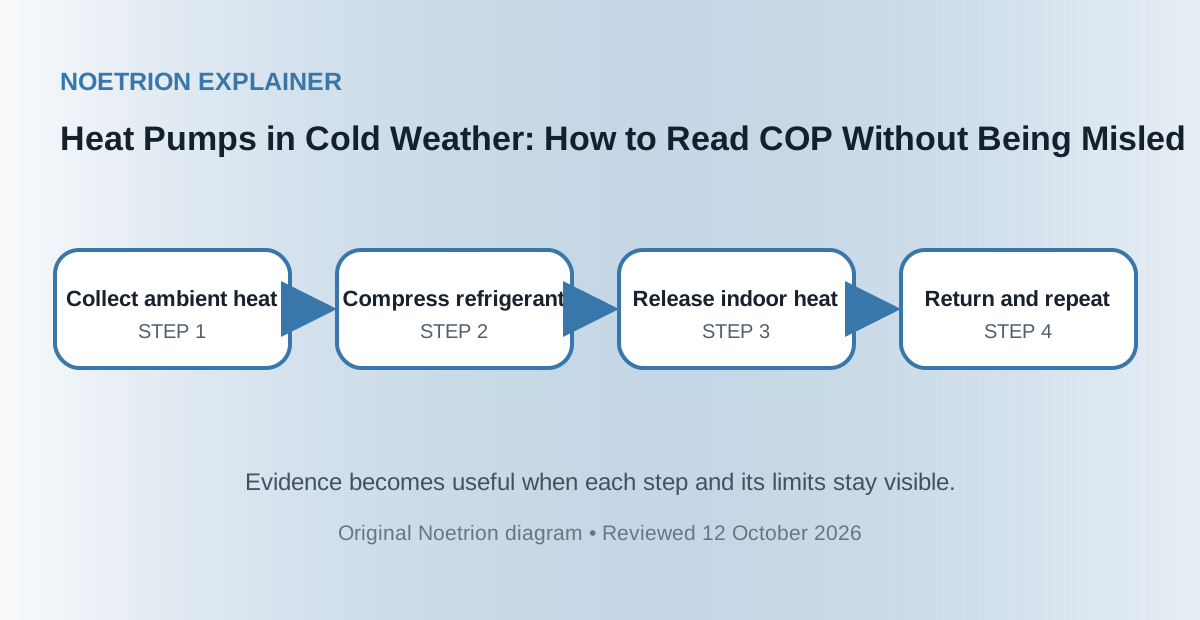
Resistance heaters convert electrical energy directly into heat, so one unit of electricity produces roughly one unit of heat at the point of use. A heat pump uses electricity to move additional heat from outdoor air, ground, or water into a building. Its coefficient of performance divides useful heat delivered by electrical input. A COP of four means four units of heat for one unit of electricity under the stated test conditions. It does not violate conservation of energy because three units came from the environment.
2. The temperature lift controls the difficulty
The compressor must raise refrigerant pressure and temperature enough for heat to flow into the indoor space. When outdoor air becomes colder or the heating system demands hotter supply air or water, the required temperature lift grows. Compressor work increases and COP generally falls. Ground-source systems often see steadier source temperatures but require different infrastructure and cost. Comparing products requires the same outdoor and indoor test conditions; a favorable mild-weather COP should not be presented as winter performance everywhere.
3. Efficiency and capacity are separate curves
COP describes the ratio of output to input, while capacity describes how much heat the machine can deliver. An air-source heat pump may retain useful efficiency in cold weather but have less maximum capacity than at a mild condition. Meanwhile, the building’s heating load rises as the outdoor temperature drops. The balance point is where equipment capacity matches load. Below it, the home may need supplemental heat, reduced indoor setpoint, or a system designed to maintain more low-temperature capacity.
4. Defrost is a normal operating process
Moisture can freeze on the outdoor coil during cold, humid conditions, blocking airflow and insulating the heat exchanger. The unit periodically reverses or changes operation to melt frost. During defrost, delivered heat can temporarily drop and energy use changes; auxiliary heat may maintain comfort. Frequent or ineffective defrost can signal sizing, drainage, sensor, airflow, or maintenance problems. Laboratory ratings and field monitoring should distinguish steady-state performance from complete cycles that include defrost and standby energy.
5. Variable-speed compressors improve part-load control
Most heating hours occur at loads below the coldest design condition. Variable-speed systems can reduce compressor output instead of repeatedly switching fully on and off. Longer, lower-output operation can improve comfort, humidity control, and efficiency, but performance depends on the equipment’s modulation range and installation. Oversizing may cause cycling during mild weather; undersizing can increase backup use during extremes. A design should examine the building load curve rather than selecting equipment from floor area alone.
6. Building improvements and equipment interact
Air sealing and insulation reduce heating load, which can allow smaller equipment, raise comfort, and reduce backup operation. A heat pump can still save energy in a poorly insulated building, but the system must be sized and distributed appropriately. Duct leakage, insufficient emitters, blocked airflow, or very high hydronic temperatures can reduce performance. Retrofit analysis should separate the heat source from the building envelope and delivery system while recognizing that the best package may improve several together.
7. Cost and emissions need local inputs
A higher COP reduces electricity per unit of heat, but operating cost depends on electricity tariffs, fuel prices, fixed charges, climate, and backup strategy. Emissions depend on the electricity mix over relevant hours and on the fuel displaced. A gas boiler’s rated efficiency also differs from seasonal delivered performance. Honest comparisons model a full year with weather and controls, disclose prices and carbon factors, and test sensitivity. A universal claim that one system is always cheaper confuses physics with local economics.
8. Read ratings as standardized comparisons, not guarantees
Seasonal metrics aggregate performance across defined climate bins and test procedures. They are useful for comparing certified products but may not reproduce a specific home’s weather, ductwork, thermostat behavior, or maintenance. Review low-temperature capacity, not only a headline seasonal efficiency. Ask whether resistance backup is included in the estimate and whether the installer performed a room-by-room load calculation. Post-installation electricity and temperature data can reveal whether the real system follows its design intent.
Conclusion
Heat pumps remain efficient because they transport environmental heat, but their performance is a system curve rather than one COP number. Outdoor temperature, supply temperature, capacity, defrost, building load, and backup controls all matter. Matching equipment to the building and evaluating annual operation turns laboratory efficiency into reliable comfort and savings.