Europe's Right to Repair Rules in 2026: What Consumers and Product Makers Need to Know
EU right-to-repair rules apply from July 31, 2026. Learn the limits of repair rights, guarantee extensions and implications for product makers.
Published-source date: July 31, 2026
A broken appliance does not always need to become a replacement purchase. That simple idea sits behind the European Union's right-to-repair framework, with relevant national implementing measures applying from July 31, 2026. The European Commission says the rules are designed to make repair easier and more attractive for covered products such as washing machines, vacuum cleaners, mobile phones, and tablets.
The reform is not an unlimited right to demand free repairs on anything you own. Its practical value lies in a more specific set of obligations and consumer choices.
What changes for consumers?
The Commission explains that consumers can request repair from manufacturers for products that are technically repairable under relevant EU rules. The repair must be provided free or at a reasonable price within a reasonable timeframe, according to the applicable conditions. The framework also extends the legal guarantee by at least 12 months when a consumer chooses repair instead of replacement within the seller's liability period.
| Consumer question | Practical answer |
|---|---|
| Can every product be repaired under the new rule? | No. Covered categories and legal repairability conditions matter. |
| Is every repair free? | No. The rule refers to free or reasonably priced repair where applicable. |
| Does any repair create a new unlimited warranty? | No. The specified legal guarantee extension has conditions. |
| Is the European repair platform already operational? | The Commission's current directive explainer foresees operation in January 2028. |
Consumers should check the applicable national implementation and the product's legal status rather than relying on a short social-media summary.
Why repairability begins with engineering
Repairability is often determined before a product reaches a store. Engineers decide whether batteries are replaceable, whether a device can be opened without damage, whether spare parts are standardized, and whether diagnostic information is available to repair professionals.
These choices involve trade-offs. A device may need water resistance, electrical safety, compact dimensions, and affordable manufacturing. Good repair design considers those constraints while reducing unnecessary barriers to servicing. Reliability and repairability are not identical: a product can last for years but be difficult to fix, or be easy to open but fail frequently.
What changes for manufacturers and repair shops?
Manufacturers may need to plan spare-parts availability, service information, repair partners, turnaround times, and customer communication. Repair shops may see new opportunities where access to parts and information improves. Retailers may need to update return and warranty workflows so staff can explain repair options accurately.
A useful service dashboard could track repair turnaround time, parts availability, repeat failures, repair cost, and customer satisfaction. A promise to repair is only meaningful when customers can obtain a reliable service at a predictable cost.
How to decide whether to repair or replace
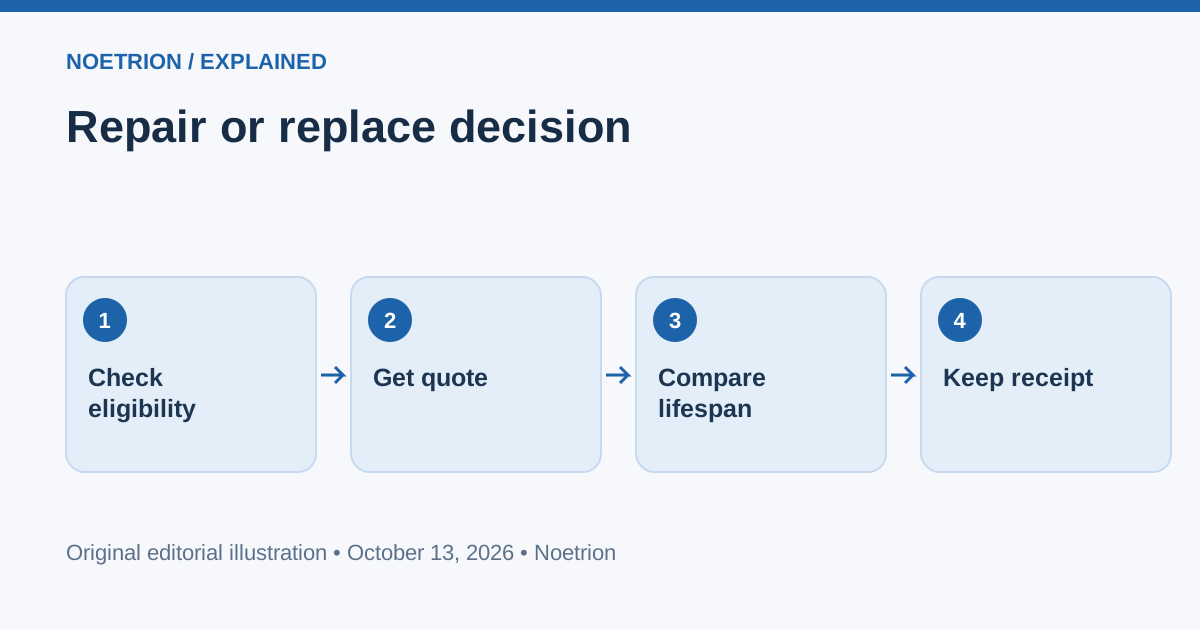
Before buying a replacement, compare the quoted repair cost with the replacement price, expected remaining lifespan, energy consumption, and safety. A phone battery replacement and a major repair to an inefficient appliance can have very different economics.
Ask four questions: What caused the failure? Does the repair restore full functionality? What warranty applies afterward? Will my data or personal information be protected during service? Back up devices before handing them over, and use qualified technicians for safety-critical electrical or mechanical work.
Environmental benefits need careful measurement
Keeping products in use longer can reduce waste and demand for new materials. But lifecycle effects vary. A repaired device that consumes far more energy than a modern alternative may require a more nuanced comparison. Transportation, replacement parts, manufacturing impacts, and the remaining useful life all matter.
The long-term goal should be a market where manufacturers compete on durability, serviceability, and lifecycle value—not just on a lower upfront price.
FAQ
Do the EU rules apply worldwide?
No. Other countries have their own consumer protection and repair frameworks.
Does choosing repair always extend the guarantee by a year?
The extension applies in the specified circumstances, including a qualifying repair choice during the seller's liability period.
When is the EU repair-finder platform expected?
The Commission's current directive explainer foresees January 2028; its July 2026 news item gave an earlier 2027 expectation.