Europe's T+1 Settlement Transition: What the October 2027 Deadline Means in 2026
EU markets target T+1 settlement on October 11, 2027. Learn the December 2026 milestone, operational challenges and investor implications.
Educational analysis, not a personal investment or payment recommendation. Check the dated sources and the rules that apply in your jurisdiction.
Published-source date: July 20, 2026
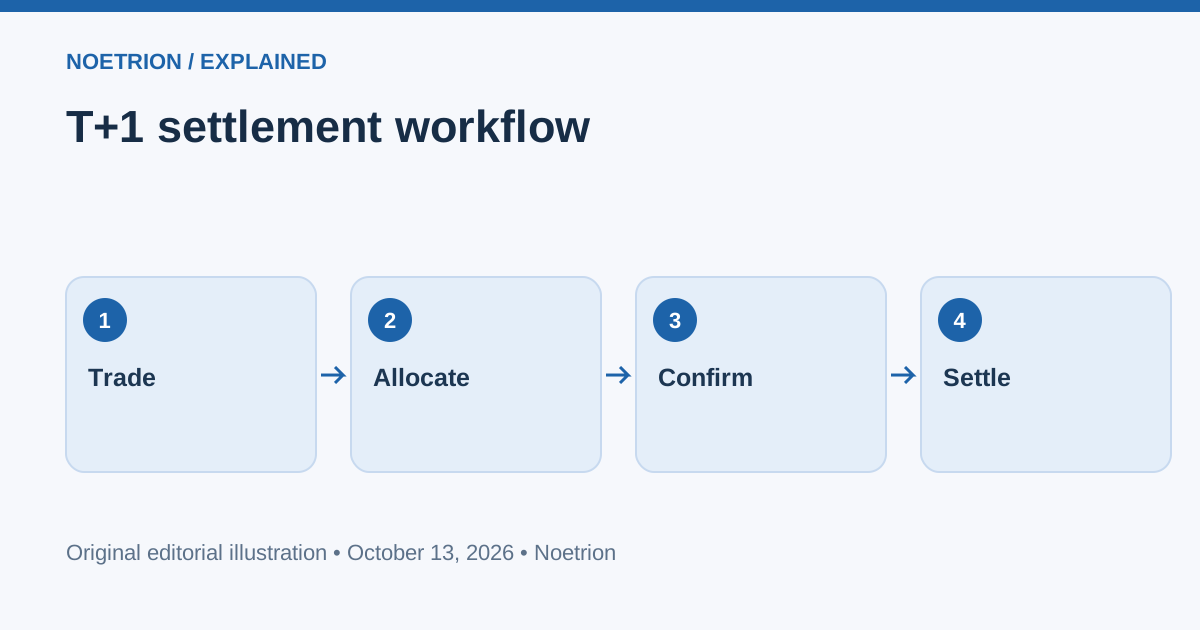
Buying a share on an exchange and legally settling the trade are not the same event. After a trade is executed, securities and money still need to move through the post-trade system. That is why a seemingly small change from T+2 to T+1 can require months of operational preparation.
On July 20, 2026, the European Securities and Markets Authority (ESMA) reminded market participants to prepare for the European Union's move to a T+1 settlement cycle on October 11, 2027. ESMA called 2026 a critical preparation year and highlighted a first regulatory milestone on December 7, 2026 for allocations and confirmations processes.
What T+1 actually means
“T” is the trade date. T+1 generally means settlement occurs one business day after the trade date, compared with two business days under T+2. The term concerns the settlement cycle for relevant securities transactions, not a guarantee that every investor can withdraw funds immediately after placing an order.
| Process | Under T+2 | Under T+1 |
|---|---|---|
| Trade execution | Trade date | Trade date |
| Target settlement | Two business days later | One business day later |
| Time for matching and corrections | Longer window | Shorter window |
| Operational pressure | More time for manual processes | Greater need for timely automation |
| Investor experience | Depends on broker and account terms | Still depends on broker and account terms |
Public holidays, instrument eligibility, and market rules can affect how a particular transaction is handled.
Why a shorter cycle can be useful
Reducing the time between trading and settlement can reduce certain counterparty exposures and improve capital efficiency. It can also shorten the period during which a failed or unmatched transaction remains unresolved. However, moving faster is not free: the industry must adapt processes that previously relied on an extra day.
The most difficult tasks often involve trade allocation, confirmation, foreign-exchange funding, custody instructions, and exception handling. A global investment manager may need to coordinate teams and systems across time zones.
What ESMA wants firms to prepare
ESMA's July 2026 statement urges firms to check readiness across the entire trading and settlement chain. Earlier ESMA proposals discussed same-day allocation and confirmation processes, machine-readable messaging, and improved settlement discipline. A single broker cannot solve the problem if its counterparties, custodians, or infrastructure providers remain unprepared.
A practical readiness exercise should map a trade from execution to final settlement. Record who sends each instruction, when it is due, what happens if it fails, and how corrections are approved. Test realistic scenarios: late trade allocations, holidays, foreign-exchange delays, and mismatched account details.
What retail investors should understand
T+1 is primarily a market-infrastructure change. It may reduce certain settlement-related frictions, but it does not eliminate price volatility, broker fees, market risk, or investment losses. Investors should read their broker's current policies for cash availability and withdrawals rather than assuming the regulatory target date automatically changes every account feature.
If you invest internationally, be aware that different markets may have different settlement calendars and deadlines. Do not plan an urgent payment around assumed settlement timing without confirming it with your broker.
A checklist for firms
- Inventory affected products, counterparties, and custody arrangements.
- Identify processes that still depend on manual end-of-day work.
- Validate allocation and confirmation timing against current requirements.
- Coordinate tests with custodians, clearing members, and technology providers.
- Track settlement fails and exception resolution times.
- Update contingency procedures and customer communication.
The goal is not merely to hit the October 2027 date. It is to maintain reliable settlement under a tighter operational clock.
FAQ
Does T+1 mean the stock market becomes open every day?
No. It concerns settlement timing, not exchange opening hours.
Is October 11, 2027 the EU target date?
Yes, according to ESMA's July 2026 statement.
Does the change guarantee immediate withdrawals?
No. Broker account rules and payment processing remain separate considerations.