Exam Wrappers: Turn Confidence Gaps into a Better Study Plan
Use an exam wrapper to compare confidence with accuracy, diagnose costly mistakes, and test a focused study change with a worked example and worksheet.
You finish a practice test expecting 80%. The marking guide says 60%. The uncomfortable part is not only the missing marks. It is that your internal estimate failed to warn you which answers needed attention.
An exam wrapper makes that mismatch useful. It is a short review around an assessment: what you expected, what happened, why marks were lost, and what you will change before the next attempt. The aim is a better decision about studying, rather than a longer reflection journal.
A 2026 pharmacy education study brings the question back into focus. But the research does not justify treating wrappers as a guaranteed grade booster. This guide separates the evidence from a practical, original worksheet you can use with a quiz, coding exercise, or university examination.
What an exam wrapper actually wraps
The assessment remains the main event. The wrapper adds a record before answers are checked and a structured review afterward. Carnegie Mellon's Eberly Center describes reviewing strengths, weaknesses, preparation, and recurring errors to guide future learning.
For independent study, keep four fields: predicted performance, observed performance, error explanation, and one testable adjustment. A prediction written after seeing the solution is unreliable evidence of what you originally believed. Capture it first.
You do not need to record confidence on every homework question forever. Choose a manageable assessment with a clear answer key or marking rubric. If a course forbids retaining examination questions, record permitted topic labels and feedback instead. Reflection should respect assessment rules.
What the 2026 research adds—and leaves unresolved
Short and colleagues' longitudinal pharmacy study was published online on July 23, 2026, with a November issue assignment. Its survey followed predictions, preparation information, reflections, and topic confidence over consecutive grading periods. The indexed abstract reports positive relationships between predicted and actual scores, with reported correlations from 0.564 to 0.826.
That is evidence about relationships in the studied course sequence. It does not establish that an individual's confidence was numerically calibrated, or that using the wrapper caused an improvement compared with an otherwise equivalent untreated group. Two students can rank their likely results correctly while both predicting scores that are consistently too high.
An earlier Soicher and Gurung study, first published online in August 2016 and appearing in a 2017 issue, provides an important counterweight. Among 86 students remaining in introductory psychology classes, wrapper, sham-wrapper, and control conditions did not differ in the reported examination, final-grade, or metacognition outcomes. Assignment was by class section rather than random individual allocation.
The useful conclusion is modest: a wrapper can organize feedback and expose decisions worth changing. Its effectiveness depends on what happens next. These are education studies in specific settings, not a promise that the worksheet below raises everyone's grades. The recent paper's indexed abstract was available for this review; detailed results beyond that abstract are not presented here.
Distinguish confidence, accuracy, and calibration
Accuracy measures how often an answer is correct. Confidence estimates how likely you think correctness is. Calibration asks whether those estimates match outcomes across repeated judgments.
If you assign 80% confidence to many comparable answers, good calibration would mean roughly eight out of ten are correct over a sufficiently informative sample. One answer cannot validate that probability. A correct 20%-confidence guess also does not prove the low confidence was irrational.
There is another distinction: calibration and discrimination. You may predict 90% for easier questions and 60% for harder ones, correctly distinguishing their difficulty, yet be too optimistic in both groups. Conversely, assigning 60% to everything can match an overall 60% result while telling you nothing about which answers need review.
This matters because different problems require different adjustments. An inflated average prediction needs better estimation. Confident mistakes need correction of specific beliefs. Low confidence on correct answers may signal that the reasoning is fragile—or simply that you are cautious.
A worked example: the same score hides different risks
The following eight-question assessment is fictional. Each item has equal weight and is scored either correct or incorrect. Confidence means the estimated probability of receiving full credit, recorded before marking.
| Item | Confidence | Result | Review note |
|---|---|---|---|
| 1 | 90% | Correct | Method and arithmetic checked |
| 2 | 90% | Incorrect | Used population SD where sample SD was needed |
| 3 | 80% | Correct | Explained why the method applies |
| 4 | 80% | Incorrect | Applied a formula outside its assumptions |
| 5 | 60% | Correct | Reasoning sound, hesitation about notation |
| 6 | 60% | Correct | Verified with a second method |
| 7 | 40% | Incorrect | Could not choose a starting model |
| 8 | 40% | Incorrect | Left incomplete after losing time |
Items 1, 3, 5, and 6 are correct. Accuracy is 4/8 = 50%. Mean confidence is 540/8 = 67.5%. The average confidence gap is therefore 17.5 percentage points above observed accuracy.
Now group the judgments. The four items at 80% or 90% confidence have 85% average confidence but only 50% accuracy. The two at 60% are both correct. The two at 40% are both wrong. These tiny groups are diagnostic clues, not stable estimates of long-run calibration.
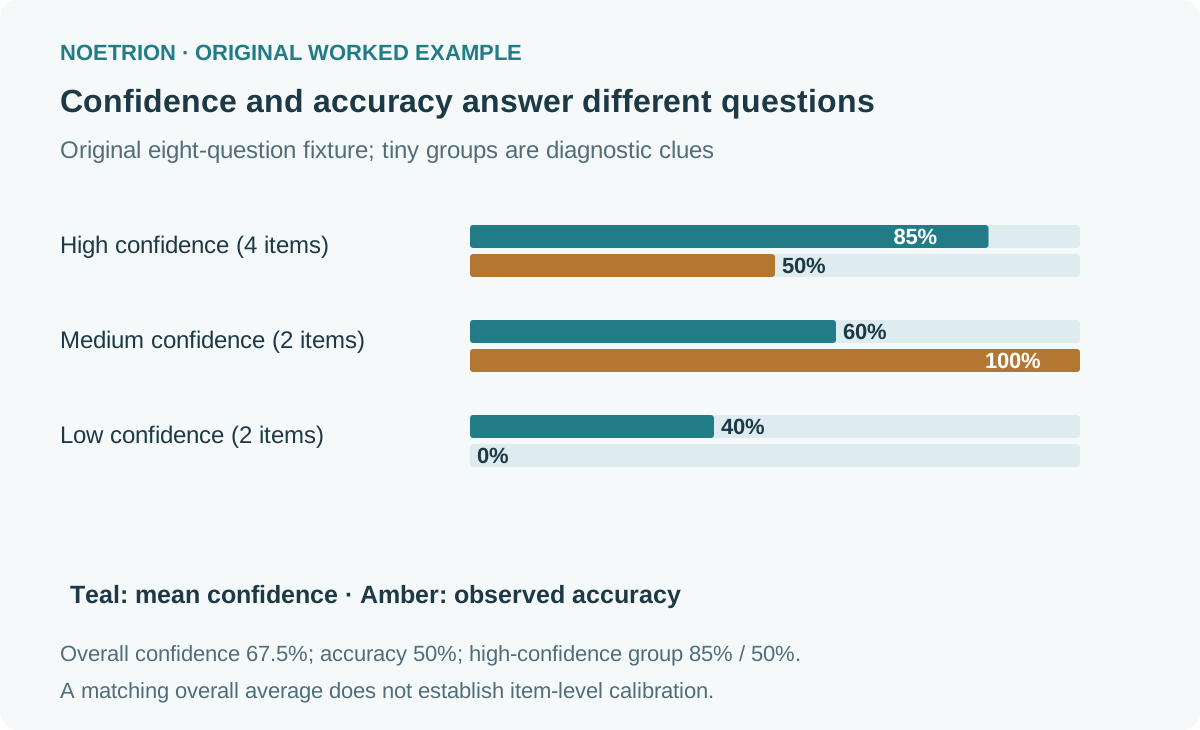
The immediate priority is not simply “study the hardest questions.” Items 2 and 4 contain confidently applied wrong rules. More repetition of those rules without feedback could reproduce the same errors.
Use an error taxonomy that changes the next action
Avoid labeling every missed question “careless.” That label often ends the investigation. Instead, identify the first point at which the solution diverged from a defensible approach.
| Error pattern | Evidence to look for | A focused adjustment |
|---|---|---|
| Missing concept | Cannot explain the relevant idea without notes | Reconstruct the explanation, then check it |
| Wrong method choice | Knows formulas but selects an unsuitable one | Compare two look-alike problems and justify selection |
| Execution error | Method is correct; one operation fails | Add a specific check at that operation |
| Misread requirement | Solves a different quantity or ignores a constraint | Restate the requested output before calculating |
| Time allocation | Later items remain unfinished | Rehearse a time limit and a skip-return rule |
A question can have multiple errors. For prioritization, identify the earliest consequential one. Fixing arithmetic will not recover a solution built on the wrong assumptions.
For partial-credit work, record lost marks and the rubric explanation. Do not convert “three out of five marks” automatically into a 60% probability of correctness; those quantities answer different questions. Keep the binary example above separate from a marks-based analysis.
Build a ten-minute wrapper you will actually reuse
Before marking, write your expected score, the three least secure answers, and the reason for each uncertainty. For a short quiz, add item confidence in broad increments such as 20%, 40%, 60%, 80%, and 90%. Avoid defaulting to 100% merely because an answer looks familiar.
After marking, calculate the observed score, find confidently wrong answers, and choose one error pattern to address. Then write a concrete change: “For the next six inference problems, name the parameter and assumptions before selecting the test.” This is more inspectable than “be more careful.”
The final field is a follow-up date and assessment condition. Use a new question without the solution visible. If you repeat the identical worked problem immediately, familiarity with its answer can conceal the original decision weakness.
The ten-minute duration is an editorial suggestion for keeping the process lightweight. It is not a research-established optimum, and a complicated examination may need a longer review with an instructor.
Test whether the adjustment helped
Compare like with like where possible: similar topic coverage, scoring, difficulty, and time conditions. A higher result on a much easier quiz is weak evidence that your new routine helped.
Suppose the fictional learner's next eight-item quiz produces six correct answers and mean confidence of 75%. The aggregate gap is zero because both equal 75%. That looks encouraging, but still inspect the individual items. A perfectly matching average can hide confident mistakes balanced by unexpectedly correct guesses.
Track three things over several assessments: accuracy, average confidence gap, and the number of high-confidence errors. Add a brief note about changed difficulty or scoring. You are looking for a useful pattern, not trying to diagnose a personality trait from two quizzes.
If performance does not improve, revise the intervention. Ask a teacher to inspect the mistaken reasoning, reduce the range of topics, or change the feedback source. Completing a form faithfully is not the same as correcting the underlying model.
Reader exercise: turn one mistake into an experiment
Choose one answer you marked wrong while feeling confident. Write the rule you believed, the evidence that contradicts it, and a replacement rule with its conditions. Then create two questions: one where the replacement applies and one where it does not.
Before solving them, predict your performance. Solve without notes, mark against a reliable source, and explain the selection decision aloud or in writing. If you can only reproduce the familiar calculation, the repair is incomplete.
End the review with one sentence you can act on: “Before my next practice assessment, I will test whether I can distinguish these two cases.” The wrapper has earned its place when that sentence changes your preparation and produces evidence you can review.
Use the learning transfer test to create a follow-up problem that changes the decision conditions.
Sources and evidence boundaries
- Short et al., That's a wrap: Longitudinal exam reflections for pharmacy student self-awareness, online July 23, 2026; indexed abstract reviewed. Associations are not interpreted as causal effects.
- Soicher and Gurung, Do Exam Wrappers Increase Metacognition and Performance?, online August 8, 2016; 2017 issue. The study includes null between-condition findings and nonrandom class-section assignment.
- Carnegie Mellon University, Exam Wrappers, teaching guidance, accessed October 14, 2026. The worksheet and all numerical examples here are original rather than reproductions of its handouts.