Learning Transfer: Build a Test That Changes the Problem
Design a learning transfer test with varied problems, case comparisons and a scoring rubric. Check when a familiar method works—and when it should stop.
Solving a familiar example proves something useful: you can execute that example. It leaves a different question unanswered. Can you recognize the same relationship in a new setting, choose the relevant information, and notice when the old method no longer applies?
That is the purpose of a learning transfer test. Instead of asking for more copies of a solved problem, it changes selected features and examines your reasoning. The practical design below uses price comparisons, but you can adapt its structure to statistics, programming, scientific models, or workplace training.
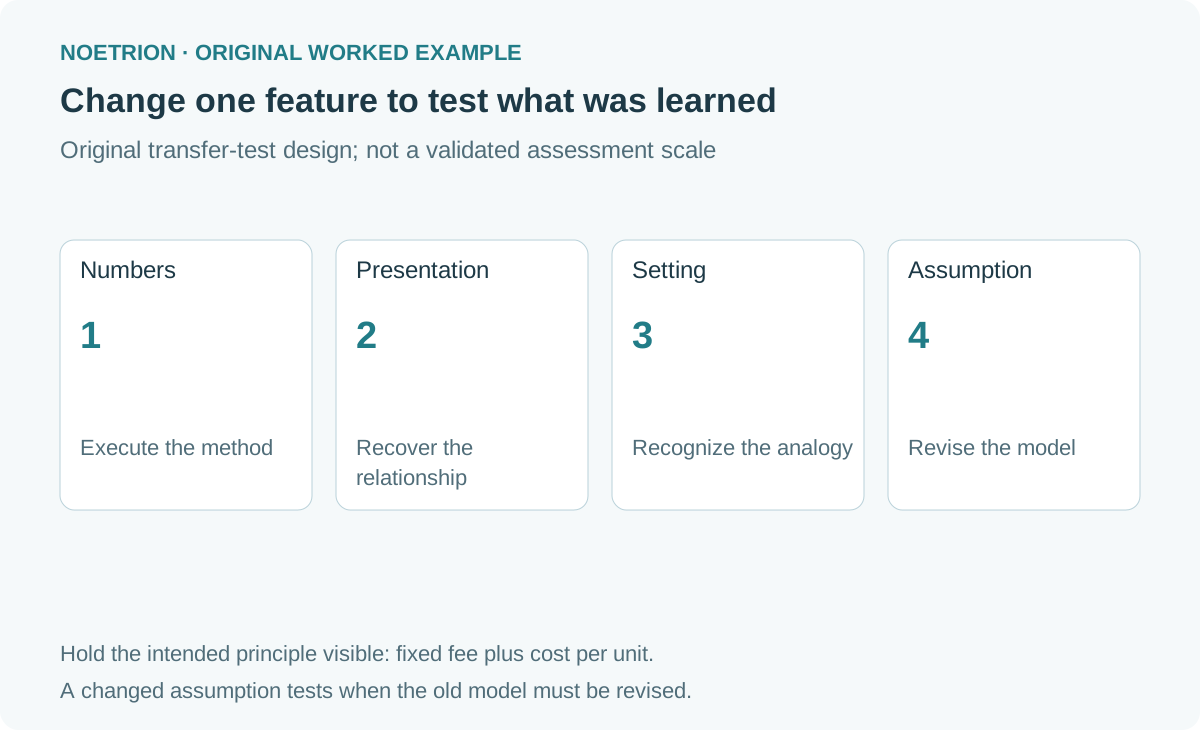
Start with the destination, not the chapter title
Write the intended skill as an action with conditions: “Given two offers with a fixed fee and a constant per-unit charge, identify the cheaper offer at a specified quantity and explain the crossover.” This is more testable than “understand linear equations.”
Then list what the learner will encounter at the destination. Will the information arrive as a table, a paragraph, or a graph? Will the quantity be known? Will some details be irrelevant? Will the relationship remain linear? Without these choices, “transfer” becomes a vague promise about being better at everything.
The OECD's Navigating Life with Low Literacy and Numeracy, published 1 July 2026, draws on the 2023 Survey of Adult Skills. It emphasizes differing literacy and numeracy needs and contextualized adult learning. Its publication year is not the year every skill was measured. It provides a reason to connect learning to actual uses; it is not an experiment validating this article's test. OECD report.
Choose a narrow destination first. Testing an unfamiliar professional vocabulary and an unfamiliar mathematical principle together makes a wrong answer difficult to interpret.
Specify what near and far mean in your test
Near transfer usually involves a change close to the practiced task. Far transfer involves a more substantial change of context or demands. The labels are relative: moving from one telephone tariff to another is different from recognizing the same cost structure in a machine-rental decision.
Describe the actual changes instead of assigning a distance score. A renamed story can still be mathematically identical; a familiar story with a quantity discount can require a new model.
| Test variant | What changes | What the response can reveal |
|---|---|---|
| New numbers | Fees and rates | Independent execution of the procedure |
| New representation | Equations become a table | Recovery of the underlying relationship |
| New setting | Printing becomes equipment rental | Recognition without familiar story cues |
| Boundary case | Constant rate becomes a tiered rate | Recognition that the old rule needs revision |
Do not interpret success in the rental example as proof of broad far transfer across all subjects. It establishes a specific bridge between two cost-comparison tasks.
Read the 2026 experiment within its limits
A study published 29 January 2026 analyzed 241 English-proficient adults aged 18–30, recruited from a university pool and the Cleveland community. Participants completed five training rounds of a grid-based resource-and-defense game, then a sixth round that either retained or changed the task version. Stable and variable stimulus–response mappings, plus stress/control conditions, were manipulated. Original study; full text.
Stable mappings supported efficient learning, but switching to variable mappings disrupted performance. The authors note that task versions differed in baseline difficulty and that the game and young-adult sample limit generalization. This is evidence about adaptation within that game, not proof that varied homework guarantees school-subject far transfer.
My design inference is modest: specify the changed demand and assess performance after it changes. The tasks and rubric below are original teaching tools, not a replication of that experiment or a validated diagnostic scale.
Build four original problems before showing the answers
Start from this worked example: printer A charges 24 credits plus 0.08 per page; printer B charges 8 plus 0.12 per page. Equal cost occurs when 24 + 0.08q = 8 + 0.12q, giving q = 400. Below 400 pages B is cheaper; above 400 A is cheaper. The assumptions include constant rates and no additional fees.
Now cover the worked solution and attempt these four items. Write a method and explanation before checking the answer key.
1. Changed numbers. Printer C charges 18 credits plus 0.10 per page. Printer D charges 6 plus 0.14 per page. Find the crossover and choose an offer for 200 pages.
2. Changed representation. A table lists plan X at 100 pages: 22 credits, and 300 pages: 38 credits. Plan Y costs 20 and 44 credits at those quantities. Assuming constant per-page rates, which is cheaper at 250 pages? Recover both formulas.
3. Changed setting. A workshop can rent a tool for 30 credits plus 4 per operating hour, or 10 plus 6 per hour. Which option is cheaper for 12 hours? State one condition under which the comparison would be insufficient.
4. Broken assumption. Printer C still charges 18 plus 0.10 per page. Printer D charges 6 plus 0.14 for each of the first 100 pages, then 0.06 for each additional page. At 200 pages, is the answer from item 1 still valid? Explain the revised model.
The set changes one principal feature at a time. You can therefore locate a weakness more precisely than with one long, unfamiliar problem.
Check answers and compare the cases
| Item | Answer | Reasoning to inspect |
|---|---|---|
| 1 | Crossover 300 pages; D is cheaper at 200 | C = 38, D = 34; the fixed-fee difference is offset at 12 ÷ 0.04 |
| 2 | X = 14 + 0.08q; Y = 8 + 0.12q; X is cheaper at 250 | X = 34, Y = 38; slopes come from cost changes over 200 pages |
| 3 | First rental costs 78; second costs 82 | Equal cost at 10 hours; availability or minimum hire periods could change feasibility |
| 4 | C = 38; D = 26; D remains cheaper, but the model has changed | D = 6 + 0.14 × 100 + 0.06 × 100; applying 0.14 to all pages gives the wrong total |
Compare items 1 and 3: which quantities play the same role despite different nouns? The setup fee maps to the rental fee, pages to hours, and per-page price to hourly price. Compare items 1 and 4: the story remains familiar, but the constant-rate assumption disappears.
For self-explanation, answer “Why can I subtract the fixed fees here?” and “Why does one slope no longer describe D in item 4?” An explanation should name relationships and assumptions. “Because that is the formula” supplies little evidence of understanding.
Score reasoning separately from the final number
Use this original rubric on each response. Give zero when absent, one when partial, and two when complete for each dimension. Keep the dimensions visible rather than using a total as a pass certificate.
| Dimension | What earns two points |
|---|---|
| Representation | Correctly identifies quantities, units, and the cost relationship |
| Method choice | Selects a comparison that fits the question and rate structure |
| Execution | Carries out the arithmetic correctly |
| Boundary judgment | States a relevant assumption or identifies where it fails |
A correct answer with the wrong model can be accidental: item 4 still selects D even if the learner incorrectly calculates 34 credits. That response should lose representation or method credit despite the correct choice. Conversely, a small arithmetic slip need not erase a sound explanation of a tiered rate.
Record hints separately. “Solved after being told to construct a piecewise function” is different evidence from independently detecting the price break. Both can guide teaching, but they should not be reported as equivalent.
Use the error to choose the next task
If formulas are correct but the table causes failure, practice reconstructing relationships from another table. If the rental problem fails, explicitly map the two cases and then try a fresh context. If the tiered-rate problem fails, compare a constant-rate and a tiered-rate offer with the same surface wording.
Keep at least one unpracticed item for a later check. Once you have studied its answer, it becomes training material. Do not keep calling repeated success on that same item new transfer evidence.
For your next lesson, write one destination, one changed representation, one changed setting, and one boundary case. Check each answer yourself, remove headings that reveal the method, and ask the learner to explain one decision. You will leave with a concrete account of what transfers and what still needs support, without making a claim about optimal study timing.
Sources and scope
- OECD: Navigating Life with Low Literacy and Numeracy, 1 July 2026. Context for adult foundational skills, using 2023 survey data.
- LaFollette and colleagues: Task, person, and experiential characteristics drive the transfer of learning, 29 January 2026. Original experiment; accessible full text.