Your Financial AI Has a Backup Provider. Have You Tested the Exit?
Use the FSB October 2026 AI practices to test provider dependence, fallback capacity, data portability, and safe recovery with an original backlog example.
A financial operations team buys an AI service to classify incoming documents. The contract includes an exit clause, and procurement records a second provider. The team considers the dependency covered. Then the primary service fails, and the backup cannot read the same document fields, enforce the same access rules, or reproduce the review queue.
The exit exists on paper. The ability to continue the business has not been demonstrated.
On October 15, 2026, the Financial Stability Board published its final sound practices for responsible AI adoption. The twelve practices include governance, performance assessment, human oversight, and third-party dependencies. Its third-party practice explicitly covers concentration, supply-chain, and business-continuity risk. For an operating team, a useful response is a bounded recovery drill with measurable results.
Define the service the business must preserve
Start with the actual service, such as “review payment-supporting documents before release,” rather than the technology label “AI classification.” Identify the output needed, required data, decision deadline, and consequence of a delay or wrong answer. A model returning text is only one part of that chain.
Then distinguish reduced service from unsafe service. A fallback may process fewer documents while preserving necessary checks. A faster fallback that silently drops identity verification or changes approval authority has not preserved the same business service.
The following operating method is Noetrion's practical synthesis, not an official FSB checklist or a claim of regulatory compliance. Its purpose is to make continuity assumptions observable enough to challenge.
Map dependencies beyond the named model
The Basel Committee's December 2025 third-party-risk principles establish a baseline for banks and supervisors across third-party arrangements. They broaden the perspective beyond traditional outsourcing. The useful implementation lesson is to inventory what must work together before judging a substitute service independent.
For this exercise, map the model endpoint, cloud region, identity provider, document store, retrieval index, workflow queue, observability system, and staff access. Mark which are shared by the primary and fallback arrangements. Two model brands may still depend on one cloud account or one unavailable document store.
Record an owner and evidence for every dependency. “Vendor manages this” is not a recovery procedure. If a provider cannot disclose a dependency, record that uncertainty and design the exercise around the information you actually possess.
Use one failure scenario at a time
A first drill can assume the model endpoint becomes unavailable while internal systems remain functional. Later exercises can separately test invalid outputs, lost credentials, a damaged retrieval index, or a provider that must be abandoned because of a security incident. Combining everything immediately makes it difficult to identify which control failed.
Before the drill, write the stop conditions. No live customer funds should move because a test prompt proposes a payment. Use representative, appropriately protected test documents and a separate queue. Define who can activate fallback, who can stop it, and who approves return to normal operation.
A continuity exercise is allowed to reveal an uncomfortable result. Changing the success criterion after the queue grows makes the report reassuring and the test useless.
Calculate the backlog rather than guessing capacity
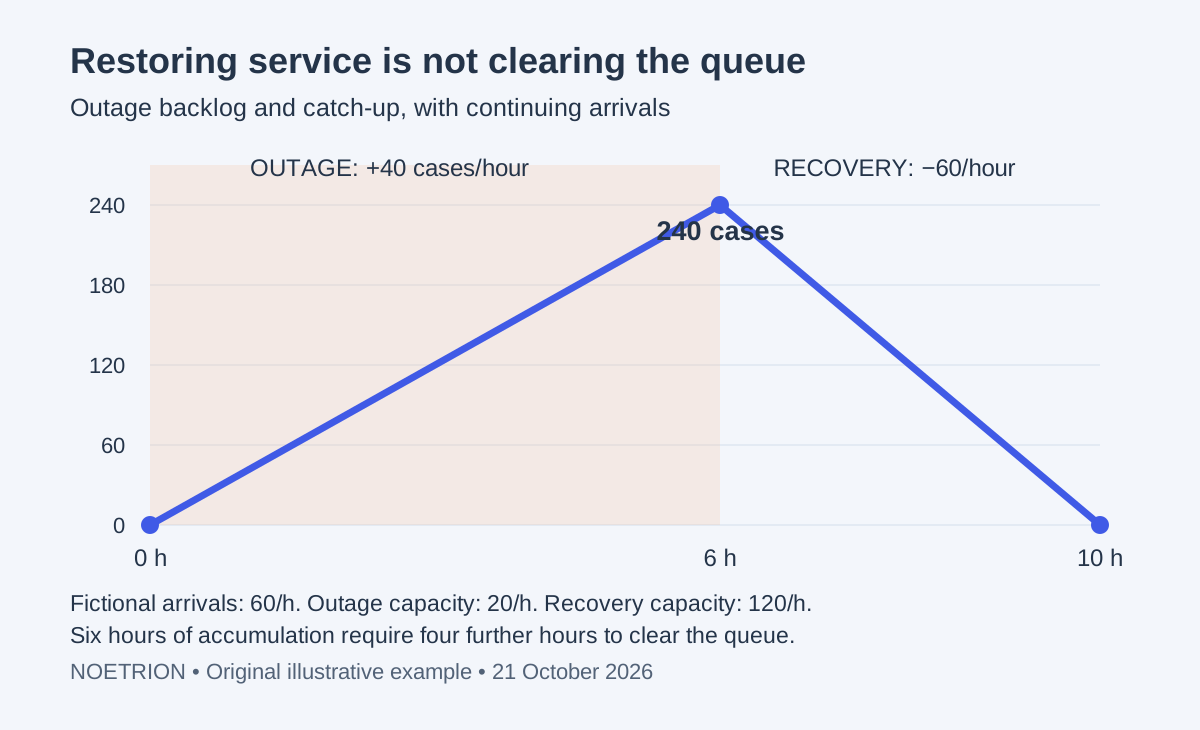
Consider a fictional team receiving 60 cases per hour. During a six-hour AI outage, trained staff can complete 20 cases per hour without dropping required checks. Assume a constant arrival rate, an initially empty queue, and no priority differences.
Net accumulation is 60 − 20 = 40 cases per hour. After six hours, the backlog is 240 cases. If restored total processing capacity becomes 120 cases per hour, ongoing arrivals consume half that capacity. Net clearance is 60 cases per hour, so the backlog takes four more hours to clear.
| Illustrative operating phase | Arrivals/hour | Completed/hour | Queue change/hour | Duration |
|---|---|---|---|---|
| Six-hour outage | 60 | 20 | +40 | 6 hours |
| Recovery at double arrival capacity | 60 | 120 | −60 | 4 hours to clear 240 |
| Return only to normal arrival capacity | 60 | 60 | 0 | Backlog never clears under these assumptions |
That final row is easy to overlook. Restoring ordinary throughput stops deterioration without recovering the accumulated work. A plan needs temporary excess capacity, lower incoming volume, or a longer acceptable clearing period.
These figures do not establish a service guarantee. Real arrivals vary, cases differ in difficulty, staff need breaks, and complex cases may dominate the remaining queue. Measure performance during the drill and replace constant-rate assumptions with observed ranges where practical.
Test portability as a business result
Exporting a file does not prove a successful migration. Select a fixed set of representative cases and test whether the fallback preserves required fields, document references, permissions, confidence handling, review routing, and audit information. A count of exported records is a start, not the finish.
A useful original test set might contain routine documents, ambiguous totals, missing pages, duplicated records, and deliberately unsupported instructions inside document text. Define expected handling before executing the exercise. The backup should route ambiguous cases for review rather than win the test by guessing more aggressively.
Compare accepted outputs with a reference decision made under the same business policy. Record errors by consequence, including false acceptance and unnecessary escalation. Avoid a single accuracy percentage that hides rare but costly mistakes.
Measure recovery time at the right boundary
Capture the time of failure detection, fallback authorization, first valid completion, stable throughput, queue clearance, and validated return to normal. Each timestamp answers a different question. The provider endpoint being reachable does not prove that staff have reviewed the accumulated cases.
Also reconcile items that were in flight. A request may have succeeded remotely even if its acknowledgement never arrived. Retrying without a stable case identifier can create duplicate records or repeated actions. For this document-review scenario, retain case IDs and review states so recovery can distinguish completed work from uncertain work.
Treat recovery as an explicit reconciliation job. Count starting cases, arrivals, completed cases, failed cases, duplicates, and remaining cases. Investigate any mismatch before declaring the incident over.
Make the commercial exit usable
A permanent exit differs from a temporary outage. Confirm what data can be exported, its format, the time required, permitted retention, deletion evidence, and access after contract termination. Verify these points against the agreement and applicable obligations; do not rely on a sales presentation.
Model the overlap cost. A migration may require paying both providers, training staff, rebuilding evaluations, and retaining historical records. If a fictional switch needs forty staff-hours at an internal planning cost of $50 per hour plus $1,200 of parallel service, the direct planning estimate is $3,200 before other expenses. Label those inputs as assumptions and include them in the decision, rather than calling the switch “free.”
Assign a review date after material architecture changes. A successful drill from a former model, data pipeline, or staffing arrangement is evidence about that configuration, not indefinite proof of resilience.
Questions readers ask
Is having two AI vendors enough? No. They may share infrastructure or require incompatible workflows. Independence and usable capacity need evidence.
Should every task switch automatically? The answer depends on consequence, performance evidence, and approval design. A tested manual queue may be preferable for a sensitive process until a substitute is validated.
Does this satisfy the FSB practices? This article offers an operational exercise inspired by selected themes. It does not certify compliance or replace institution-specific assessment.
Sources and review boundaries
- FSB, Sound Practices for Responsible Adoption of Artificial Intelligence: Final report, October 15, 2026. Governance, performance, human oversight, and third-party-risk context.
- Basel Committee on Banking Supervision, Principles for the sound management of third-party risk, December 10, 2025. Banking third-party-risk framework.
Reviewed October 21, 2026. All queues, costs, and exercise design examples are original and fictional. Appropriate continuity objectives depend on the actual business service and obligations.