Formative Assessment and Mastery Learning: Feedback That Changes Teaching
Distinguish formative assessment from frequent grading, set usable mastery criteria, respond to misconceptions, and avoid turning flexible support into rigid pacing.
Reviewed October 12, 2026.
Distinguish formative assessment from frequent grading, set usable mastery criteria, respond to misconceptions, and avoid turning flexible support into rigid pacing.
| Concept | What it means | Important limit |
|---|---|---|
| Formative assessment | Evidence used to adapt ongoing learning | A quiz is not formative if nothing changes |
| Mastery criterion | Defined evidence of sufficient understanding | One percentage may hide essential gaps |
| Corrective support | A different route after difficulty | Repeating the same explanation may not help |
| Enrichment | Deeper work after secure foundations | Should not become idle waiting |
1. Formative describes use, not test format
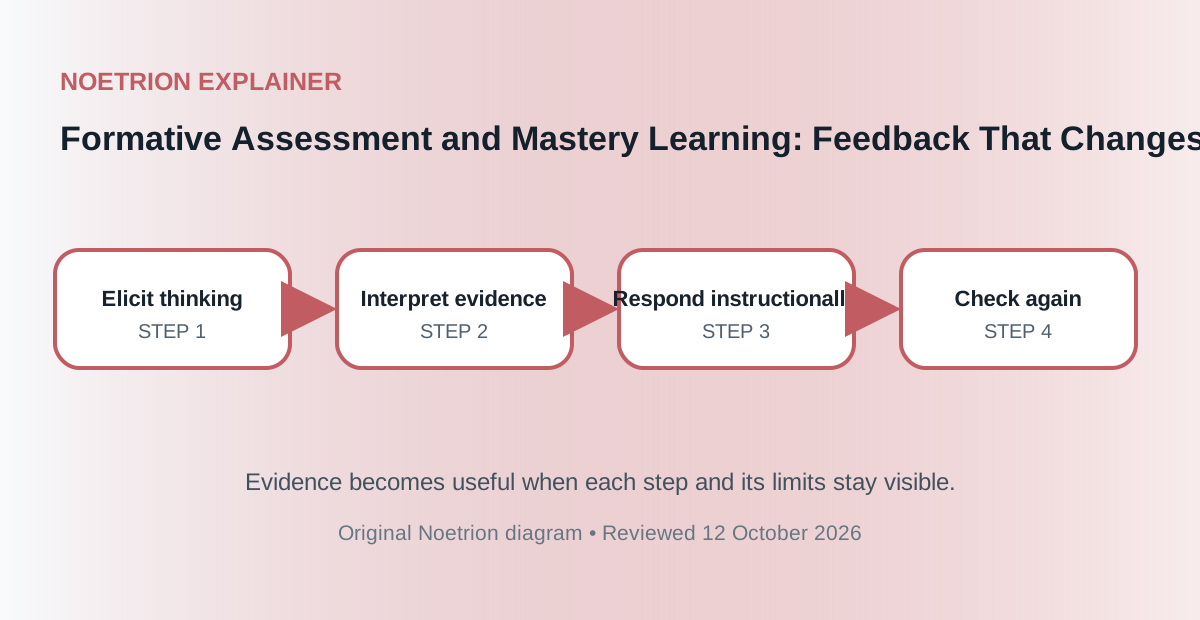
An assessment is formative when evidence about current understanding changes what teachers or learners do next. An exit ticket, conversation, worked problem, or multiple-choice question can serve this purpose. The same quiz becomes merely summative if it is scored, recorded, and ignored. Good formative practice starts with a learning goal, elicits thinking that can reveal specific misconceptions, interprets the evidence, and selects a response. More frequent testing alone does not guarantee better instruction.
2. Questions should discriminate among explanations
A question that almost everyone answers from recall may show fluency but reveal little about reasoning. Diagnostic questions use plausible alternatives linked to known misconceptions and ask students to explain or commit before seeing peers’ answers. Open tasks can expose strategies, while carefully designed multiple choice can sample a class quickly. The aim is not to catch students out. It is to distinguish “does not know,” “used the wrong rule,” and “made a slip,” because those states require different next actions.
3. Feedback needs a path for action
Comments are useful when students understand them, have time to respond, and know what improvement looks like. Vague praise offers little direction; a page of corrections can overload attention. Effective feedback may identify the gap, prompt a strategy, provide one model, or ask for revision. Sometimes immediate verbal feedback is best; sometimes delayed feedback preserves productive thinking. The measure is not how much a teacher writes, but whether subsequent work shows that the learner used the information.
4. Mastery learning changes time and support
A mastery approach defines a sequence of learning objectives, checks understanding, provides corrective instruction for learners not yet secure, and offers enrichment or extension for those ready to proceed. The aspiration is that more students reach essential outcomes when time and support vary. It does not mean every child learns identically or that progress stops until everyone scores one hundred percent. Implementation needs realistic pacing, cumulative review, and plans for prerequisites that remain unfinished.
5. Criteria should reflect the structure of knowledge
A single total score can hide a critical misconception. A student might reach 80 percent while consistently failing fraction equivalence or source evaluation. Mastery criteria should identify essential components, transfer tasks, and acceptable errors. Evidence may include explanation, application, and retention, not just immediate repetition of a practiced item. Thresholds require judgment and should be tested against later performance. They are decision rules for support, not labels of student worth or fixed ability.
6. Corrective instruction must be genuinely different
When a learner struggles, assigning more items of the same type can rehearse the same error. Corrective support might use a concrete representation, prerequisite review, a worked example, peer explanation, a smaller step, or targeted practice with feedback. The teacher chooses based on diagnostic evidence. Short loops reduce delay: elicit, respond, and check again. If the second check still fails, the plan should escalate thoughtfully rather than lower expectations or repeatedly restate the original lesson.
7. Enrichment protects depth and motivation
Students who demonstrate secure understanding need meaningful work while others receive support. Enrichment can apply ideas in unfamiliar contexts, compare methods, create explanations, investigate exceptions, or connect concepts. Simply giving more routine questions turns success into extra labor. Flexible grouping should change with evidence and avoid public tracks that become identities. A mastery classroom needs both a floor of essential knowledge and a ceiling high enough for curiosity, reasoning, and independent challenge.
8. Evidence quality and workload set boundaries
EEF rates the security of mastery-learning evidence as low despite identifying many studies, a reminder that an appealing model is not a universal guarantee. Programs differ in subject, age, pacing, training, technology, and comparison conditions. Teachers also face large classes and limited planning time. Implementation should start with a few high-leverage objectives, reusable diagnostic questions, and scheduled response routines. Track later retention and equity, not only immediate quiz improvement or student satisfaction.
Conclusion
Formative assessment is a feedback system: evidence must change instruction or learning behavior. Mastery learning organizes that system around clear objectives, corrective routes, and repeated checks. Its promise depends on diagnostic quality, actionable feedback, flexible time, meaningful enrichment, and honest evaluation of workload and long-term learning.