The Green Revolution: Higher Yields, Uneven Benefits, Lasting Trade-offs
Understand why high-yield crops transformed parts of Asia and Latin America, why outcomes varied, and what later agriculture inherited.
Reviewed October 11, 2026.
Understand why high-yield crops transformed parts of Asia and Latin America, why outcomes varied, and what later agriculture inherited.
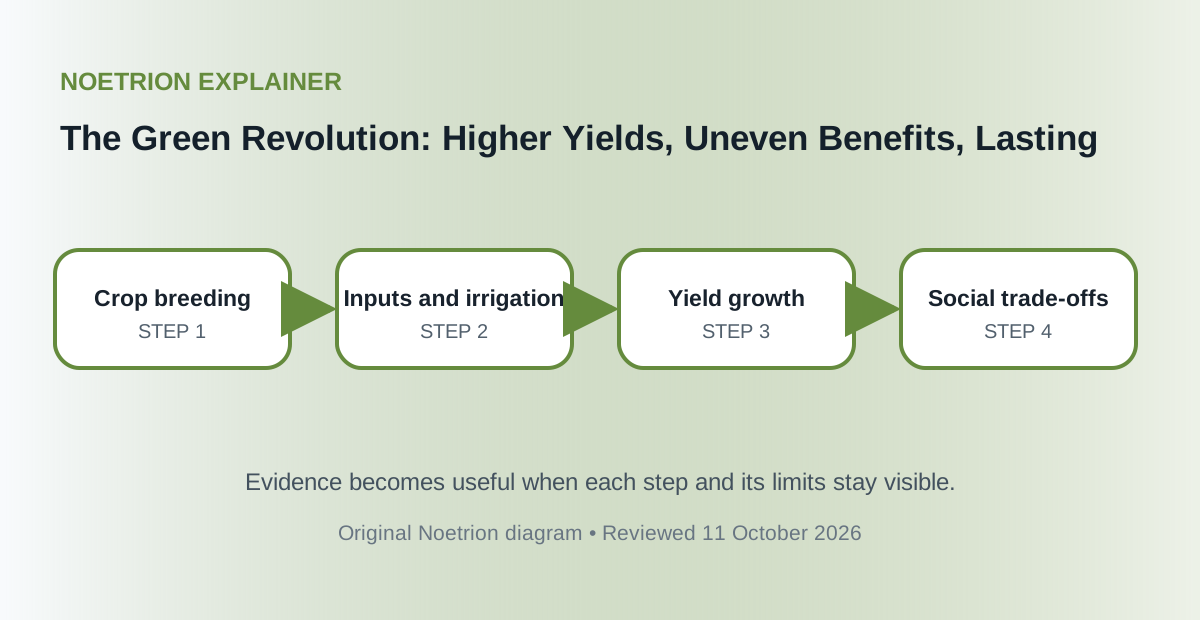
| Concept | What it means | Important limit |
|---|---|---|
| Seeds | Semi-dwarf, input-responsive varieties | Performance depended on local conditions |
| Water | Reliable irrigation and timing | Groundwater stress could accumulate |
| Fertilizer | More available nutrients | Runoff and emissions required management |
| Institutions | Research, credit, extension, markets | Benefits could bypass resource-poor farmers |
1. The term describes a package, not a miracle seed
The Green Revolution refers to rapid agricultural change associated especially with wheat and rice in parts of Asia and Latin America from the 1960s onward. New semi-dwarf varieties could allocate more growth to grain and resist lodging under heavier fertilizer use. Their potential depended on reliable water, nutrients, pest control, timely planting, and management. Research institutes, national breeding programs, extension services, credit, roads, procurement, and markets helped turn genetics into harvests. Explaining the period as one scientist or one seed hides the institutional system.
2. Semi-dwarf architecture changed the response to inputs
Traditional tall cereals could fall over when fertilized heavily, limiting the yield benefit. Shorter stems allowed improved wheat and rice varieties to support larger grain heads under favorable conditions. Breeders also selected for maturity and disease resistance. Yet “high yielding” is conditional: a variety yields highly in an environment that supplies the water, soil fertility, and crop protection it expects. Farmers adapted varieties and schedules to local seasons, and breeding continued after introduction. The biological innovation was therefore a platform for regional experimentation rather than a frozen package.
3. Irrigation reduced risk and enabled multiple cropping
Reliable irrigation made input-responsive varieties less vulnerable to irregular rainfall and allowed some regions to plant more than one crop each year. Dams, canals, pumps, and groundwater expanded effective growing seasons. This infrastructure could increase output and stabilize supply, but distribution was unequal and maintenance mattered. Where pumping exceeded recharge, groundwater tables fell; poorly drained irrigation could contribute to salinity or waterlogging. The same engineering that reduced short-term production risk could create long-term resource pressure if extraction and drainage were poorly governed.
4. Yield growth affected both farms and food prices
Higher cereal yields can raise producer output while lowering food prices for consumers, particularly when supply expands faster than demand. Rural labor effects depend on mechanization, cropping intensity, wages, and land distribution. Some smallholders benefited from increased productivity and multiple harvests; others lacked credit, secure land, irrigation, or access to inputs. Aggregate production statistics therefore cannot reveal distribution by themselves. A historical assessment should examine yields, farm income, wages, food affordability, nutrition, and regional inequality together.
5. Public research and policy shaped diffusion
International centers exchanged germplasm and knowledge, but national systems tested, multiplied, and distributed varieties. Governments influenced fertilizer prices, irrigation, procurement, and credit. Guaranteed markets could encourage adoption, while extension translated recommendations into practice. These institutions also created path dependence: subsidies or procurement focused on a few cereals could discourage crop diversity. Success was greatest where breeding matched agroecology and farmers could obtain complementary inputs. Regions without those conditions did not experience the same transformation simply because seeds existed.
6. Environmental costs emerged from intensity and management
More fertilizer increased nutrient availability but inefficient use contributed to water pollution and nitrous oxide emissions. Broad pesticide use selected for resistance and affected non-target organisms. Monoculture and replacement of local varieties could narrow diversity, although seed systems and breeding collections preserved some material. Intensive irrigation altered rivers and aquifers. These effects were neither identical everywhere nor proof that yield growth itself was a mistake. They show that productivity metrics must be paired with soil, water, biodiversity, and health indicators.
7. Nutrition requires more than cereal calories
Wheat and rice expansion improved availability of staple calories in many places, an important achievement where famine risk and population growth were major concerns. But a food system dominated by refined staples does not automatically provide adequate protein quality, micronutrients, fruits, vegetables, and diverse diets. Income, prices, culture, storage, sanitation, and health services influence nutrition. Later policy debates therefore broadened from tonnes per hectare toward nutrition-sensitive agriculture and resilient diets, without dismissing the importance of staple productivity.
8. The legacy is a lesson in systems innovation
Climate change now increases heat, drought, flood, and pest risks. A contemporary transformation may use stress-tolerant breeding, precision input management, soil restoration, diversified rotations, and better forecasting. The historical lesson is that technology works through institutions and incentives. New seeds will not produce fair outcomes without access, trusted extension, finance, markets, and resource governance. Nor should every region copy a wheat-rice model. The target is locally appropriate productivity that preserves the ecological base on which future harvests depend.
Conclusion
The Green Revolution prevented a simple story. It raised yields and expanded food supply, yet its benefits and costs varied by farm, crop, and landscape. Its deepest legacy is that agricultural change is a coupled biological, economic, and political process. Evaluating the next revolution requires measuring all three.