Grid Battery Sizing: MW, MWh, and the Energy You Can Actually Use
Work through a 2 MW, 8 MWh battery example to separate power, usable energy, discharge efficiency, backup reserves, and competing grid services.
A battery advertised as 2 MW and 8 MWh invites a quick calculation: eight divided by two equals four hours. That arithmetic is correct when both ratings refer to compatible, available quantities. It becomes misleading when the energy figure describes gross stored energy while the power figure describes output to the grid, or when part of the battery must remain reserved for another task.
The IEA's Electricity 2026, published February 6, gives grid flexibility a dedicated chapter. Its battery discussion warns that nameplate capacity may exceed actual peak-event discharge because of temperature, starting charge, or insufficient duration. IEA report and flexibility chapter. These observations make a practical sizing question more useful than a single headline capacity: what must this installation deliver, at which electrical boundary, under which conditions?
Read the current reports with their dates
The IEA's Global Energy Review 2026, published April 20, assesses 2025 developments. Its battery chapter reports 108 GW of new storage capacity in 2025 and says about 80% was utility scale. These are power-capacity figures, not a measure of stored energy. Report publication and scope; battery chapter.
A May 29 IEA commentary describes projects combining services. IEA battery commentary. More recently, an ACE–IEA paper addresses ASEAN battery procurement and remuneration. Its publisher lists September 28, 2026 as publication and October 7 as the ministerial launch. ACE publication record. That regional policy discussion does not specify a universal battery size. The calculations below are original teaching examples, checked October 14.
MW limits the rate; MWh limits the duration
Power is the rate of energy transfer. Energy is the accumulated transfer. Supplying a steady 1 MW for three hours transfers 3 MWh. At a variable load, calculate energy by adding power multiplied by the length of each interval.
| Quantity | Example | What it constrains |
|---|---|---|
| AC discharge power | 2 MW | Maximum assumed output rate |
| Gross DC energy | 8 MWh | Stored-energy reference before exclusions |
| Operating energy window | 6.4 MWh DC | Energy between allowed charge limits |
| Reserved energy | 1.2 MWh DC | Energy withheld from routine dispatch |
| Dispatchable AC energy | 4.94 MWh | Delivered energy after assumed discharge loss |
The boundary labels matter. A supplier may state usable AC energy after losses and operating limits. Applying the same deductions again would undercount the battery. Conversely, treating gross DC energy as delivered AC energy would overcount it. Ask for definitions before comparing bids, including whether auxiliaries, degradation, and temperature effects are included.
Duration is therefore a result of the selected energy budget and load, not an immutable property of a cabinet. A “four-hour battery” usually describes a specified rating relationship rather than every possible operating schedule.
Work through a 2 MW, 8 MWh example
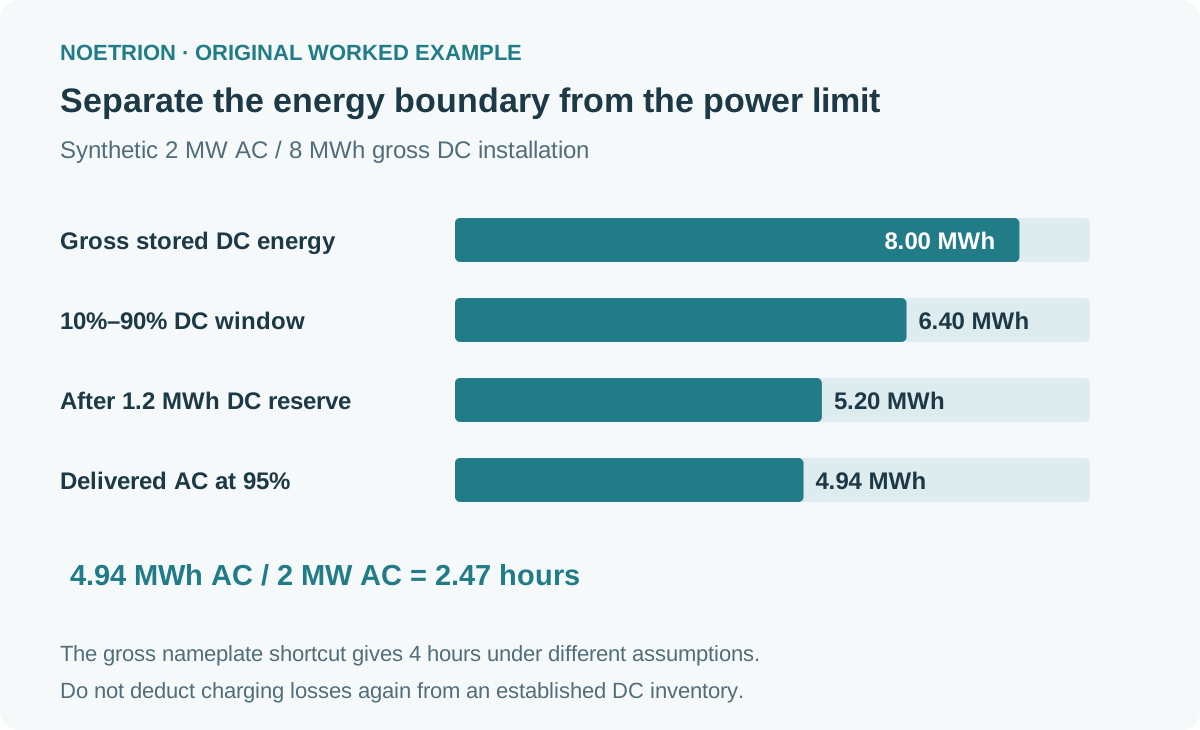
Assume a fictional installation with a 2 MW AC discharge limit, 8 MWh gross DC capacity, a 10%–90% state-of-charge operating window, and 95% DC-to-AC discharge efficiency. Assume it starts at the upper operating limit. These are chosen inputs, not representative guarantees for commercial equipment.
The usable window is 8 × (0.90 − 0.10) = 6.4 MWh DC. Reserve 1.2 MWh DC above the lower operating limit for a separate obligation. Routine dispatch can consume 6.4 − 1.2 = 5.2 MWh DC, delivering 5.2 × 0.95 = 4.94 MWh AC.
At 2 MW, this lasts 4.94 ÷ 2 = 2.47 hours, or 2 hours 28 minutes 12 seconds. Without that reserve, the operating window would deliver 6.08 MWh AC and last 3.04 hours. Both results are shorter than the gross-rating calculation of four hours because the assumptions refer to different boundaries.
| Reserve above the lower limit, DC | Routine energy delivered, AC | Duration at 2 MW |
|---|---|---|
| 0 MWh | 6.08 MWh | 3.04 hours |
| 1.2 MWh | 4.94 MWh | 2.47 hours |
| 2.0 MWh | 4.18 MWh | 2.09 hours |
This table isolates reserve sensitivity. It does not simultaneously change efficiency, capacity, or output rating, so the cause of each difference remains clear.
Size the reserve against the actual backup task
Suppose the requirement changes to supplying 1 MW AC for three hours, with no recharge during the event. The task needs 3 MWh AC. At the assumed discharge efficiency, it requires 3 ÷ 0.95 = 3.1579 MWh DC above the lower operating limit.
The earlier 1.2 MWh DC reserve would deliver 1.14 MWh AC, lasting just 1.14 hours at that load. It would not satisfy the new three-hour requirement. Reserving 3.1579 MWh DC leaves 6.4 − 3.1579 = 3.2421 MWh DC for routine discharge: 3.08 MWh AC, or 1.54 hours at 2 MW.
For a changing load, sum the interval energies first. An example of 0.8 MW for one hour followed by 1.1 MW for two hours also needs 3 MWh AC. Peak power still needs a separate check. A load briefly exceeding the inverter's capability cannot be made feasible simply by installing enough stored energy.
Energy adequacy also does not establish backup capability. A design must address islanding, protection, transfer arrangements, startup demand, and the ability to operate without the grid where required. Those capabilities need project-specific engineering evidence beyond this energy calculation.
Keep discharge and round-trip efficiency separate
The 95% factor above is one-way discharge efficiency. If charging efficiency is also 95%, the simplified round-trip efficiency is 0.95 × 0.95 = 90.25%. These assumptions exclude time-dependent standby and auxiliary loads.
Delivering 3 MWh AC consumes 3.1579 MWh DC. Replacing that stored energy requires 3.1579 ÷ 0.95 = 3.3241 MWh AC input. Equivalently, divide the delivered energy by the round-trip efficiency. The two routes give the same result because they use the same boundary and loss convention.
Do not multiply available DC energy by round-trip efficiency to calculate a discharge-only event. Charging losses occurred before that starting inventory was established. Also do not assume that a published round-trip figure uniquely determines one-way efficiencies: different charging and discharging combinations can produce the same product.
Stacking services shares physical headroom
One installation can participate in several services, but its commitments share finite power and energy. The following original comparison describes scheduling conflicts rather than market eligibility rules.
| Service | Resource it needs | Conflict to investigate |
|---|---|---|
| Evening energy shifting | Stored energy and discharge time | Daytime dispatch may leave insufficient evening charge |
| Rapid balancing | Upward and downward power headroom | Full-power output leaves no extra upward capability |
| Backup | Retained energy and suitable electrical architecture | Routine trading can consume the required reserve |
| Local congestion relief | Availability at a constrained location and time | A remote market instruction may conflict with local needs |
For example, 1.5 MW of scheduled output leaves only 0.5 MW of upward headroom against the assumed 2 MW limit. Downward response and charging capability require their own definitions. Reserving backup energy can coexist with power headroom, but both constraints must survive the planned dispatch sequence.
Turn the arithmetic into a sizing checklist
Before selecting a rating, define the task at the connection point. Obtain the load profile, required event duration, acceptable starting charge, and recharge opportunity. Then check power and energy independently.
- Label every energy figure as gross or usable, DC or AC.
- Apply the permitted charge window once, at the correct boundary.
- Calculate reserve from the specified service, including its load profile.
- Use discharge efficiency for discharge; use round-trip efficiency for replenishment economics.
- Test competing commitments against the same time sequence.
- Recalculate with warranted end-of-life capacity, temperature derating, auxiliaries, and outages.
If available gross capacity fell to 7 MWh under the same simplified assumptions, the operating window would fall to 5.6 MWh DC. The three-hour backup reserve would still require 3.1579 MWh DC, leaving only 2.32 MWh AC for routine use. This is a capacity sensitivity, not a predicted degradation rate. A useful specification states the service that must remain feasible at the agreed conditions.
Sources and calculation scope
- IEA Electricity 2026, February 6, 2026, and its flexibility chapter.
- IEA Global Energy Review 2026, April 20, 2026, and its battery storage chapter, reporting 2025 deployment.
- IEA battery storage commentary, May 29, 2026.
- ACE–IEA Accelerating Battery Energy Storage System for vRE Integration, publisher date September 28, 2026; ministerial launch October 7.
Calculations assume constant efficiency, full starting charge, and no auxiliary use. Substitute system-specific data.