A Glucose Meter Can Measure Correctly and Still Send the Result to the Wrong Record
Understand the October 2026 StatStrip correction by separating analytical measurement, patient association and record delivery, with an original data-integrity drill.
This guide explains research and technology. It does not provide diagnosis or treatment, and regulatory status should be checked with the relevant authority.
A hospital meter produces a glucose value and sends it to an electronic record. In fact, the result has to remain connected to the right specimen, patient, time and record throughout the process. A correct number attached to the wrong person is still an unsafe information product.
An FDA communication updated October 30, 2026 makes the distinction concrete. The StatStrip Glucose Hospital Meter System correction concerns retained barcode information that can associate a result with the wrong patient or quality-control identifier. The notice states that the issue does not affect analytical measurement performance.
This article explains the evidence boundaries through an original synthetic data-integrity exercise. It does not provide bedside operating instructions or decide how an affected device should be managed. Staff handling an actual affected system should use the current FDA and manufacturer communications and their authorized local procedures.
Read the correction as the specific failure it describes
The FDA notice describes a software issue in the affected Gen 2.0 systems: previous patient or QC barcode information can remain displayed after a new scan. If accepted, that retained information can link the current result to the wrong identifier. The October 30 update clarifies recommended actions while a software correction is pending.
That is a result-association problem. Rewriting it as “the meter gives inaccurate glucose readings” changes the mechanism and loses the notice's explicit analytical-performance distinction. Conversely, saying the measurements are analytically unaffected does not make the association error harmless.
Keep the current communication date beside any summary. Older notices can describe an earlier stage of the response. A planned software release is not evidence that every local instrument has already received and verified an update.
Separate three claims about a reported value
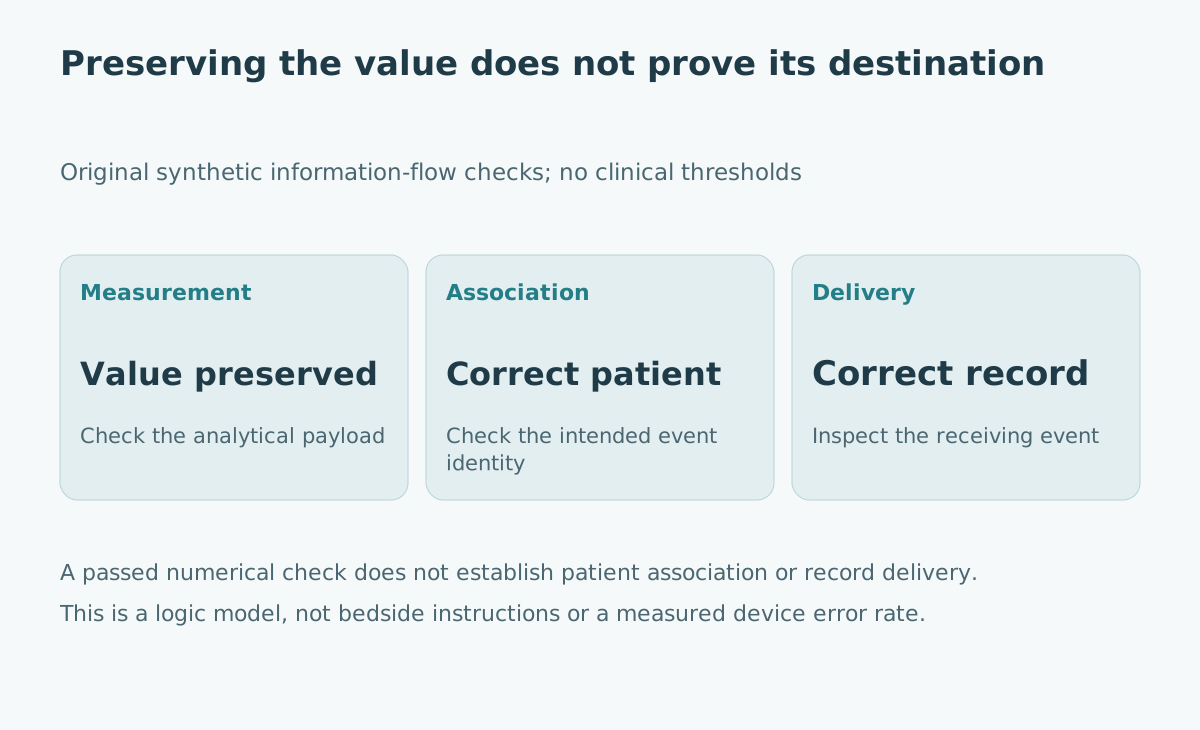
The first claim concerns measurement: did the process produce the intended analytical result under its validated conditions? The second concerns association: does this event belong to this patient or QC item? The third concerns delivery: did the intended receiving record get the correct event?
These claims require different evidence. A numerical comparison cannot establish the identity of the person whose sample was tested. An accepted network message cannot, by itself, establish the correctness of the identifier in its payload.
For a technology review, write these questions in separate rows. Avoid a single “test passed” field that allows a successful measurement check to stand in for a complete end-to-end result.
Why a control result does not close the identity question
A control exercise can provide evidence about the conditions it actually tests. If it checks a known test material and a numerical acceptance rule, it answers that analytical question. It does not automatically examine every patient-association path or every receiving record.
The current FDA issue also explicitly includes QC barcode identifiers. That is an additional reason to distinguish the control material, the identifier attached to its result and the destination in which the result is stored.
This is an evidence argument, not a claim that any particular QC procedure is inadequate. Determine what a local test covers from its documented design and expected outcomes. Then identify which remaining claims require separate checks.
Build an isolated, synthetic information-flow exercise
Imagine a fictional test environment containing two synthetic patients, A and B. Two events have known identifiers and reference payloads. No real clinical record or treatment decision is involved.
The test deliberately simulates an association failure by retaining A's identifier when processing B's event. The value field remains unchanged. A numerical equality check passes, while the identity check fails.
| Original synthetic event | Value field | Expected record | Simulated receiving record | Review finding |
|---|---|---|---|---|
| Event A | Payload A preserved | Patient A | Patient A | Association matches |
| Event B | Payload B preserved | Patient B | Patient A | Association mismatch |
This example avoids clinical interpretation of the values. It establishes only a logical possibility: preserving a payload does not establish correct patient association. It does not reproduce the manufacturer's software, estimate occurrence rates or show that every failure would be detected by this small exercise.
Follow the data through the receiving system
FDA's interoperable-device guidance, issued in September 2017, addresses safe exchange and use of information between connected devices and other technology. Its scope goes beyond whether a connection exists.
For the fictional drill, trace the event through the device output, interface or middleware and receiving record. At each stage, record the event identifier, patient identifier, time context, result status and the source of the observation. Distinguish message receipt from application acceptance and from final record presentation.
Keep any assumptions visible. A shared identifier format does not prove that two systems refer to the same person. A display may show a transformed value or a later status than the transport log. Investigate the actual chain rather than assuming each screen is a complete copy of the previous stage.
Use identity evidence without creating a new privacy exposure
The US health IT patient-matching explanation describes linking a person's information within and across health systems using multiple demographic fields. Matching is a distinct interoperability task, not merely formatting a patient number correctly.
An engineering exercise should use synthetic identities where possible. If an authorized investigation requires real records, access, retention and sharing must follow the applicable institutional procedures. Do not paste identifying health information into a public issue tracker or an unapproved AI tool merely to make a debugging example convenient.
Also retain uncertainty. An ambiguous match is unresolved; it is not automatically a confirmed mismatch or a confirmed correct association. Those states should remain distinguishable in the investigation record.
Test the failure boundary and the normal path
An original review plan can include consecutive distinct identities, repeated identifiers, QC and patient-event transitions, missing identity fields, delayed delivery and a receiving-system rejection. Define expected outcomes before running the isolated exercise.
For each case, inspect the intended receiving record and the records that could have received the event incorrectly. Checking only the intended record can reveal absence while overlooking a misplaced result elsewhere.
These are proposed information-system tests, not replacement instructions for operating a medical device. The competent clinical, laboratory and technology owners must determine the appropriate test protocol and acceptance criteria for a real deployment.
Keep the conclusion as narrow as the evidence
A useful finding might state that specified synthetic events retained both payload and identity through a named configuration, while a particular transition remained untested. That is stronger than a broad assurance that “the integration works,” because another reviewer can see what was examined.
For responding to a device notice through inventory matching, see UDI and recall reconciliation. This article addresses the later information boundary: which record receives the result. The reliable output is the complete attributable event. Numerical correctness is necessary evidence within that chain; it cannot carry the entire claim of safe delivery by itself.
Sources and limits
- FDA, StatStrip Glucose Hospital Meter correction, updated October 30, 2026: barcode-retention association mechanism, affected generation and analytical-performance distinction reviewed.
- FDA, Interoperable medical-device design guidance, September 2017: official guidance overview on safe information exchange and use reviewed.
- ONC, Patient Identity and Patient Record Matching, last updated December 8, 2025: official explanation of patient matching reviewed.
Checked October 31, 2026. The synthetic events and review plan are original. No analytical defect, real patient outcome, software-fix completion or clinical management decision is inferred from the illustrative exercise.