Industrial Thermal Storage: Find the Electricity Price That Makes Stored Heat Worthwhile
Calculate industrial thermal storage costs with charging losses, usable heat, tariff limits, and a worked break-even example before choosing equipment.
A factory needs heat at 2 p.m., while electricity is cheapest overnight. Thermal storage offers a way to move energy between those hours without requiring the production line to move with it. The proposition sounds straightforward: buy cheap electricity, store heat, and use it later.
The real decision has several moving parts. How much heat reaches the process? Can the site charge quickly enough? Does the electricity contract pass through low prices? And after losses and annual costs, is stored heat actually cheaper than the existing supply?
The IEA has examined this problem through industrial heat electrification and hybrid systems. This article turns that discussion into an original screening worksheet with explicit units and a tariff break-even calculation. It focuses on delivered process heat, not electricity generated back from a thermal store.
Why the industrial heat discussion matters now
In its December 9, 2025 industrial heat analysis, the IEA explains that combining electric boilers with thermal storage or existing gas boilers can improve competitiveness under suitable market conditions. Its examples use regional prices and model assumptions, including German 2024 hourly electricity prices, and exclude grid connection costs.
The December 23, 2025 Renewables for Industry report also treats thermal storage as a connection between variable renewable electricity and continuous industrial heat demand. It highlights barriers including electricity-to-gas price ratios, grid connections, capital costs, and policy conditions.
These are reasons to evaluate the technology, rather than evidence that it wins at every site. An Indonesian factory on a fixed electricity tariff and a German plant exposed to hourly prices do not face the same opportunity. A site-level decision needs its own tariff, temperature requirement, and operating schedule.
Store the energy form the process actually needs
The US Department of Energy defines thermal energy storage as heat stored for later use, including industrial processes or electricity generation. Materials and heat-transfer equipment determine how stored energy moves to the application.
For a process that needs heat, returning the energy as heat can avoid an unnecessary conversion back to electricity. But temperature matters as well as quantity. Ten MWh of low-temperature heat cannot automatically replace ten MWh of high-temperature process heat. A heat exchanger must meet the required delivery conditions as the store discharges.
Start the specification with the process: temperature, pressure where relevant, flow, output power, and acceptable interruption. Then select a technology that can serve those conditions. Comparing stores by a single cost per kWh without those constraints can produce a cheap design that cannot do the job.
Define the energy boundaries before using efficiency
Three quantities recur in a simple electric charging system: purchased electrical input, heat admitted to storage, and useful heat delivered to the process. Give each boundary a name and record losses between them.
For the synthetic example below, charging efficiency is 98%. Delivery and storage retention combined are 90% over the specified storage cycle. Their product is 0.98 × 0.90 = 0.882. This means one MWh of purchased electricity supplies 0.882 MWh of useful heat under the example assumptions.
| Quantity | Synthetic assumption | Meaning |
|---|---|---|
| Process heat requirement | 8 MWh/day | Useful heat at the process boundary |
| Charging efficiency | 98% | Electricity converted to stored heat |
| Retention and delivery factor | 90% | Stored heat that reaches the process |
| Combined factor | 88.2% | Useful heat per electrical input |
| Charging window | 4 hours/day | Time available to buy and charge |
| Process delivery window | 8 hours/day | Time over which heat is required |
These are teaching assumptions, not vendor performance guarantees. A real proposal should define whether an efficiency includes auxiliaries, standing losses, the chosen temperature range, and part-load operation.
Size charging power separately from delivery power
To deliver 8 MWh of useful heat, the system needs 8 / 0.882 = approximately 9.07 MWh of purchased electricity. Buying that within four hours requires average electrical charging power of about 2.27 MW. Design margin and operating constraints could require a higher rating.
The store needs approximately 8 / 0.90 = 8.89 MWh of usable heat at the storage boundary before delivery. That is not automatically the manufacturer's gross nameplate capacity. Some heat may remain below the useful delivery temperature, or be held as operating reserve.
The process needs an average 8 MWh / 8 hours = 1 MW of delivered thermal power. The charging connection and the heat delivery equipment therefore have different requirements: roughly 2.27 MW electrical average during the charging window and 1 MW thermal average during delivery.
The distinction is easy to miss when a presentation labels both numbers simply MW. Add subscripts or plain descriptions to every worksheet column. Electrical charging MW, usable storage MWh, and thermal delivery MW answer different questions.
Worked example: calculate delivered heat cost
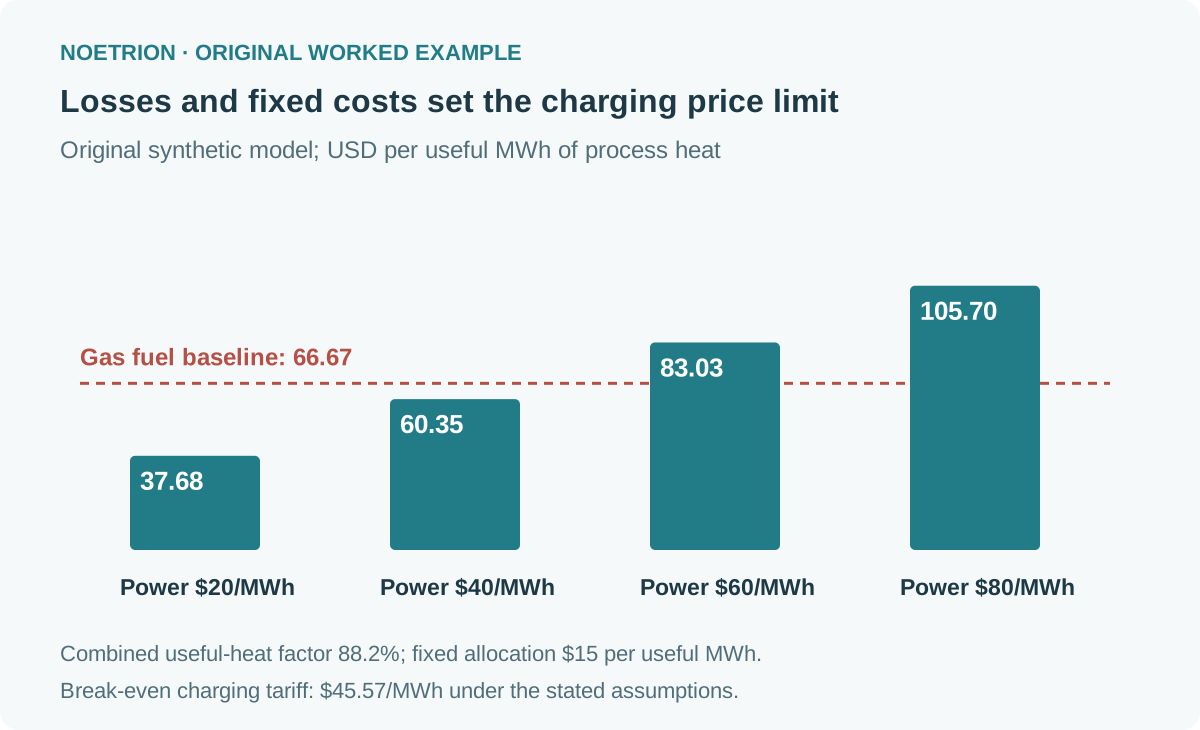
Assume the purchased overnight electricity costs $40/MWh. The system shifts 8 MWh of process heat per operating day and runs on 300 days annually, supplying 2,400 MWh of useful heat. Suppose annualized capital and fixed operating costs together are $36,000. The fixed allocation is therefore $15 per MWh of delivered heat.
Variable electricity cost per useful MWh is the charging tariff divided by 0.882. At $40/MWh, that is approximately $45.35/MWh of heat. Adding the $15 fixed allocation produces a screened cost of $60.35/MWh of useful heat.
For comparison, assume gas costs $60/MWh of fuel and the existing boiler supplies heat at 90% efficiency. Its fuel cost is $60 / 0.90 = $66.67/MWh of useful heat. This baseline excludes boiler fixed costs already incurred, taxes, carbon charges, and other variable costs. It is an incremental screening comparison, not a complete levelized cost study.
| Charging electricity tariff | Electricity cost per useful MWh | Including $15 fixed allocation | Versus $66.67 gas fuel baseline |
|---|---|---|---|
| $20/MWh | $22.68 | $37.68 | Lower by $28.99 |
| $40/MWh | $45.35 | $60.35 | Lower by $6.32 |
| $60/MWh | $68.03 | $83.03 | Higher by $16.36 |
| $80/MWh | $90.70 | $105.70 | Higher by $39.04 |
At the $40 tariff, the annual advantage against that baseline is about $15,156, after the stated annualized storage cost. Small rounding differences in displayed per-MWh figures should not replace calculation with full precision.
Find the break-even charging price
The tariff threshold is more useful than a single cheap-price example. Let P be the all-in electricity price per purchased MWh. With the assumptions above, stored heat is competitive on this screening basis when:
P / 0.882 + 15 < 60 / 0.90.
Rearranging gives P < 0.882 × (66.6667 − 15), or approximately $45.57/MWh. Below that threshold the storage case wins within the specified boundaries; above it the gas fuel baseline is cheaper.
The threshold is sensitive to utilization. If the same $36,000 annual cost is spread over 150 operating days, delivered heat halves to 1,200 MWh and the fixed allocation becomes $30/MWh. The break-even tariff falls to $32.34/MWh. Cheap power for a few nights does not necessarily support the annual investment.
Losses also matter. If the delivery factor falls from 90% to 80%, the combined factor becomes 78.4%. With the original $15 fixed allocation, the threshold falls to about $40.51/MWh. A supplier's best-case efficiency should not silently become the financial base case.
The tariff and grid checks that can overturn the result
Wholesale prices are not necessarily the prices the factory pays. A fixed retail contract may insulate the site from both cheap and expensive hours. Time-of-use charges, network charges, taxes, and a demand charge can change the relevant input cost. Use the actual marginal bill effect of charging, not a market chart downloaded from another jurisdiction.
The charging window also needs to recur reliably. Four cheap hours on average may arrive at different times, while production needs heat on a strict schedule. A dispatch model should test price sequences and required state of charge, rather than assume the tank is full whenever the process starts.
Check grid connection limits before assuming the calculated 2.27 MW can be added. A larger connection may require equipment, approval, a lead time, and a cost omitted from an attractive storage-only quotation. Keeping an existing boiler for backup may help continuity, but its continuing maintenance and readiness costs must be visible.
A worksheet for the first supplier meeting
Bring a month of process heat observations and the electricity contract to the discussion. Record useful heat demand by hour, required delivery conditions, planned downtime, and the site's current electrical peak. Ask for performance at those conditions, including partial discharge.
A useful proposal separates storage hardware, charging equipment, delivery equipment, controls, installation, connection work, commissioning, and lifecycle costs. Ask who guarantees the useful heat boundary and which exclusions apply. If a number is uncertain, test a range before committing to a preferred design.
The strongest decision rule is conditional: proceed when a credible hourly model, engineering fit, and fully specified cost boundary support the case. Thermal storage creates flexibility. Its economic value comes from what that flexibility lets a particular factory avoid or purchase more cheaply.
The battery sizing guide provides a companion example of keeping power and usable energy boundaries separate.
Sources and scope
- IEA, low-temperature factory heat competitiveness, December 9, 2025; regional modeling includes 2024 price data and stated exclusions.
- IEA, Renewables for Industry executive summary, published December 23, 2025; reviewed October 14, 2026.
- US DOE, thermal energy storage and heat transfer media, technology definitions and research context.
Every price, efficiency, annual cost, and facility load in the worked example is synthetic. No local tariff, equipment quotation, or guaranteed project return is implied.