Your Interest Coverage Looks Healthy. Can You Still Make the Loan Payment?
Distinguish EBIT interest coverage from cash available for principal and interest, then build a transparent debt-service and maturity stress worksheet.
Educational analysis, not a personal investment or payment recommendation. Check the dated sources and the rules that apply in your jurisdiction.
The finance spreadsheet shows interest coverage of three times. That sounds comfortable. Then the scheduled principal repayment arrives, a customer pays late, and cash becomes tight. The ratio was calculated correctly. It simply answered a narrower question than the business needed.
The IMF's October 2026 Global Financial Stability Report, released October 13, describes resilient markets alongside elevated vulnerabilities, including possible sovereign-yield shocks and leverage-related stress. A small company's useful response is not to predict the next market shock. It is to understand which obligations can be met from cash under several explicit conditions.
Three questions that deserve three different measures
Interest coverage commonly compares a defined earnings measure with interest expense. Debt-service coverage compares a defined cash or income measure with scheduled debt payments, including principal where specified. Liquidity analysis asks whether cash is available at the required date. A company can pass one test and fail another.
Definitions matter. One analyst may use EBIT, another EBITDA, and a loan contract may specify adjusted amounts with particular exclusions. Never label a worksheet “covenant compliant” before reconciling it to the agreement. This article uses clearly stated educational definitions so the arithmetic can be reproduced.
The SEC's financial-statements guide explains why earnings and cash flow are distinct: income statements measure financial performance over a period, while cash-flow statements track cash movement. A profitable sale on credit does not put the customer's money in the account on the day revenue is recognized.
Build a cash bridge before calculating coverage
Consider a fictional workshop with the following annual plan. Its $300,000 EBITDA less $60,000 depreciation produces $240,000 EBIT. Annual cash interest is $80,000. EBIT interest coverage is therefore $240,000 divided by $80,000, or 3.0 times.
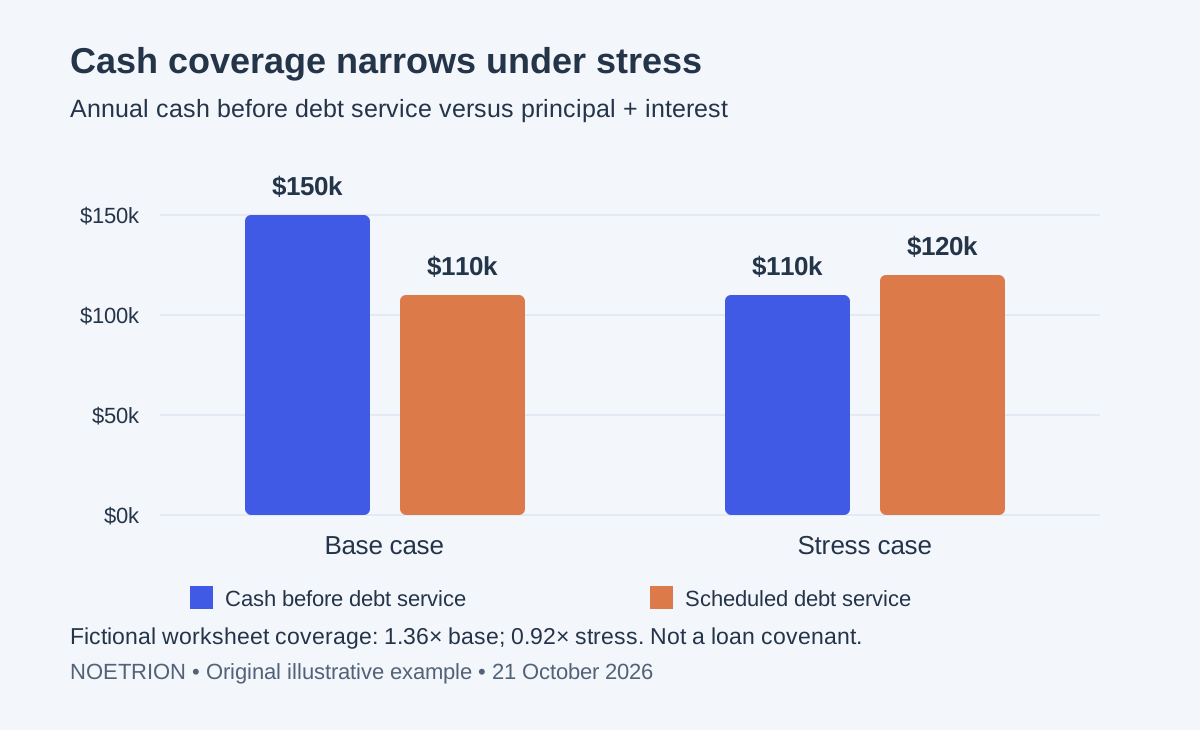
For this worksheet, cash available before debt service starts with EBITDA and deducts $40,000 cash taxes, $50,000 additional working-capital investment, and $60,000 necessary maintenance spending. Assume no other adjustments. That leaves $150,000. Define scheduled debt service as $80,000 cash interest plus $30,000 principal, or $110,000. Educational cash coverage is consequently 1.36 times, rounded from 150/110.
| Fictional annual bridge | Base case | Stress case |
|---|---|---|
| EBITDA | $300,000 | $270,000 |
| Cash taxes | −$40,000 | −$35,000 |
| Additional working-capital investment | −$50,000 | −$65,000 |
| Necessary maintenance spending | −$60,000 | −$60,000 |
| Cash available before debt service | $150,000 | $110,000 |
| Cash interest | $80,000 | $90,000 |
| Scheduled principal | $30,000 | $30,000 |
| Total scheduled debt service | $110,000 | $120,000 |
| Cash surplus or shortfall after debt service | $40,000 | −$10,000 |
The table does not mean taxes mechanically move with EBITDA as shown. Every stress input is an independent illustrative assumption requiring a reason in a real model. The maintenance figure is also a judgment about spending required to keep the workshop operating, not an accounting depreciation figure.
Stress the numerator and denominator together
In the stress case, EBITDA falls 10%, customers absorb an extra $15,000 of working capital, and annual cash interest rises $10,000. After the assumed tax change, available cash falls to $110,000 while debt service rises to $120,000. Coverage becomes 0.92 times and the annual funding gap is $10,000.
This is more informative than raising the interest rate alone. Demand weakness can reduce earnings while slower collection absorbs cash. Financing costs may increase at the same time. Combining those assumptions is not proof that all will occur; it is a way to discover a fragile dependence before signing an obligation.
Avoid adding interest twice. If your starting point is cash from operations that already includes paid interest, reconcile its classification before subtracting interest again. Financial-statement presentation and the selected coverage definition must match. Keep a separate calculation note describing the exact source of each line.
Annual adequacy does not guarantee monthly survival
Suppose the base case's $40,000 annual surplus is concentrated in the final quarter. A $30,000 principal payment due in March may still create a shortage. Build a monthly or weekly cash schedule with opening usable cash, collections, operating payments, capital spending, taxes, interest, principal, and closing usable cash.
“Usable” deserves attention. Restricted deposits, collateral accounts, cash in an inaccessible subsidiary, and money already committed to payroll cannot automatically fund the next payment. Record restrictions explicitly rather than presenting all balance-sheet cash as one freely available pool.
For an original timing example, assume opening usable cash of $25,000, cash receipts of $45,000, operating and tax payments of $40,000, interest of $5,000, and principal of $30,000 in one month. Closing cash is −$5,000 before any new financing. An annual ratio cannot make that month disappear.
Treat a maturity payment as a separate decision
An interest-only loan can look affordable until its entire principal matures. The OCC's October 3, 2024 refinance-risk guidance describes the risk that existing debt cannot be replaced on reasonable terms under prevailing market conditions. It emphasizes repayment capacity and thoughtful underwriting rather than assuming refinancing will always be available.
If a fictional $400,000 balloon matures in twelve months, “we will refinance” is an assumption, not an operating cash inflow. Document the fallback if only $300,000 can be refinanced, the new rate is higher, or closing is delayed. Estimate the cash required for fees and any principal paydown as well as future interest.
Do not mix a bank's underwriting judgment with your own ratio target. A lender may assess collateral, guarantees, covenants, sector conditions, and other evidence. A threshold copied from another business is not a universal approval rule.
Turn the worksheet into an action plan
For every shortfall, attach a feasible action, an owner, a decision date, and evidence. “Improve sales” is too vague. “Collect the three overdue invoices by the documented date, with customer confirmation” can be tested. “Use the credit facility” requires checking availability and conditions, rather than assuming the headline limit can be drawn.
Separate reversible actions from costly commitments. Reducing discretionary expansion may preserve cash; postponing essential maintenance can merely move risk into equipment failure. Model customer discounts and accelerated collections after their actual cost, not as free money.
Keep a rolling maturity list covering principal, leases, guarantees that may be called, and other material commitments. Update after a signed contract or meaningful forecast change. The aim is to identify the last comfortable decision date, when options are still available.
Questions readers ask
Is EBITDA the cash available to repay debt? Not automatically. Taxes, working capital, maintenance spending, and other items can consume it. Reconcile the bridge rather than relying on the label.
Does coverage below one prove a company will default? No. Opening cash, asset sales, new equity, financing, or negotiated changes may cover a shortfall. Their availability must be demonstrated.
Which ratio should I use? Use the actual contract definition for covenant testing and an explicit cash schedule for operating decisions. Keep both visible.
Sources and review boundaries
- IMF, Global Financial Stability Report: Resilience, Risk, and Transformation, October 13, 2026. Current financial-risk context, not a prediction about the fictional workshop.
- SEC, Beginners' Guide to Financial Statement, February 4, 2007. Financial-statement distinctions.
- OCC, Commercial Lending: Refinance Risk, October 3, 2024. Refinance-risk principles; US banking guidance.
Reviewed October 21, 2026. All company figures and calculations are original educational examples. Actual lending and accounting definitions require the relevant agreement and professional review.