Interleaving vs Blocked Practice: How to Study When Problems Look Too Similar
Interleaving can help students choose among similar methods. Learn what research says, when blocking is better and a practical 45-minute routine.
Evidence base: Peer-reviewed research published in 2019 and 2021
Imagine solving ten calculus problems using the same formula. By the tenth problem, you feel fluent. Then the exam mixes derivatives, integrals, and probability questions—and suddenly choosing the right method is harder than performing the calculation. That gap is one reason researchers study interleaved practice.
Blocked practice means working on one problem type repeatedly before switching. Interleaved practice means mixing different types so the learner must recognize which method applies. Both have a place. The useful question is when to use each, not which one deserves to win every study session.
What the evidence says
A 2019 meta-analysis covering 59 studies reported an overall interleaving effect of Hedges' g = 0.42, with important variation across materials. It found a smaller positive effect for mathematical tasks, while results for other materials were mixed or even favored blocking. This is evidence against the simplistic claim that mixing everything always works best.
A 2021 study in undergraduate physics examined homework practice over eight weeks and found benefits for memory and problem-solving from interleaving. Its setting is relevant to technical courses, but a single study does not guarantee identical results in every classroom.
| Practice method | Example | Most useful when |
|---|---|---|
| Blocked | Ten derivative problems of one type | Learning a new procedure initially |
| Interleaved | Derivative, limit, probability, derivative | Choosing among known methods |
| Spaced | Revisit a topic over several days | Maintaining knowledge over time |
| Retrieval | Solve without looking at notes | Checking whether knowledge is accessible |
These approaches are complementary. A student can interleave problem types while spacing practice across days and attempting retrieval without notes.
Why mixing can feel harder but help later
Blocked practice gives repeated cues. Once you know the chapter title, you may already know which formula to use. Interleaving removes that clue. You must inspect the problem, identify its structure, and select a method.
That extra decision can make practice feel slower and less satisfying. Yet many exams and real-world tasks require exactly this kind of selection. In a workplace, a data analyst must decide whether the question calls for a join, a statistical test, or a visualization before applying a tool.
A practical 45-minute session
Use this plan for a course with three related topics you have already encountered:
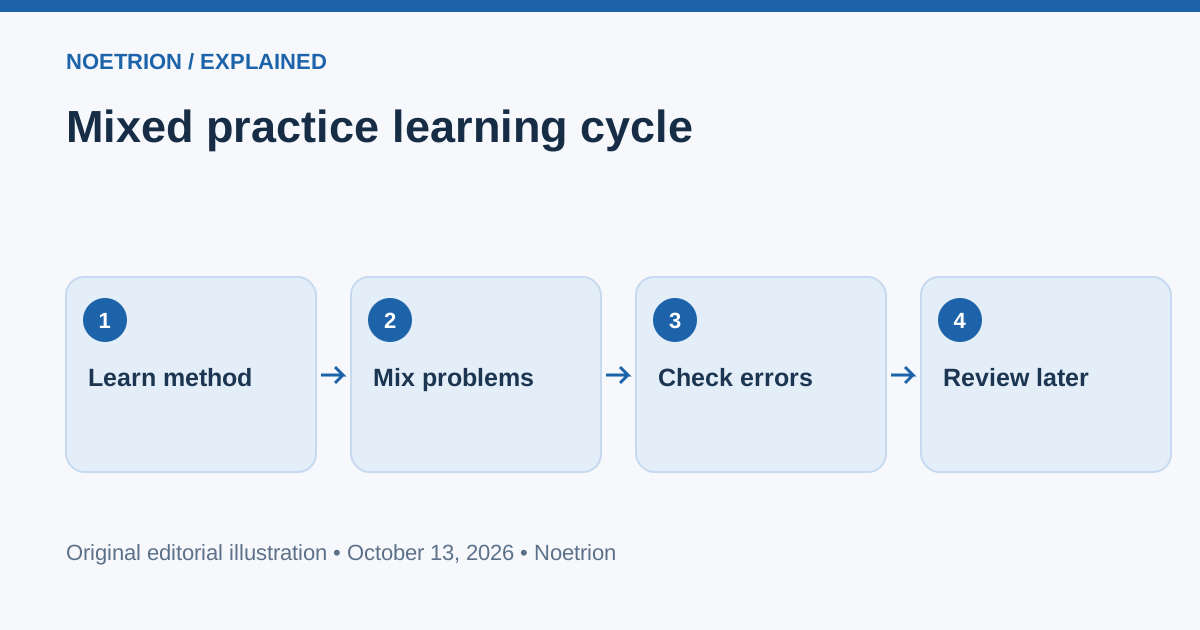
- Minutes 0–10: Review one weak procedure with two worked examples.
- Minutes 10–25: Solve six mixed problems drawn from three topics without labels.
- Minutes 25–35: Check answers and write down why each method was appropriate.
- Minutes 35–40: Redo the two most difficult problems from memory.
- Minutes 40–45: Schedule a brief revisit in one to three days.
The exact minute allocations are a practical suggestion, not a schedule validated by the cited studies. Adjust them for task difficulty and fatigue.
How to build a good mixed problem set
Choose problems that look superficially similar but require different reasoning. In statistics, mix binomial, hypergeometric, and geometric probability questions. The goal is to recognize clues such as replacement, independence, and “first success.” In programming, mix tasks that require a loop, a dictionary, or a function so you practice selecting an approach rather than copying a pattern.
Do not begin with an entirely unfamiliar set of methods. If you cannot perform any method independently, initial blocked examples may be more appropriate. Interleaving is especially useful once the procedures are familiar enough to compare.
Track the right progress measure
Instead of counting how many questions you finished, record two things: method selection accuracy and solution accuracy. You may choose the correct distribution but make an arithmetic error, or compute perfectly using the wrong distribution. Those are different weaknesses and need different corrections.
Test yourself again after a delay. Immediate fluency is not the same as durable learning. If mixed practice exposes confusion, treat that as diagnostic information rather than proof that the method failed.
FAQ
Is interleaving always better than blocked practice?
No. The research shows differences by subject and material; blocking can help during initial acquisition.
Is interleaving the same as multitasking?
No. Interleaving alternates problem types within a focused study session; it does not require checking unrelated apps or notifications.
How many topics should I mix?
Start with two or three related, previously learned types and adjust based on errors.