How JWST Reads Exoplanet Atmospheres—and Why a Spectrum Is Not a Biosphere
See how transit light becomes a spectrum, how models infer molecules, and why atmospheric detection is not the same as finding life.
Reviewed October 11, 2026.
See how transit light becomes a spectrum, how models infer molecules, and why atmospheric detection is not the same as finding life.
| Concept | What it means | Important limit |
|---|---|---|
| Transit depth | Planet blocks a fraction of starlight | A deeper line is not automatically one molecule |
| Absorption pattern | Molecules affect selected wavelengths | Clouds and temperature can mimic features |
| Repeated transit | Signal accumulates across observations | Stellar variability still needs modeling |
| Retrieved abundance | A model-supported atmospheric estimate | Not a direct sample of the air |
1. Start with a tiny change in a star, not a photograph of air
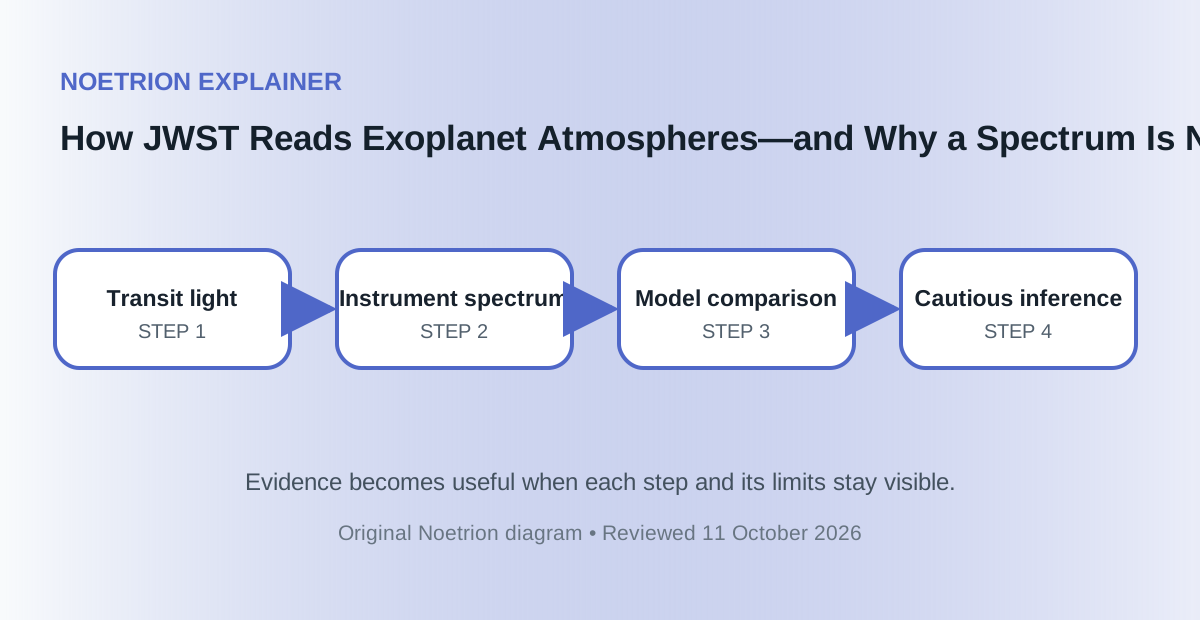
When a planet crosses its star, it blocks an area of the stellar disk. A thin annulus of atmosphere can block a little extra light at wavelengths where gases absorb. Astronomers compare spectra taken during and outside the transit, seeking differences far smaller than the star’s total brightness. Webb’s mirrors collect infrared light and its spectrographs separate that light by wavelength. The result is not a colorful photograph of weather. It is a calibrated series of measurements with uncertainties, detector effects, and assumptions about the star and orbit.
2. Molecules leave patterns rather than unique single lines
Atoms and molecules absorb sets of wavelengths determined by their energy levels. Water vapor, carbon dioxide, methane, sodium, and other species can therefore create characteristic bands. Identification depends on matching a pattern across multiple channels, not pointing to one noisy bump. Different gases can overlap, while haze or clouds can flatten a spectrum. Temperature and pressure alter line strength and shape. A responsible analysis asks whether the proposed mixture explains the whole measured pattern better than plausible alternatives and reports how strongly the data distinguish them.
3. Calibration is part of the scientific result
Raw detector counts include instrument drift, pointing changes, cosmic-ray hits, thermal backgrounds, and changes in the star. Teams build a light curve for each wavelength bin, correct known systematics, and estimate remaining correlated noise. Independent pipelines may make different defensible choices. Agreement across reductions increases confidence; disagreement reveals sensitivity to assumptions. The useful artifact is therefore not merely a plotted spectrum, but a chain from detector frames to calibrated points, with code, priors, and quality checks detailed enough for other researchers to examine.
4. Retrieval turns spectra into conditional atmospheric estimates
Atmospheric retrieval compares observations with many forward models. A model proposes temperature, gravity, clouds, and gas abundances, then predicts the spectrum those conditions would produce. Statistical sampling maps which combinations remain compatible with the data. The output is a posterior distribution conditioned on the chosen model family and prior assumptions. Degeneracy is common: a high cloud deck and a lower abundance may both weaken a feature. Retrieval is powerful precisely because it quantifies competing explanations, but its abundance intervals should not be read as direct chemical sampling.
5. The host star can imitate or distort a planetary signal
A planet transits only part of a star. Unocculted spots and bright faculae can give that region a different spectrum from the stellar disk as a whole, imprinting wavelength-dependent changes that resemble atmospheric absorption. This is especially important for active small stars whose compact habitable zones make transits easier to observe. Researchers monitor stellar activity, compare multiple epochs, and model the stellar surface. A claimed planetary molecule is stronger when it persists across visits and cannot be explained more simply by the changing star.
6. One molecule is not a biosignature verdict
A molecule can have biological and non-biological sources. Methane may come from life, but also water-rock reactions or volcanism; oxygen can accumulate through photochemistry under some conditions. Meaning comes from context: the planet’s mass, temperature, radiation environment, companion gases, and geologic plausibility. Even a chemically intriguing disequilibrium would be evidence to investigate, not proof of inhabitants. Researchers seek converging observations and examine false-positive pathways before using the word biosignature.
7. Gas giants and rocky worlds pose different problems
Large, hot planets have extended atmospheres and often produce stronger signals, making them excellent laboratories for testing instruments and atmospheric chemistry. A temperate rocky planet presents a much smaller atmospheric annulus and may require many transits. Clouds can hide lower layers, and transmission spectroscopy samples the limb rather than the surface. Webb can transform knowledge of selected worlds, yet it was not designed to deliver a census of Earth twins. Target brightness, orbital period, atmospheric scale height, and observing time all shape what is feasible.
8. A practical checklist for reading discovery headlines
Check whether the result is a detection, a tentative preference, or an upper limit. Ask how many transits were observed, which instrument modes were combined, and whether alternative reductions agree. Look for uncertainty intervals and tests of stellar contamination. Separate the presence of an atmosphere from the abundance of a gas, and both from habitability. Finally, distinguish a peer-reviewed analysis from an early conference claim. A careful spectrum can be revolutionary without supporting the most exciting interpretation circulating online.
Conclusion
Webb converts minute wavelength-dependent changes in starlight into evidence about remote atmospheres. Every stage—observation, calibration, retrieval, and interpretation—adds both knowledge and uncertainty. The best reading is neither cynical nor credulous: molecular features are real achievements, while claims about climate, habitability, or life require a larger, repeated body of evidence.