Malaysia E-Invoicing: Readiness Means Resolving Exceptions, Not Sending PDFs
Check Malaysia's updated e-invoice scope, distinguish submitted from valid records, and build an exception worksheet with a reconciled numerical example.
Educational analysis, not a personal investment or payment recommendation. Check the dated sources and the rules that apply in your jurisdiction.
The invoice looks right, the customer has received it, and the accounting system says “sent.” Yet the transaction may still need attention in the tax authority's system. A readable document, a successful transmission, and a validated e-invoice are different milestones.
Malaysia's recent guidance updates make this a useful time to review the whole process. Start with whether the rules apply to your entity, then test what happens when data is rejected, a response is delayed, or a validated invoice contains a mistake. A demonstration of one successful invoice does not establish that the monthly process is ready.
Start with the current official documents
Malaysia's Inland Revenue Board updated its implementation timeline on August 30, 2026. The page states an exemption for annual turnover or revenue below RM3 million. However, the version 4.8 guideline, also published August 30, sets out exceptions involving certain shareholders, holding companies, related companies, and joint ventures. A turnover number alone therefore cannot settle every entity's position.
The general FAQ updated September 4, 2026 describes a structured XML or JSON e-invoice, rather than a PDF or image. These are Malaysian requirements, not a universal definition of compliance in every jurisdiction.
This article is an operational readiness guide checked on October 21, not a personalized tax ruling. Establish the applicable entity, implementation date, exemptions, and transitional treatment using the current official documents or qualified local advice. Keep a dated record of that determination.
Build an applicability record before buying software
An applicability record should identify the taxpayer and explain why a requirement applies. That is more reliable than copying a vendor's general deadline table into the project plan. Guidance can change, and entities that look similar commercially can have different ownership or commencement histories.
| Applicability field | Evidence to keep | Question it resolves |
|---|---|---|
| Taxpayer identity | Registered entity and tax identifiers | Whose obligation is being assessed? |
| Turnover basis | Relevant accounts and period | Is the threshold being evaluated correctly? |
| Ownership and relationships | Current structure and supporting records | Does an exemption exception need assessment? |
| Start of operations | Documented commencement history | Which implementation treatment is relevant? |
| Decision and source | Official version, date, and reviewer | Can the conclusion be revisited accurately? |
Do not store sensitive identifiers in a publicly shared project board. The purpose is traceability within an appropriately restricted process. If an input is missing, label the conclusion provisional and assign someone to resolve it.
A readiness project can still improve record quality while applicability is being clarified. It should not quietly turn an uncertain legal assumption into an instruction to issue or omit a required document.
Map the transaction through distinct states
The official guideline distinguishes statuses including submitted, valid, invalid, and cancelled. Submission and validation are therefore separate events. Your internal workflow should preserve the distinction instead of collapsing them into one green “complete” label.
An operational record can also show local states such as prepared, awaiting response, and awaiting correction. Label those as your own process states, not official MyInvois terminology. A local timeout means that the system does not yet know the result; it does not prove the authority rejected the transaction.
Give every source transaction a stable internal identifier. Store the external identifier and status against that record when available. A correction or retry should remain connected to its original business transaction, so that a reconciliation does not mistake two messages for two sales.
For the underlying data-management principle, see Noetrion's data contracts guide. The goal here is narrower: a finance team should be able to explain where every invoice went and what must happen next.
Reconcile a batch by count and value
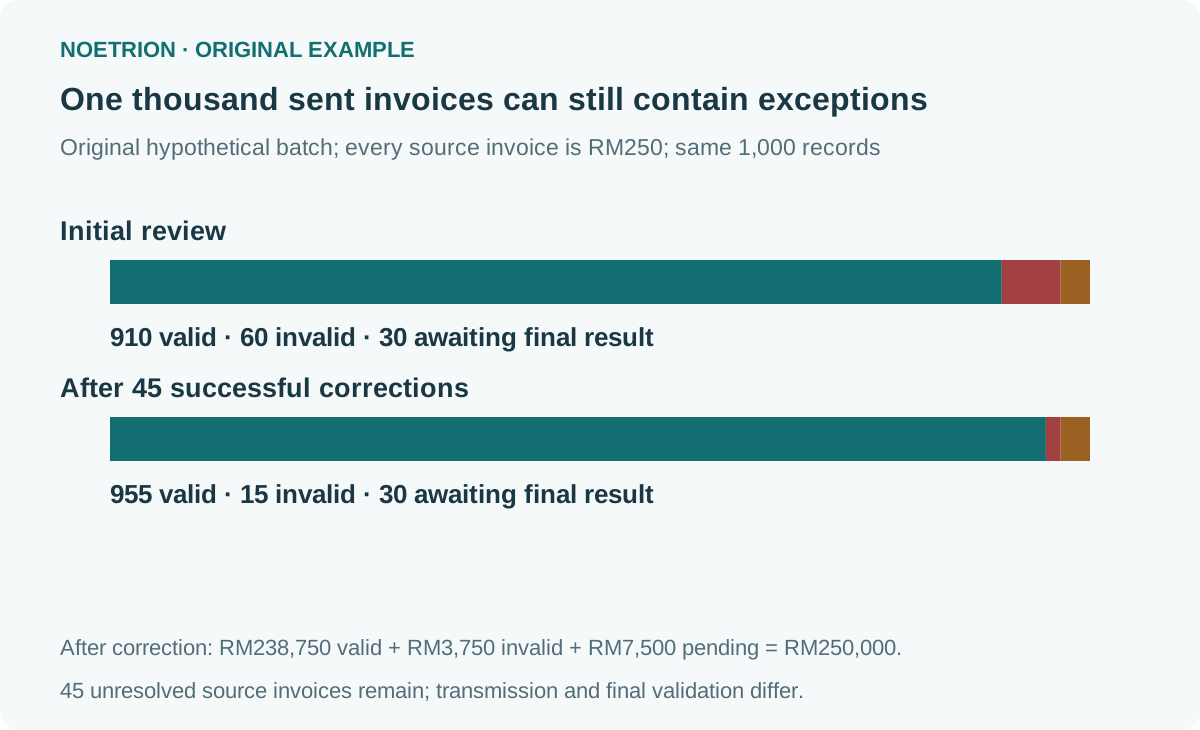
Consider a hypothetical business preparing 1,000 invoices, each worth RM250, for a total of RM250,000. Assume every record has been submitted once. At the first review, 910 are valid, 60 are invalid, and 30 still await a final result.
| Review point | Valid | Invalid | Awaiting final result | Total source invoices |
|---|---|---|---|---|
| First review | 910 | 60 | 30 | 1,000 |
| After 45 invalid records are corrected successfully | 955 | 15 | 30 | 1,000 |
At the first review, the valid value is RM227,500; invalid value is RM15,000; pending value is RM7,500. Together they equal RM250,000. After the corrective work, valid value becomes RM238,750, invalid value RM3,750, and pending value remains RM7,500.
There are still 45 unresolved invoices, representing RM11,250. Reporting “all invoices sent” would conceal them. Reporting “95.5% valid” is more useful, but it should retain the unresolved count and value rather than imply that the remaining records are unimportant.
Equal invoice values simplify the illustration. In real records, a small number of high-value exceptions can dominate the financial exposure. Reconcile monetary totals from actual line and document values, not by multiplying a count by an average invoice size.
Give exceptions an owner and an ageing clock
A status report becomes useful when someone can act on it. For each unresolved record, keep the source identifier, known external reference, latest result, error detail, responsible person, next action, and time since the last meaningful update.
Separate data problems from uncertain delivery results. An invalid customer identifier may need master-data correction. A missing response needs investigation of the existing submission before a new one is created. Otherwise, a team trying to clear its queue can accidentally create duplicates.
The queue should prioritize both time sensitivity and financial significance. The oldest record is not always the largest exposure, and the largest invoice is not always the one nearest an adjustment deadline. A practical review displays both dimensions rather than hiding them in a single unexplained risk score.
Keep error messages factual. “Validation failed because field X was missing” is more useful than “system problem.” Repeated errors may indicate an upstream process issue that should be fixed once, instead of corrected manually on every invoice.
Treat the adjustment window as a separate control
The FAQ explains that an already validated e-invoice cannot simply be edited. It describes cancellation and reissue within 72 hours of validation, and adjustment documents such as credit, debit, or refund note e-invoices after that period. The guideline also allows relevant adjustments without requiring the cancellation route.
Do not confuse this clock with the time since a local file was prepared. Record the actual validation timestamp and the applicable route for the particular correction. An invalid submission and an error found in a valid invoice are different cases.
For an internal rehearsal, imagine validation at 10:00 on a Monday and error discovery at 09:00 on Thursday: 71 hours have elapsed. Discovery at 11:00 would be 73 hours. The example illustrates elapsed time only; the permitted action must still follow the actual transaction, policy, system capabilities, and current official rules.
Avoid scheduling a team review exactly at the boundary. A nominally available route is of little help if nobody is authorized to act before time runs out. Make responsibilities and escalation clear before a real exception appears.
Test failures before declaring the process ready
A useful rehearsal includes a correct record, a missing mandatory value, a duplicate source identifier, an uncertain response, and a mistake discovered after validation. Use approved test arrangements and synthetic data. Do not create artificial production tax records merely to prove that a screen works.
| Test case | Expected operational behavior | Evidence of readiness |
|---|---|---|
| Valid source transaction | Links source record to final external result | Traceable record and reconciled amount |
| Data rejection | Routes correction to the right owner | Specific error and successful follow-up |
| Uncertain response | Investigates existing submission before retry | No unexamined duplicate creation |
| Validated invoice error | Uses the appropriate adjustment workflow | Timestamp, authorization, and linked documents |
| Staff absence | Another authorized person can resolve the queue | Documented handover and actual access |
The expected behaviors above are recommended controls, not a claim that the tax authority mandates this exact test plan. Adapt them to the integration and the business. Record what remains untested and the consequence of a failure.
Measure effort without confusing it with compliance
Suppose the first review's 60 invalid records each require eight minutes of staff work. That is 480 minutes, or eight hours. At a hypothetical loaded labor cost of RM30 per hour, the immediate correction work costs RM240, before any investigation of the 30 uncertain results.
If a master-data fix prevents 45 of those errors in a later comparable batch, six hours of repetitive work would be avoided, worth RM180 at the same assumed rate. That is a modeled operational saving, not proof of tax compliance or a guaranteed monthly benefit.
Keep this measure separate from collection performance. Validation does not prove that a buyer accepts the underlying commercial obligation or has paid. Noetrion's working-capital cash-gap article explains why an accounting milestone and available cash must not be treated as the same event.
Before scaling, run a complete close: reconcile source sales, final statuses, adjustment documents, and accounting entries. Ask whether an independent reviewer can explain every difference without relying on one employee's memory. That is a stronger readiness test than a successful submission demo.
Sources, dates, and limits
- IRBM implementation timeline, updated August 30, 2026: headline rollout and exemption information.
- IRBM e-Invoice Guideline version 4.8, August 30, 2026: exemption exceptions, workflow statuses, and adjustment processes.
- IRBM general FAQ, updated September 4, 2026: structured formats and adjustment clarification.
Checked October 21, 2026. All batch values, timestamps, and labor costs are hypothetical and independently calculated. The article does not determine an individual taxpayer's obligations or replace the full official guidance.