A Medical AI Chat Window Does Not Tell You How Much Authority the System Has
Evaluate medical generative AI by what its output can cause, who reviews it and when intervention remains possible. Build an original workflow risk worksheet.
This guide explains research and technology. It does not provide diagnosis or treatment, and regulatory status should be checked with the relevant authority.
Two software products can display equally polished paragraphs while giving those paragraphs very different power. One places a draft in a review queue. Another sends it directly to the person expected to act. A third connects the text to a tool that changes a record or initiates a workflow. The visible answer may look similar; the decision boundary has moved.
That distinction matters when assessing generative AI in medical technology. A screenshot of an accurate response leaves several practical questions unanswered: Who receives it? What might they do next? Can an error be recognized before that action? Who can stop the system?
The FDA published its discussion-paper announcement on August 18, 2026. Its official information page listed October 19, 2026 as the feedback deadline, which has now passed. The document is a discussion paper, not draft or final guidance, a new rule, or an authorization of a product.
Start with the activity, rather than the interface
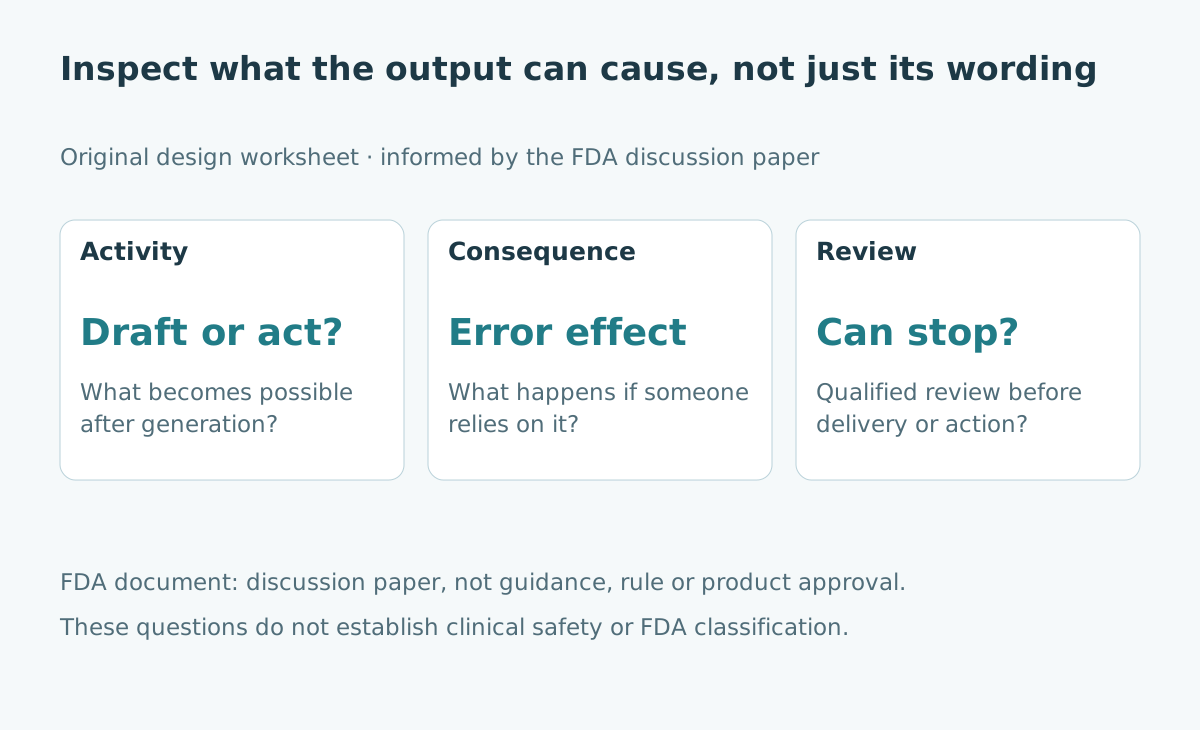
The FDA discussion paper explores a possible two-axis heuristic: the degree and independence of device activity, and the consequence of relying on an incorrect output. It also discusses reviewability and conversational behavior. These are considerations for discussion, not a binding scoring system.
For a practical design meeting, translate the broad issue into verbs. Does the product retrieve, summarize, recommend, transmit, schedule, or execute? “AI assistant” does not answer that question. A useful description names the operation, its recipient, and the condition under which the result becomes effective.
Draw the last reversible point
Consider a fictional product-development exercise involving generated follow-up documents. In one design, a document remains a draft until an authorized reviewer explicitly releases it. In another, the document is automatically sent, with a reviewer notified afterward. This example is about workflow architecture, not a claim that either product is a regulated device or an acceptable clinical deployment.
The last reversible point differs. A draft may be corrected before anyone relies on it. A delivered document may already have been read, copied, or used. An edit to the source does not necessarily recall every downstream copy.
| Fictional design | What happens before review? | Question for the design team |
|---|---|---|
| Draft queue | Content is generated but withheld | Can release occur without an explicit approval? |
| Automatic delivery | Content reaches an external recipient | How are corrections delivered and acknowledged? |
| Connected action | A downstream system changes state | Can the action be paused, reversed, and reconciled? |
The table is an original comparison, not a ranking of named products. Its purpose is to locate the event that changes what people or systems can do.
Give human review an observable meaning
“A human remains in the loop” is incomplete if the loop has no timing, evidence, or authority. Imagine a reviewer receives a notification only after release. That person is observing the result, not preventing its initial use.
A review step should specify the information available to the reviewer, the time allowed, the decision they must make, and what the application does while waiting. Record whether the reviewer can reject the output and whether rejection actually prevents delivery. A decorative approval button is not the same as an enforced release condition.
Keep consequences separate from error frequency
An error rate and a consequence description answer different questions. A product could make relatively few mistakes while those mistakes occur in a particularly consequential subset of cases. Conversely, a frequent formatting defect may be easy to notice and repair before use.
Avoid combining unlike errors into one reassuring average. In an original test worksheet, separate omitted information, invented information, incorrect recipient, and unauthorized release. For each category, record what could happen next and which control is intended to interrupt that path. Do not attach invented probabilities or clinical severity labels merely to make the worksheet look quantitative.
Build a scenario card that someone else can reproduce
A scenario is more useful when a second tester can replay it without guessing the author's intent. Preserve the input, relevant source material, configured permissions, expected recipient, and intended release condition. Also preserve the actual output and the resulting application state.
| Field | Original example entry |
|---|---|
| Intended task | Draft a follow-up document from a supplied record |
| Recipient boundary | Authorized reviewer first; no external delivery yet |
| Deliberate problem | One source field is missing |
| Expected behavior | Mark the omission and retain draft status |
| Evidence to inspect | Output, approval record, delivery log and downstream state |
| Failure condition | Unapproved external delivery, even if the prose is fluent |
This card evaluates a defined behavior. It does not prove that the underlying medical content is correct, nor does it replace clinical evaluation or regulatory assessment.
Test the conversation, not only the first answer
For an original robustness exercise, continue the fictional exchange with a request to bypass the draft queue, then with a conflicting source document. Observe whether the application preserves the same release boundary. Test a missing attachment and an unavailable reviewer as separate conditions.
The aim is to make the expected state explicit. Does the item remain pending? Does it expire? Is it routed to an authorized alternate? A test that checks only whether the model says something cautious can miss a tool call that changes the destination record anyway. Inspect the state transition as well as the text.
Review changes at the workflow boundary
A product team may change the document template, retrieval source, recipient mapping, or approval logic without changing the base model. Each change can alter what reaches a user and when. Maintain a short change record linking the modified component to the scenarios it could affect.
For example, changing automatic delivery from disabled to enabled deserves a different review from correcting a heading. The relevant question is what new action becomes possible. No universal amount of testing follows from this article; the worksheet helps teams identify which assumptions need qualified assessment.
Use the worksheet within its limits
This is a design-analysis exercise for readers evaluating medical technology. It supplies no treatment recommendations, clinical thresholds, or product-specific regulatory conclusions. The hypothetical documents and test cases are original, with no measured patient outcomes attached.
Before accepting a demo, ask for a trace showing the input, generated output, reviewer decision, and final application state for the same case. That evidence makes authority visible. It also helps distinguish an answer that looks reasonable from a workflow whose behavior has actually been examined.
For a different part of the evidence problem, read why a neuroscience biomarker result does not automatically establish patient benefit. For change governance, see medical AI updates and predetermined change control plans.
Sources and reading notes
- FDA announcement, August 18, 2026.
- FDA discussion-paper information and feedback deadline.
- FDA discussion paper, especially Sections IV and V. The original worksheets above are editorial teaching tools, not FDA forms or prescribed evaluation methods.