Better Meetings Start with an Output You Can Check
Turn vague meeting goals into verifiable outputs, use a worked agenda and decision record, and evaluate AI assistance without overstating the research.
“Discuss the launch” fills a calendar slot. It does not tell participants what they should prepare, who can decide, or what will be different afterward. When the meeting ends, everyone may agree that the discussion was useful while leaving with incompatible versions of the decision.
AI summaries can preserve that ambiguity in beautifully organized prose. Before adding another assistant, make the desired output inspectable: a decision, an accepted plan, a resolved question, or a shared understanding that participants can explain. This article proposes a practical way to do that, informed by recent meeting research but without claiming a guaranteed productivity gain.
The 2026 research is more cautious than a productivity headline
A preregistered field experiment submitted in February 2026 involved 361 employees and 7,196 meetings in a global technology company. The treatment prompted participants to reflect on goals before meetings. Its effect on meeting effectiveness was not statistically significant. Both groups completed post-meeting surveys, which themselves appeared to encourage reflection and complicated interpretation of the comparison.
The useful lesson is methodological: making people think about goals is plausible and worth investigating, but that study does not justify a promise that a pre-meeting prompt improves effectiveness. Nor does a nonsignificant result prove that goals never matter. It describes what the intervention and comparison established in that setting.
The workflow below is an editorial proposal. Test it against the problems your team actually has, rather than treating the research as a stamp of approval for a template.
Replace a topic with a verifiable output
Compare two invitations. The first says “Website launch sync.” The second says: “Choose whether the new checkout can enter a limited launch on Monday; record the deciding owner, blocking conditions, and next review.” The second provides a preparation target and a clear endpoint.
Not every meeting should produce a decision. A mentoring conversation may aim to understand a difficult situation; a design exploration may aim to produce alternatives. State the appropriate output rather than forcing every interaction into an approval gate.
For an exploratory session, an inspectable output might be three genuinely different options and the uncertainty each addresses. For an onboarding conversation, it might be the newcomer explaining how to request access and where to ask for help. Avoid a metric that rewards producing a document while missing the human purpose.
Distinguish preparation, participation, and authority
In the fictional launch example, invite the product owner who can authorize the launch, the engineer who can explain failure modes, and the support lead who can describe customer impact. Other stakeholders may need the record without needing to attend the entire discussion.
Before sending the invitation, ask who possesses necessary evidence, whose agreement is required, and who owns the next action. These roles may overlap, but they are not interchangeable. A room full of informed people can still lack authority to decide.
Send a short pre-read with the decision question, the options, the evidence available, and the unresolved issue. If a crucial measurement will not exist until tomorrow, decide whether today's meeting has a useful intermediate output. Rescheduling is sometimes sensible; so is meeting to define how the missing evidence will be obtained.
A worked 25-minute agenda
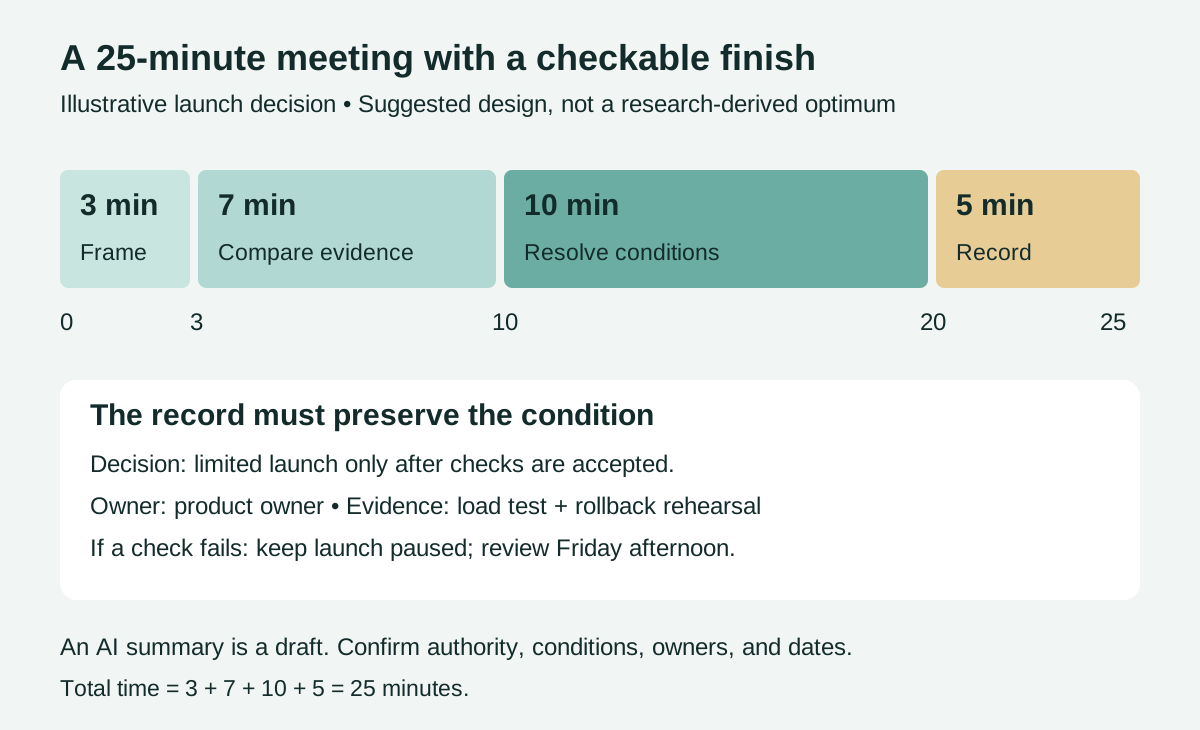
Suppose a team must choose between a limited launch and a full launch. In this invented scenario, the checkout passed its functional tests, but the latest load test is incomplete. No real company or incident is represented.
| Minutes | Task | Concrete output |
|---|---|---|
| 0–3 | Confirm the question and authority | Product owner confirms what can be decided today |
| 3–10 | Compare the two options | Evidence, assumptions, and unresolved risks separated |
| 10–20 | Resolve objections and conditions | Clear list of blocking conditions and owners |
| 20–25 | Read the record back | Decision, next action, deadline, review trigger |
The timeboxes add to 25 minutes. They are deliberately modest: a genuinely complex or sensitive decision may need longer. The purpose is to reserve time for closure instead of letting comparison consume the entire slot.
At minute ten, an engineer might say the limited launch also depends on a tested rollback. That is not an annoying detour; it changes the conditions for the decision. Record it visibly. If the discussion reveals that neither option is ready, “defer pending evidence” can be a valid decision when accompanied by an owner and deadline.
Write a record that survives the next meeting
An illustrative record could say: “Product owner authorizes a limited launch only after the load-test report and rollback rehearsal are accepted. Engineer owns both checks by Friday noon. Support lead prepares the incident contact list. If either check fails, launch remains paused and the owner reviews the plan Friday afternoon.”
That record identifies a conditional decision. It does not silently rewrite “we might be ready” as “approved.” Keep rejected alternatives and major assumptions when they will help a later reader understand the choice.
Research on temporal work across meetings, published at DIS 2025, explores how interfaces can connect looking back and planning ahead across recurring work. The practical application here is simple: begin the next meeting from the previous commitments and new evidence, rather than from a fresh summary that loses the history.
Use AI to ask better questions, then verify the record
A 2025 Meeting Purpose Assistant study used a technology probe with 18 employees. It explored AI-assisted reflection on purposes, challenges, and success conditions, reporting promising changes in preparation and perspective alongside social, time, and technology barriers. That is exploratory evidence, not proof of a universal time saving.
A useful prompt for your own draft is: “Identify any agenda item without an output, any decision without an owner, and any dependency without a check. Ask questions; do not invent approvals.” After the meeting, compare the generated record with what participants actually agreed.
Specifically check negation, conditions, numbers, deadlines, and attribution. “Do not launch until testing passes” is materially different from “launch after testing,” especially if the record omits who decides whether testing passed. Ask the owner to confirm the final version through your normal workflow.
Evaluate improvement without manufacturing a success story
Try the format on one recurring meeting for a few cycles. Track whether actions have owners, whether conditions remain unresolved, whether decisions are repeatedly reopened because the record was unclear, and whether participants think the preparation burden is reasonable.
Measure preparation time as well as meeting time. Saving ten minutes in the meeting while adding an hour of unnecessary pre-work is not an obvious improvement. Also avoid rewarding fast closure when the underlying question needed more disagreement or consultation.
This small trial will not isolate causality: workload, attendance, and project stage may change. Use it to find operational problems and decide whether to keep or revise the workflow. A reduction in calendar minutes alone cannot establish that the team made better decisions.
Frequently asked questions
Should every meeting have an agenda?
Match the structure to the interaction. For a decision meeting, a question, evidence, and endpoint are helpful design choices. For a supportive conversation, an overly rigid agenda may get in the way. Make the purpose explicit enough that participants know what they are joining.
Can an AI summary replace the decision record?
Use it as a draft. Someone with the relevant authority should verify what was decided, the conditions, and who accepted the actions. Fluency does not establish agreement.
What if no decision can be made?
Record the missing information, who will obtain it, and when the question will be revisited. Avoid presenting a delay as approval or scheduling another meeting with exactly the same unresolved inputs.
Sources and evidence scope
- Tankelevitch and colleagues, Nudging Attention to Workplace Meeting Goals, submitted February 18, 2026; preregistered field experiment, related CHI 2026 publication.
- Scott and colleagues, What Does Success Look Like?, CHIWORK, June 2025; exploratory technology-probe study.
- Vanukuru and colleagues, Designing Interfaces that Support Temporal Work Across Meetings with Generative AI, DIS, July 2025; design research on work across meetings.
Sources checked October 21, 2026. The launch scenario, agenda, record, and evaluation suggestions are original practical applications; no percentage productivity improvement is claimed.