Work-Sample Hiring: Build a Test That Measures the Job
Design a job-related work-sample assessment with clear tool rules, a scoring rubric, a checked numerical example, and a practical candidate preparation plan.
A hiring task asks an analyst to create a polished dashboard over a weekend. The actual job mostly involves checking inconsistent weekly reports and explaining their limits. The exercise produces impressive screenshots, but it may measure spare time and presentation experience more than the work the employer needs.
A good work sample begins with a narrower question: what should a person be able to do when entering this role, and what observable evidence would demonstrate it? Clear expectations benefit hiring teams and candidates.
Start with an entry requirement, not a favorite puzzle
The U.S. Office of Personnel Management describes work samples and simulations as tasks resembling activities performed on the job. Its guidance emphasizes using them for competencies applicants are expected to possess on entry. A task can resemble the job while testing a skill the employer intends to teach later; that would weaken its fit as an entry assessment.
For a junior reporting role, entry requirements might include checking arithmetic, identifying missing information, and explaining uncertainty. Memorizing one company's proprietary dashboard interface may be trainable later. Test the former unless the latter is genuinely necessary at entry.
Write a task claim: “This exercise provides evidence that a candidate can reconcile a small report and communicate a qualified recommendation.” Then delete elements that do not serve that claim. Visual flair can be assessed separately if it is an actual job requirement.
Distinguish a realistic task from a validated decision
An exercise that looks like work has face validity: candidates may recognize its relevance. That is helpful, but appearance alone does not establish that its score supports a hiring decision. You also need evidence that the assessed content matches the job and that the scoring works consistently.
A September 24, 2026 preprint by Ashlagi and colleagues models hiring when AI-assisted applications become less informative. Its theoretical results describe conditions under which an intermediate assessment can restore screening opportunities, particularly for compatible applicants without experience. It is a mathematical model, not a field trial proving that a particular test improves hiring outcomes.
The practical implication is an editorial inference: if an application no longer gives sufficient evidence of a skill, collect a focused additional observation. That observation still needs its own justification. Adding a simulation, AI avatar, or video requirement does not make an assessment reliable by itself.
Write the assessment contract before candidates begin
A short contract states the deliverable, time expectation, permitted resources, scoring dimensions, and accommodation contact. It should also explain whether the task is a simulation and how submitted material will be used.
| Decision | Example for a junior reporting task | Why it matters |
|---|---|---|
| Deliverable | Reconciled table and a 150-word recommendation | Defines what counts as completion |
| Time | Approximately 35 minutes plus a short debrief | Makes workload visible |
| Tools | Spreadsheet or Python; provided documentation allowed | Prevents hidden assumptions about memory |
| AI assistance | Explicitly allowed with disclosure, or explicitly excluded for a defined stage | Identifies which performance is being measured |
| Data | Synthetic, with no customer information | Avoids unnecessary confidentiality exposure |
| Scoring | Four dimensions with published descriptions | Directs attention to relevant evidence |
The duration and format above are original design choices, not universal recommendations. Pilot them with people who understand the role. If capable employees cannot finish the essentials, investigate whether the instructions, time limit, or task complexity is wrong before raising the cutoff.
A worked example: reconcile three report lines
Consider a fictional team hiring for an entry-level operations analyst. The candidate receives this synthetic report, told that revenue excludes tax and refunds:
| Product | Units | Unit price | Reported revenue |
|---|---|---|---|
| A | 40 | $25 | $1,000 |
| B | 30 | $18 | $540 |
| C | 20 | $12 | $300 |
| Total | 90 | — | $1,840 |
The line for C is inconsistent: 20 × $12 = $240, not $300. Corrected total revenue is $1,780. The reported total is overstated by $60, or approximately 3.37% of the corrected total. The denominator matters; relative to the reported total, the difference is approximately 3.26%.
The task then asks whether to reorder C. A strong response corrects the arithmetic but does not claim that revenue alone establishes the reorder decision. Inventory on hand, stockout risk, costs, margins, and demand timing are missing. Recognizing that boundary is part of the job, not a failure to provide a confident answer.
A useful deliverable states the correction, preserves the original value, names the missing decision inputs, and proposes a next check. A beautiful chart that repeats $300 should not outweigh those essentials.
Score observable evidence with anchored criteria
Use a rubric that describes performance rather than personal impressions. Four dimensions can cover arithmetic, traceability, decision boundaries, and communication. Each receives a score from zero to four, with weights summing to 100%.
| Dimension | Weight | Example of a score-4 response | Example of a score-1 response |
|---|---|---|---|
| Numerical checking | 40% | Finds C error and corrects line and total | Repeats incorrect numbers without checking |
| Traceability | 25% | Shows original value, correction, and calculation | Overwrites values without an explanation |
| Decision reasoning | 20% | Identifies missing reorder inputs and limits conclusion | Makes an unsupported reorder recommendation |
| Communication | 15% | Gives a concise, actionable, qualified explanation | Leaves the reader unsure what changed |
Define scores two and three as well before administering a real assessment; the examples show only the endpoints needed to explain the design. Set any essential minimum separately. For instance, a role may require a numerical-checking score of at least three even if a weighted total is high. Such a threshold requires job-related justification; it should not be invented after seeing the applicants.
Suppose candidate P receives scores of 4, 3, 2, and 3. The weighted total is 40×4/4 + 25×3/4 + 20×2/4 + 15×3/4 = 80. Candidate Q receives 3, 4, 3, and 4, producing 85. Q ranks higher in this illustrative rubric, although P has the stronger arithmetic score.
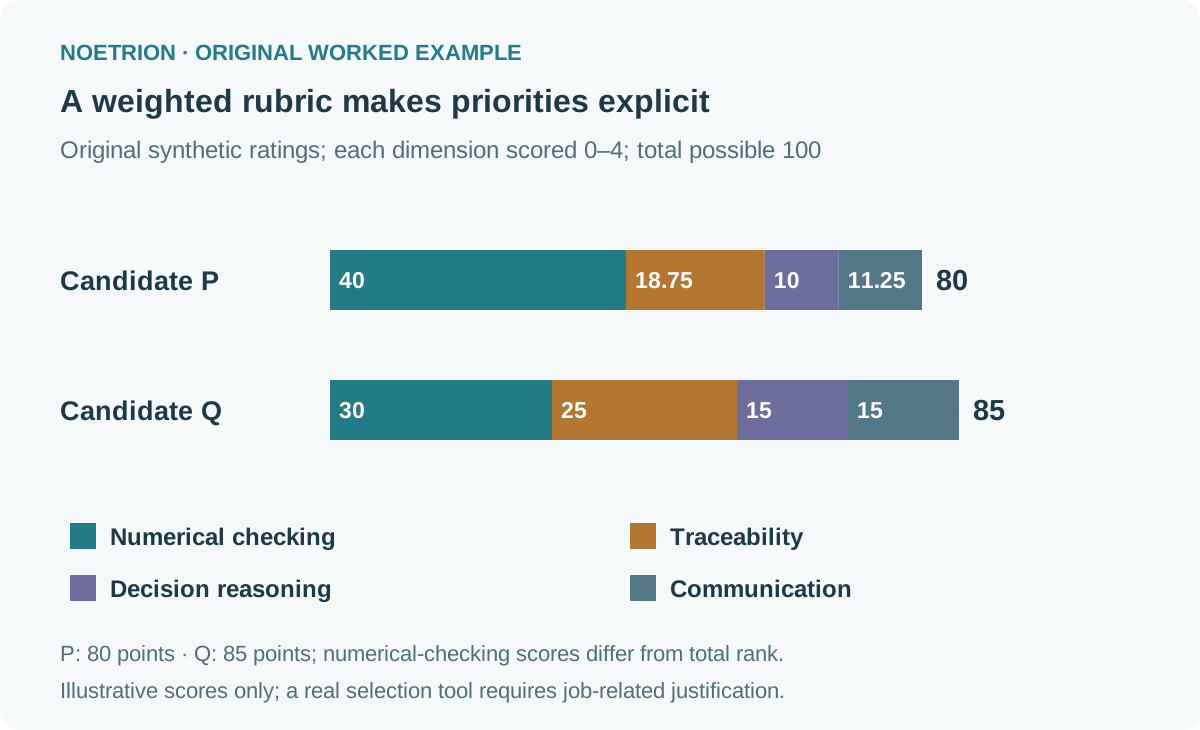
That difference shows why weights are a substantive decision. If perfect arithmetic is indispensable, use a justified requirement rather than quietly changing the weights to favor the preferred candidate.
Separate independent scoring from the debrief
Have reviewers score the same artifact against the same anchors before discussion. Record brief evidence for each score. A statement such as “noticed the C discrepancy but omitted the corrected total” is more useful than “seems analytical.”
Then use a short, standardized debrief: ask the candidate to explain one correction and respond to one new condition. For example, “The reported revenue included a $60 delivery fee not shown in the table. What would you verify before changing it?” The strongest answer may revise the initial conclusion after checking the reporting definition.
OPM's structured-interview guidance links interview questions to critical job competencies and predetermined evaluation criteria. Applying the same discipline to follow-up questions helps keep a debrief from turning into an improvised personality contest. It does not remove every source of bias.
Make tool rules match the skill you want to observe
If everyday work permits calculators and documentation, banning them may add an irrelevant memory demand. If the task specifically measures independent reasoning without an assistant, allowing undisclosed assistance changes what the score means. State the rule at the point of use.
Avoid claiming to identify prohibited AI use from polished writing, a pause, or an unusual phrase. A suspicious impression is not a validated finding. Use clear conditions, proportionate administration, and an explanation stage rather than unsupported accusations. Also tell candidates not to upload employer or personal information into unauthorized external tools.
Check accessibility and burden as part of design
The U.S. Equal Employment Opportunity Commission's technical assistance discusses job-relatedness, validation, disparate impact, and reasonable accommodation in employment testing. Its 2007 issue date should not be mistaken for a new 2026 rule. The agency's guidance is U.S.-specific and is not itself a statute or worldwide hiring standard.
For the example here, ask whether speed is genuinely an essential skill or merely a convenient way to shorten the session. Provide accessible instructions and a clear accommodation route. A candidate should not need expensive software to complete a task when the tested competence does not depend on that software.
Keep the exercise proportionate. If substantial custom work is genuinely necessary, clarify compensation and local requirements before assigning it. A simulation should not become unpaid production work. Check applicable local obligations.
A candidate's preparation worksheet
Before the assessment, confirm the deliverable, allowed tools, time, and scoring focus. During practice, use synthetic data and retain a correction log: original value, proposed correction, calculation, and unresolved assumption. Practice explaining a limit without abandoning the task.
Try the report example with C changed to 25 units at $12. The reported $300 is then consistent and the $1,840 total is correct. A candidate who memorized “C is wrong” will fail; a candidate who checks the underlying relationship will adapt.
For hiring teams, finish the pilot with three questions: did the task reveal the entry skill, could reviewers explain their scores, and did capable people understand the instructions? For candidates, ask a parallel question: does the artifact show what I checked and why the conclusion follows? That shared focus makes a work sample a clearer observation of work rather than a competition in presentation.
The workplace task audit provides another way to connect responsibilities to observable work.
Primary sources and evidence boundaries
- OPM, Work Samples and Simulations, official assessment guidance, checked October 20, 2026; no publication date displayed.
- OPM, Structured Interviews, official guidance on job-related questions and evaluation, checked October 20, 2026.
- Ashlagi et al., The Evaluation Bottleneck in Hiring, September 24, 2026 preprint. Theoretical model, not demonstrated outcomes of the example assessment.
- EEOC, Employment Tests and Selection Procedures, December 1, 2007 technical assistance, checked October 20, 2026. U.S. scope; not individualized legal advice.
All candidate scores, task data, thresholds, and worksheets are original synthetic illustrations. They have not been validated for an actual hiring decision.