Workplace AI: Audit Tasks and Negotiate a Better Job Design
Map workplace AI tasks, review time and team handoffs before changing a role. Use ASEAN evidence to negotiate responsibility, workload and learning time.
An assistant drafts a customer reply in seconds. The employee still checks the order, confirms the delivery date, removes an unsupported promise, and sends the message. Meanwhile, a supervisor begins receiving more exceptions to approve. Calling the whole role “automated” hides how the work has moved.
A workplace AI task audit makes that movement visible. It records what a role produces, how quality is checked, who carries responsibility, and where a changed process creates work for others. The goal is a negotiated job design: an explicit agreement about tasks, decision rights, workload, and learning opportunities.
Read ASEAN exposure figures as a starting point
The ILO's July 2026 ASEAN brief estimates that 22.9% of regional employment, nearly 80 million workers, was in occupations with more than minimal generative AI exposure in 2025; 3.3% was in the highest category. Exposure describes technical possibilities for tasks, rather than observed job losses. The brief finds no widespread disruption in the employment trends it examines, while noting emerging pressures for some young workers. These trends cannot establish AI causality. ILO ASEAN brief.
The underlying May 2025 index combines task assessments, expert input, and model predictions. It describes occupational exposure, not a measurement of your employer's deployment or your probability of dismissal. ILO refined index.
The regional brief uses different years for country comparisons; Indonesia's figure uses 2023 data. Infrastructure, adoption, and preparedness differ across ASEAN. Regional findings cannot establish uniform outcomes across Indonesian workplaces.
Use these findings to identify questions worth investigating locally. A department with approved tools and clean records faces different implementation choices from a small enterprise whose orders arrive through inconsistent messages.
Map deliverables before rating AI potential
Pick one role and one representative work cycle. Ask the person doing the work to describe outputs and exceptions. A job description can miss the small coordination tasks that keep a process functioning: clarifying an incomplete request, locating the current policy, or correcting another team's record.
For every task, record its trigger, inputs, output, recipient, and acceptance condition. “Handle customer service” is too broad. “Prepare an order-status response using the order record and confirmed shipping update” is concrete enough to inspect.
Here is an invented task map for an order-support coordinator. It illustrates a design method, not an observed company or measured ASEAN productivity result.
| Task | Proposed AI contribution | Acceptance condition | Accountable person |
|---|---|---|---|
| Classify incoming requests | Suggest a routing category | Correct category and urgency | Coordinator |
| Draft status replies | Draft from approved records | Every status claim matches the record | Coordinator |
| Resolve mismatched order details | List conflicts for inspection | Identity and order details reconciled | Coordinator; escalate unresolved conflicts |
| Approve unusual refunds | Organize facts in a brief | Authorized decision and recorded reason | Supervisor |
| Update recurring-error log | Group similar cases | Traceable case IDs and accurate categories | Coordinator; operations team receives log |
Separate capability from permission. A tool may produce a convincing refund decision without having authority to make it. Write “may prepare a brief” and “may approve” in different fields.
Measure work where it actually lands
For a small pilot, compare similar tasks under the existing and proposed workflows. Record volume, task difficulty, and tool version. Include verification, correction, and coordination as working time. Track waiting separately: a faster draft can still spend longer awaiting approval.
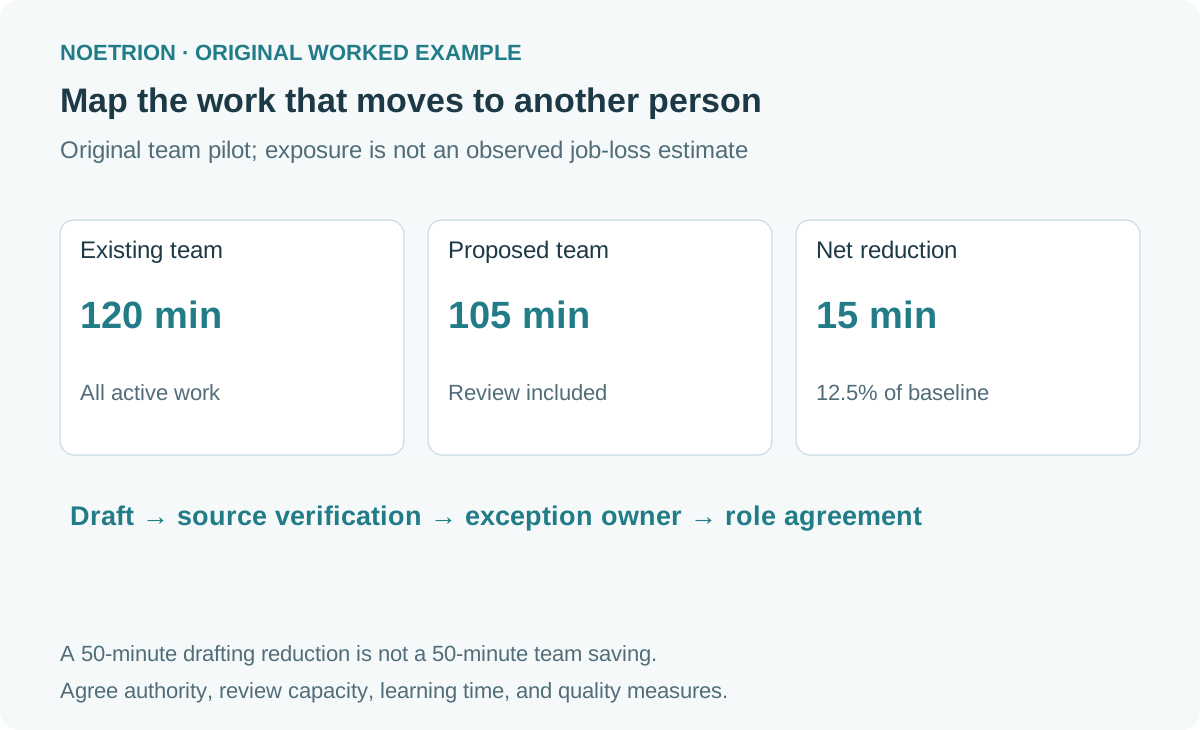
In this hypothetical 20-reply batch, the numbers refer to active minutes across the team, not elapsed turnaround time.
| Work component | Existing process | Proposed AI process |
|---|---|---|
| Preparing replies | 80 | 30 |
| Checking source records and claims | 20 | 40 |
| Correcting replies | 10 | 15 |
| Supervisor coordination | 10 | 20 |
| Total active team time | 120 | 105 |
Draft preparation falls by 50 minutes, but total team time falls by only 15 minutes, or 12.5%. The important role-design question is who receives the additional checking and coordination work. Those 15 minutes are recovered capacity in this example, not a cash saving or a reason to raise every employee's target by 12.5%.
Record quality alongside time: incorrect status claims, unauthorized promises, unnecessary escalations, and reopened cases. Define each before the comparison. A shorter reply that causes a second customer contact may simply move the work into the next batch.
Name the reviewer and the exception owner
“Human review required” is incomplete. Name the person, the source they must inspect, and the action they can take. A reviewer without access to the shipping system cannot meaningfully verify an arrival-date claim.
For routine status replies, the coordinator can compare the order ID, dispatch status, and stated date with authorized records. For a mismatch, pause the message and send the supervisor a compact handoff: case ID, conflicting fields, attempted checks, unresolved question, and required decision.
Avoid treating an AI confidence statement as a handoff criterion. Use observable conditions instead: missing order ID, contradictory delivery records, a request outside the refund policy, or an unavailable source system. The supervisor then knows why the case arrived.
Agree what happens when the supervisor's queue fills. Options include a backup owner, a capped pilot volume, or a return to the existing process. Adding an approval gate without allocating review time creates a dependency without providing capacity.
Negotiate the role as a package
Bring the task map and pilot record to the worker–manager discussion, with worker representatives where appropriate. Start with the deliverable and the evidence. “Drafting became faster, checking increased, and the supervisor received twice the coordination time” is a more useful basis for redesign than “AI improves productivity.”
The following is an original discussion template, not a statement of employment law or a guaranteed entitlement.
| Agreement item | Concrete question to settle |
|---|---|
| Scope | Which task outputs may use the tool, with which approved inputs? |
| Authority | Who can send, amend, reject, and approve each output? |
| Workload | How much verification and exception time is included in capacity? |
| Learning | Which supervised tasks preserve development of judgment? |
| Monitoring | Which quality measures are collected, and who can inspect them? |
| Review and rollback | What evidence triggers revision or return to the previous process? |
Put the answers in writing and set a review point appropriate to the work cycle. If the proposed change adds final-signoff responsibility, discuss the training, support, and role recognition needed for it. Do not silently attach greater responsibility to an unchanged output quota.
The ILO brief emphasizes job quality, autonomy, and social dialogue alongside adoption. This template translates those concerns into a local design conversation; the particular fields and pilot rules are this article's suggestions.
Keep skill development inside the workflow
An employee who only forwards polished drafts may have few opportunities to learn how decisions are made. Make learning tasks visible in the role agreement. For example, reserve selected cases for independent preparation, then compare them with a supervisor's reasoning. Allocate time for discussing why a refund exception was approved or rejected.
This does not require withholding the tool from all routine work. It requires identifying the judgment the role must maintain: detecting inconsistent records, interpreting policy boundaries, and recognizing when the available evidence is insufficient.
Also inspect the receiving team's role. If operations now receives machine-grouped error reports, it needs source links and a way to challenge a category. Otherwise, support may save preparation time while operations spends more time reconstructing cases.
Evaluate the whole handoff. A redesign is more credible when each team can explain what it receives, what it checks, and what it owns.
Decide what to keep, change, or stop
At the review point, compare the agreed measures with the pilot record. Keep a task change when its output is useful, quality is acceptable, and the assigned people can sustain their workload. Revise it when a fixable handoff or input problem creates unnecessary work. Stop or narrow it when required verification is unavailable or important errors remain unresolved.
Use a concrete closing record: “AI drafts routine status replies; the coordinator verifies records and sends them; refund exceptions remain with the supervisor; mismatches enter a named queue; review time counts toward workload.” Then name the remaining uncertainty and the next observation needed.
For a first audit, choose one recurring task, define its acceptance condition, and map one downstream recipient. That gives you a small, reviewable agreement to negotiate. An occupational exposure score starts the conversation; the observed process determines which redesign is worth keeping.
Sources and scope
- ILO: Generative AI and labour markets in ASEAN, July 2026. Regional 2025 estimates, mixed-year country comparisons, and discussion of adoption and work organization.
- ILO: Generative AI and Jobs—A Refined Global Index of Occupational Exposure, 20 May 2025; full working paper. Task-based measurement methodology.