The Misinformation Effect: How Later Details Can Rewrite Recall
Understand how post-event suggestions influence memory reports, why confidence and accuracy can diverge, and how interviews can reduce contamination.
Reviewed October 12, 2026.
Understand how post-event suggestions influence memory reports, why confidence and accuracy can diverge, and how interviews can reduce contamination.
| Concept | What it means | Important limit |
|---|---|---|
| Encoding | Initial perception and attention | Not every detail is stored |
| Post-event information | Later questions, media, or discussion | Can introduce plausible alternatives |
| Source monitoring | Judging where a detail came from | Familiarity can be misattributed |
| Confidence | Subjective certainty in a report | Depends on procedure and feedback |
1. Memory reconstructs an event from incomplete traces
People do not store a continuous, high-resolution recording of experience. Attention selects some information, perception is limited, and later retrieval rebuilds an account from surviving details, knowledge, expectations, and cues. Reconstruction is normally useful: it lets the mind organize meaning rather than archive every sensation. The same flexibility creates vulnerability. When plausible new information appears after an event, it can compete with, supplement, or alter what a person later reports as having seen.
2. The classic experiment separates event from suggestion
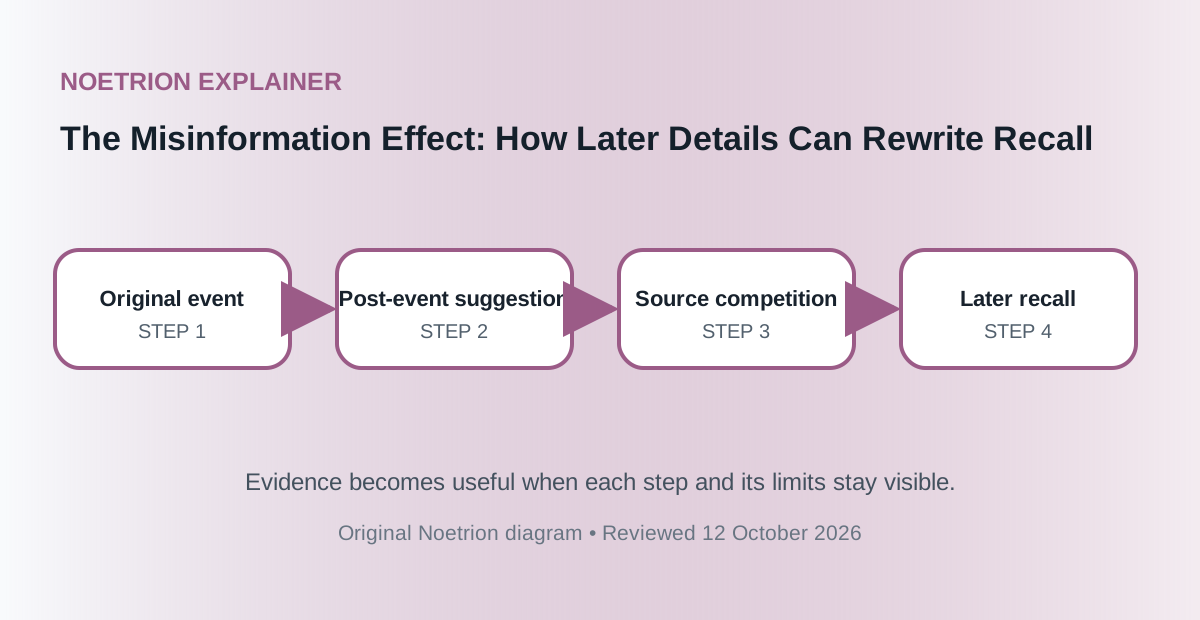
A misinformation study presents an event, supplies post-event information that is accurate or misleading, and later tests memory for the original. Across many variants, participants exposed to misleading details are more likely to report them. The effect is not evidence that every memory can be implanted or that testimony is worthless. Its size depends on timing, plausibility, attention, testing, warnings, and individual differences. Controlled experiments establish a causal influence under defined conditions; application to a particular case requires procedural detail.
3. Suggestive questions can contain the answer they seek
A question can presuppose a detail, offer limited alternatives, or use language that implies severity. Repeated questioning may increase familiarity with the suggested version. If an interviewer knows the suspect or expected story, subtle verbal and nonverbal cues can guide the witness. Open-ended prompts such as “Tell me what happened” reduce imposed content, while follow-up questions should avoid facts not already supplied. Recording the first interview preserves the sequence through which the account developed.
4. Source monitoring explains some false recollection
At retrieval, a person must decide whether a detail came from perception, imagination, a news report, another witness, or an interviewer. A vivid or familiar detail may feel perceptual even when its source was later conversation. Similar sources are especially difficult to distinguish. Asking people to identify where each detail came from can improve scrutiny, but it cannot guarantee correction. Researchers therefore distinguish memory for content from memory for source, and measure both rather than treating recall as a single capacity.
5. Co-witness discussion creates social contamination
Witnesses often talk, view social media, or encounter news before formal interviews. Another person’s confident account can supply details that become incorporated or influence reporting through conformity. Agreement between witnesses is then not necessarily independent corroboration. Investigators can separate witnesses promptly, document exposure to outside information, and ask about discussion history. Analysts should map information pathways before counting matching statements as multiple sources. Independence is a property of evidence collection, not simply the number of people.
6. Confidence is shaped by procedure
Confidence can be informative when collected immediately under fair conditions, but it is not a permanent property of a memory. Confirming feedback, repeated identification, learning that another witness agreed, or courtroom rehearsal can inflate certainty after the initial decision. Later confidence should not be projected backward. Good procedures record the witness’s own confidence in their own words at the first identification and preserve instructions, response time, lineup administration, and any feedback.
7. Warnings can help without erasing the effect
Research indicates that warnings about possible misinformation can improve discrimination in some circumstances, especially when they encourage careful source retrieval. A vague instruction to “try harder” is not equivalent to identifying a contamination risk. Warnings given before exposure may change attention, while postwarnings act during retrieval. Benefits vary and may come with skepticism toward true details. A warning is therefore one safeguard within a procedure, not a method for restoring an untouched original memory.
8. Everyday use requires calibrated language
The misinformation effect applies beyond courts: family stories, viral clips, captions, and repeated corrections can shape what feels remembered. To protect memory, record observations before reading commentary, distinguish notes from later interpretation, and avoid repeating false details unnecessarily. When evaluating a report, ask when it was first recorded, what the person encountered afterward, and whether questions introduced information. The responsible conclusion is probabilistic: contamination risk changes evidential weight, not necessarily the person’s honesty.
Conclusion
The misinformation effect shows that remembering is an active inference shaped by what happens after an event. Fair interviewing, independent witnesses, early documentation, source questions, and controlled feedback protect accuracy. The lesson is not that memory always fails, but that trustworthy recall depends partly on the information environment created around it.