Sleep and Memory: What Consolidation Means for Learning
Separate encoding, consolidation, and retrieval, and turn sleep research into a realistic study routine without overstating causality.
Reviewed October 10, 2026. This educational article is not medical advice; persistent sleep problems deserve qualified clinical care.
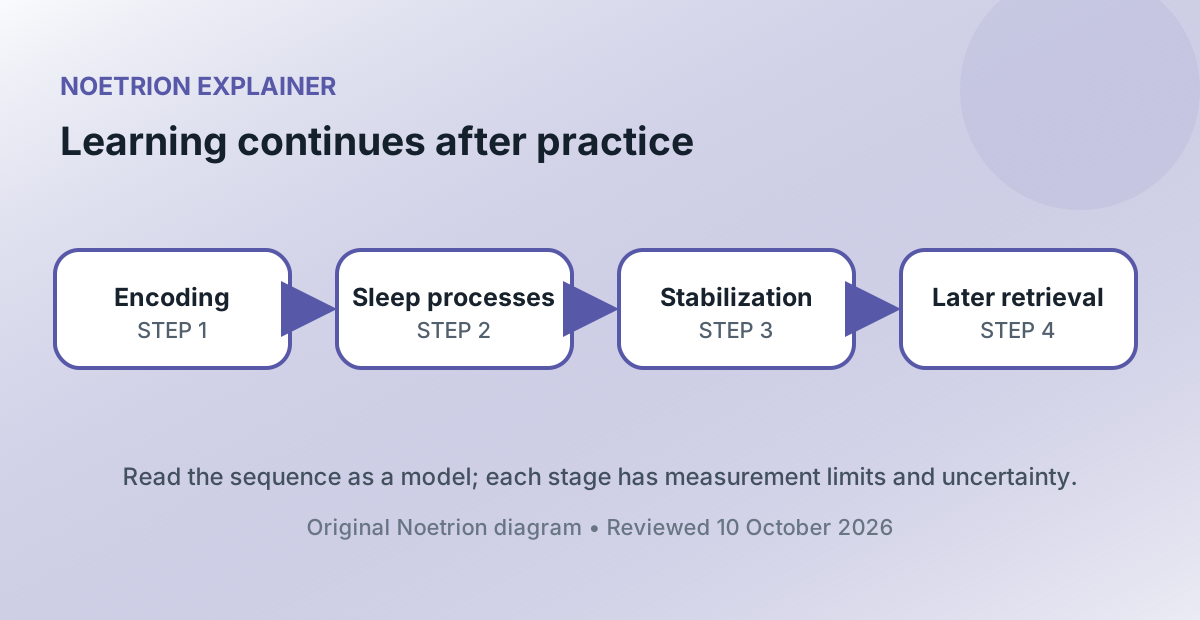
Learning does not end when a book closes. A new memory must first be encoded, then stabilized and integrated over time, and later retrieved. Sleep participates in these processes, but the popular slogan “sleep saves everything you studied” is too simple. Different tasks, sleep stages, delays, and experimental designs produce different effects.
The practical conclusion is still important: sacrificing sleep to extend passive study can harm attention during learning and the later retention of material. Sleep is not a substitute for practice. It is one condition under which effective practice can become durable.
1. Separate three stages of remembering
Encoding is the initial formation of a representation while reading, listening, solving, or practicing. Consolidation refers to processes that stabilize and reorganize memories after initial learning. Retrieval reconstructs access to the stored information when it is needed.
These stages interact. A tired learner may encode poorly, leaving less material to consolidate. A strong memory may appear inaccessible when the retrieval cue differs from the learning context. A test score alone cannot tell us which mechanism failed.
| Stage | Example failure | Useful response |
|---|---|---|
| Encoding | Attention wandered during the explanation | Shorten the session and generate examples |
| Consolidation interval | Sleep was curtailed after learning | Protect a realistic sleep opportunity |
| Retrieval | Notes feel familiar but an answer cannot be produced | Practice recall without looking |
| Transfer | Definition is remembered but not applied | Solve varied problems and explain choices |
2. Sleep is an active biological state
Sleep cycles through non-rapid-eye-movement and rapid-eye-movement stages. Brain activity, neuromodulation, and physiology change across those stages. Research links features such as slow oscillations and sleep spindles during non-REM sleep with memory processing, while REM sleep has been studied in relation to emotional and procedural learning.
It is risky to assign one simple memory function to each stage. Human memories are not files moved by a single brain process. Studies use different tasks and measures, and correlations between a sleep feature and performance do not by themselves establish that the feature caused the improvement.
3. Sleep before learning and sleep after learning both matter
Sleep before a lesson supports alertness and attention. Acute sleep deprivation can impair working memory, vigilance, and the ability to encode new information. Sleep after learning provides an interval in which newly encoded material is no longer competing with continuous waking input in the same way.
Experiments often compare retention across sleep and wake intervals, nap and no-nap conditions, or normal and restricted sleep. Time of day, interference, participant expectations, and baseline ability can complicate these comparisons. Well-designed studies attempt to control those factors, but no single experiment establishes a universal optimum for every learner.
4. Consolidation is not a photographic backup
Memory changes as it stabilizes. Details can be lost, related knowledge can become integrated, and later retrieval can modify a memory. Sleep-associated consolidation is therefore not a promise that every studied sentence becomes permanently available.
What is learned remains decisive. Meaningful organization, prior knowledge, attention, feedback, and retrieval practice all affect the representation available for later processing. Repeatedly reading confusing material until midnight does not become effective merely because sleep follows.
5. Cues and reactivation are research tools, not study hacks
Some laboratory work uses targeted memory reactivation: a sound or odor paired with learning is presented again during sleep, and later memory is compared. These findings are scientifically interesting because they test whether specific memories can be biased during offline processing.
They do not justify blasting lecture recordings all night. Uncontrolled sound can disrupt sleep, cue timing is technically difficult, and the effect sizes and eligible memory tasks vary. Protecting sleep and improving waking practice are more defensible student strategies than trying to engineer sleep stimulation at home.
6. A useful schedule combines retrieval and sleep
After learning a topic, close the source and write what you can reproduce. Check the result, correct errors, and stop before exhaustion turns the session into rereading. Revisit the topic the next day and again after several days. This schedule creates retrieval attempts across time while preserving sleep between them.
If an exam is near, prioritize representative questions and error review. An all-night session adds waking hours but can reduce next-day attention and retrieval. That trade-off is especially poor when the assessment requires reasoning rather than recognition.
7. More time in bed is not the only variable
Sleep opportunity, actual sleep duration, timing, continuity, and regularity are related but distinct. A person can spend eight hours in bed while experiencing repeated awakenings. Circadian timing affects when sleep and alertness occur, so a schedule that is possible on one day may be difficult to sustain.
Consumer devices estimate sleep using movement and physiological signals. They can support personal reflection, but their stage labels are not equivalent to clinical polysomnography. Avoid letting a single device score create anxiety or overrule how you function across repeated days.
8. Evidence applies to groups before individuals
Many sleep studies report average differences. Individuals vary in response, and a statistically significant mean effect does not determine what happened to one student on one night. Small samples, selective reporting, and varied protocols also limit sweeping conclusions.
Look for converging evidence across controlled experiments, longitudinal studies, and mechanistic research. Check whether the measured outcome was immediate recall, delayed recall, skill performance, emotional memory, or school grades. These outcomes cannot be substituted freely.
9. A practical learning protocol
Use a brief preview to establish structure, then work through examples actively. End with two to five minutes of unaided recall. Record errors as prompts for the next session. Schedule a next-day review and a later review rather than one giant block. Keep the final pre-sleep period calm enough that the routine is sustainable.
The central lesson is not that sleep performs learning for you. Sleep protects the capacity to learn and supports the biological processes through which some memories become more stable. High-quality encoding, spaced retrieval, feedback, and sleep form a system; removing one part makes the others work harder.