NVIDIA's 14-Day Data Centre Claim Starts With a Prepared Site
Read NVIDIA's October 2026 DSX POD announcement with its conditions intact. Map site readiness, factory integration and commissioning on a realistic critical path.
A modular data centre arrives with its racks, piping and cabling already integrated. That can remove a difficult stretch of onsite work. It cannot make a missing power connection, an unfinished foundation or an unavailable network route disappear.
That distinction is central to NVIDIA's October 21, 2026 DSX POD announcement. The company says its partner-built, containerized reference design can reduce deployment at a prepared site from six months to as little as fourteen days, with worldwide delivery expected in early 2027. These are vendor claims and forward-looking availability statements, not independently measured results for every project.
The useful engineering lesson is how factory integration changes the project schedule. This article builds an original critical-path example without treating a product announcement as a universal construction guarantee.
What moves into the factory
NVIDIA's technical explanation describes coordinated compute, network, storage, power, cooling and mechanical integration. More assembly and testing occurs before shipment while the site team prepares external infrastructure. The explanation explicitly retains onsite connections and commissioning.
A manufacturer can control tooling, repeat procedures and test an integrated unit before transport. Those are plausible mechanisms for improving repeatability. Their actual schedule and cost effects depend on the delivered design, regional engineering and project conditions.
Avoid reading “factory tested” as “nothing can fail after delivery.” Transport, final connections, site conditions and system interactions still create acceptance questions.
Draw the schedule boundaries first
A deployment duration needs a defined start and finish. Does the clock start when a project is approved, when equipment is ordered, when a unit reaches the gate, or when the site passes a readiness check? Does it stop at first power-on or at accepted production service?
| Milestone | Evidence that makes it meaningful |
|---|---|
| Project approval | Scope, funding and accountable sponsor |
| Site ready | Accepted interfaces and completed prerequisite work |
| Factory release | Configuration record and test results |
| Delivered | Receipt and transport-condition checks |
| Commissioned | Integrated tests against acceptance criteria |
| Production accepted | Service capacity available under the agreed conditions |
Two suppliers can quote different durations while performing similar work if their clocks start at different milestones. Normalize the comparison before calculating a saving.
Work a parallel schedule
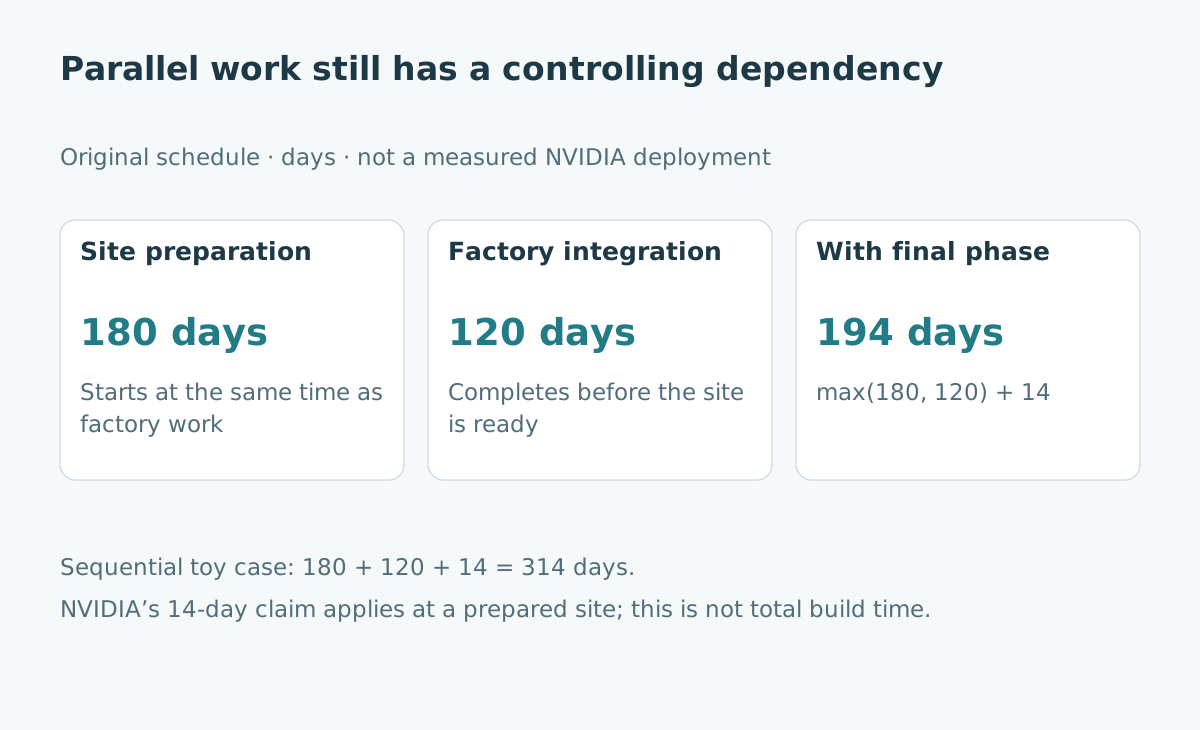
Assume site preparation takes 180 days and factory integration takes 120 days, starting together. When both must finish before delivery and hookup, the prerequisite duration is the maximum: 180 days. Add a modeled fourteen-day final phase and the overall duration is 194 days.
If the same preparation and integration were done strictly in sequence, this simplified arithmetic would be 180 + 120 + 14 = 314 days. Parallel work saves 120 days in the toy schedule. It does not make the total fourteen days.
| Original planning case | Prerequisite duration | Final phase | Total |
|---|---|---|---|
| Strictly sequential | 180 + 120 = 300 days | 14 days | 314 days |
| Parallel prerequisites | max(180, 120) = 180 days | 14 days | 194 days |
| Parallel, site delayed 60 days | max(240, 120) = 240 days | 14 days | 254 days |
This is a dependency example, not a claim that a real conventional build has those exact phases. Real projects also have design approvals, procurement lead times, transport and contingent work that may overlap only partly.
Identify the path that controls completion
In the parallel case, the factory finishes on day 120 and waits for the site until day 180. Reducing factory work by another twenty days does not move completion unless another dependency changes. Reducing site preparation by twenty days does, under these assumptions.
That observation helps teams direct effort. A visible container manufacturing milestone may attract attention while an external utility approval determines the actual service date. Track both, and ask which unfinished prerequisite currently controls the finish.
The controlling path can change. If the factory slips past the site date, manufacturing becomes the constraint. Review the schedule as evidence changes rather than treating the first diagram as a permanent truth.
Turn readiness into an interface contract
A readiness checklist should identify the required power, cooling, network, physical access and other site interfaces, with an owner for each. The specification must come from the actual supplier and qualified project engineers; a generic article cannot set electrical or mechanical design requirements.
Record how each interface will be accepted. “Power ready” can conceal a difference between installed equipment and an approved, usable service. “Cooling ready” should connect to the required operating conditions, not merely the presence of pipes.
Where the factory and site teams work independently, use change control. A late interface revision can invalidate work already completed elsewhere. The benefit of parallel execution depends partly on keeping those interfaces stable enough to work against.
Make commissioning a useful finish line
A system that powers on may not yet meet the promised workload, availability or monitoring requirements. Define production acceptance around the service the buyer needs: representative tasks, expected capacity, failure behavior and the evidence needed to approve handover.
Include integration and recovery tests, not just a favorable benchmark. Confirm that monitoring can distinguish component health from application performance. A complete handover should identify configuration, support responsibilities, spare-part arrangements and unresolved limitations.
An early performance result should state its conditions. A throughput number without model, workload, software version and resource limits is difficult to use in an operating plan.
Connect schedule claims to cash carefully
Finishing earlier can create value if demand and operational readiness allow useful service to begin earlier. It can also bring forward payments or leave capacity idle. Do not convert an earlier technical milestone directly into revenue without an explicit demand assumption.
For a business case, compare schedule scenarios with the same service scope. Include financing, site work, operating costs and uncertainty about utilization. Separately identify the value of repeatability: a design may reduce schedule variance even when its best-case date is not the shortest.
A buyer's self-check
A supplier offers fourteen-day installation, while your utility connection is expected in nine months. Which date should appear in the first revenue plan? A date derived from the full dependency schedule and acceptance process, with uncertainty shown. The installation quote is one input.
For complementary electrical reasoning, read grid battery sizing. In both cases, the impressive headline number becomes useful only after its boundary is defined.
Sources and scope
- NVIDIA newsroom: DSX POD announcement, October 21, 2026.
- NVIDIA technical explanation of DSX POD, October 21, 2026.
Checked October 22, 2026. Product timing is attributed to the vendor. All project schedules and business questions are original teaching examples, not independent performance validation.