A Clean Dependency Scan Does Not Prove Your Node.js Runtime Is Patched
Understand the October 2026 Node.js Brotli fix, separate package checks from runtime evidence, and build a deployment inventory that proves which process changed.
The package scanner is green, the release dashboard says complete, and a worker that processes uploaded files is still running yesterday's Node.js executable. All three statements can be true. Security maintenance becomes unreliable when the evidence answers a different question from the one the team thinks it asked.
The Node.js security release of 21 October 2026 makes that distinction especially practical. It addresses CVE-2026-111497, an out-of-bounds write in the bundled Brotli decoder. The advisory says attacker-supplied Brotli input decompressed through node:zlib can cause memory corruption, including possible remote code execution. It lists the affected supported release lines as 22.x, 24.x and 26.x, and provides security releases 22.23.4, 24.22.1 and 26.12.1 respectively.
Those are the release versions for this advisory, checked on 24 October. A later supported patch may supersede them. Node.js rates this issue High; this article uses the project's severity wording rather than combining ratings from different organizations.
Separate the package from the executable
A dependency lockfile describes selected application dependencies. The runtime that executes those packages is a separate deployed artifact. A result from one inventory should not be silently used as evidence about the other.
For this incident, the library involved is bundled into Node.js. Changing a JavaScript package version is therefore not the same operation as replacing the runtime. The Node.js process documentation describes process.versions, which exposes the running process's component versions. process.version identifies its Node.js version.
A workstation's version output is useful for that workstation. It says little about a container built last week, a managed runner with a pinned image, or an old process that has not restarted. Always attach the evidence to the environment and process that matters.
Draw the reachable input path
Begin with the data path, not the most alarming headline. Identify services that accept or obtain compressed data, the component that performs decompression, and the runtime executing it. Include jobs that download remote files as well as HTTP request handlers.
This inventory is a defensive scoping exercise. It is not necessary to generate malformed input to prove a runtime's version. A harmless known-good compressed fixture can support a normal-function regression check without becoming an exploit test.
| Question | Evidence to collect | Common gap |
|---|---|---|
| Which runtime executes this role? | Deployment identity and running version | Developer shell checked instead |
| Can untrusted data reach decompression? | Reviewed application and library path | Only direct imports searched |
| Was the process replaced? | Start time and deployed artifact identity | Image changed; old worker still running |
| Does normal processing still work? | Known-good fixture and output check | Health endpoint checked alone |
Indirect use deserves attention. An application can invoke a library that performs decompression without a direct node:zlib import in the main handler.
Use a fleet denominator that cannot shrink quietly
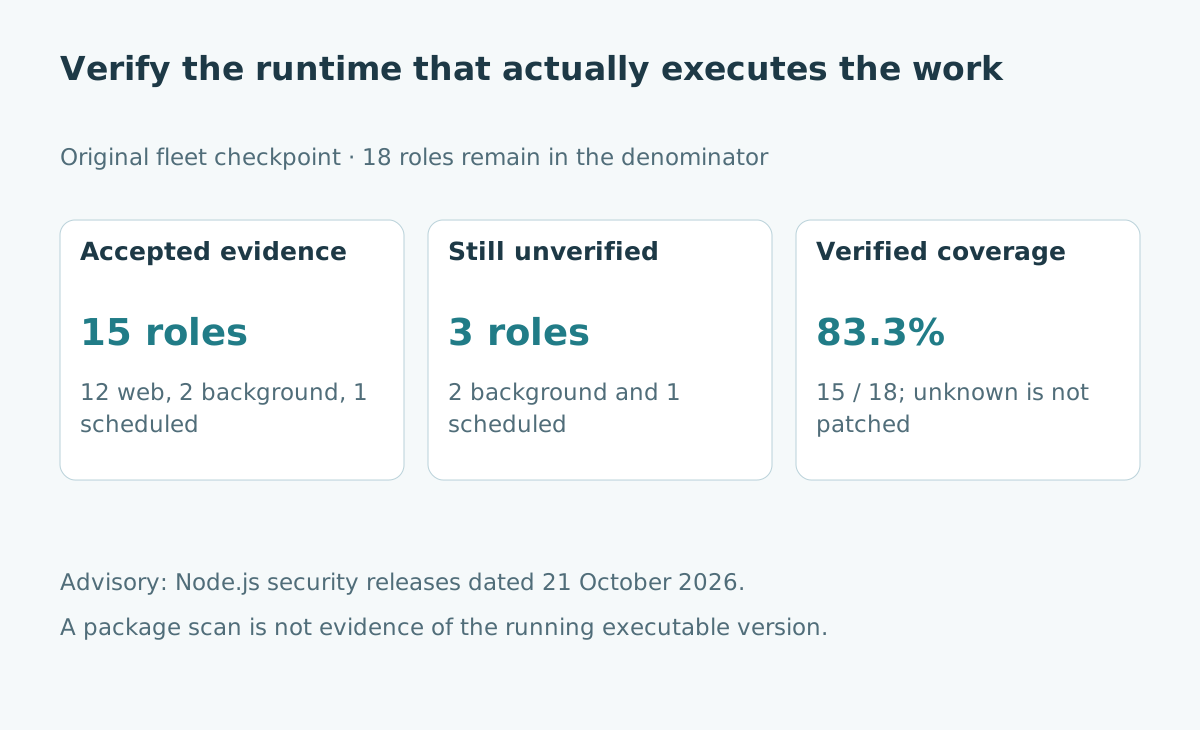
Imagine an original example with 18 application roles: 12 web roles, four background roles, and two scheduled roles. The team has accepted evidence for all 12 web roles, two background roles, and one scheduled role. That is 15 verified roles out of 18, or about 83.3%.
Three roles remain unverified: two background roles and one scheduled role. The dashboard must not remove them because they are inconvenient to inspect. Unknown is a state that needs an owner, not a successful patch result.
If the next background role meets the acceptance rule, the count becomes 16 of 18, or about 88.9%. This is progress, but it still leaves two unresolved roles. Preserve the denominator and show the remaining rows alongside the percentage.
Keep earlier snapshots in the audit history rather than mixing observation times into a single current result. A dashboard assembled from yesterday's workers and today's web processes can otherwise appear more complete than the evidence supports.
Define what counts as verified
Write the acceptance rule before gathering screenshots. For example: the role must run a supported patched release appropriate to its branch; the evidence must identify its deployment; its process must have started from the replacement artifact; and its normal workload check must pass.
A patched package installed on disk does not necessarily satisfy a running-process rule. A fresh build can still deploy an older base image if the build configuration points elsewhere. An image tag can move, so retain an immutable artifact identifier alongside its human-readable tag.
The inventory should have one accountable owner per unresolved role. Include the next action and the date of the next check. Do not leave a row at “platform team investigating” when nobody can tell who will close it.
Plan the replacement as an application change
Replacing a runtime can affect application behavior. Stage a candidate with representative requests, file-processing jobs, and outbound integrations. Record the result using the same artifact you intend to deploy.
Use a normal workload sample that includes the application's actual compression configuration. Also test error handling with ordinary invalid files under the team's approved test procedure. The purpose is to ensure that failures remain observable and contained, not to recreate the vulnerability.
Rollback planning needs care during a security update. Returning to a known vulnerable runtime restores an identified risk. Establish an alternative mitigation or corrected build path with the responsible operator rather than treating any previous image as automatically acceptable.
Check quiet systems after the busy ones
The easiest role to inspect is often the busiest web service. The easiest role to miss is a scheduled task that starts only once a week. Both belong in the inventory if they execute the relevant runtime.
For a scheduled environment, inspect the configured artifact and validate a safe representative run. For a managed service, obtain provider-specific evidence about the runtime version and rollout, rather than assuming that a platform-wide announcement proves this instance changed.
| Inventory field | Example value | Why retain it? |
|---|---|---|
| Role | Archive import worker | Identifies the workload |
| Artifact | Immutable build identifier | Distinguishes deployments |
| Running evidence | Version plus observation time | Shows what executed |
| Normal workload result | Fixture checksum matches | Detects regression |
| Remaining action | Replace second worker pool | Makes the gap actionable |
State what this check cannot prove
A patched-runtime inventory does not establish whether earlier compromise occurred. It does not discover every unrelated vulnerability, verify every package, or certify the application's authorization model. Those are separate questions with separate evidence.
Likewise, reachability review has limits when dependencies or infrastructure are opaque. Record unresolved assumptions explicitly. A role can be patched while its historical exposure remains uncertain; combining those states into a single green badge discards useful information.
Make the next update less expensive
Retain a lightweight record of runtime branch, supported update path, artifact identity, workload owner, and verification method. During the next advisory, the team can update known rows instead of rebuilding the fleet inventory from memory.
The practical outcome is modest but valuable: “patched” becomes a claim about an identified running workload. That is a stronger operational statement than “the scanner passed,” and it gives the next person enough evidence to check the conclusion.
Sources and further reading
- Node.js: 21 October 2026 security releases, checked 24 October 2026.
- Node.js process component versions, checked 24 October 2026.
- Related: PHP update inventory and evidence and package provenance.