OECD's September 2026 Outlook: What Slower Growth and Inflation Risk Mean for You
OECD forecasts 2.9% global growth in 2026 and 3.0% in 2027. Understand energy shocks, inflation, household budgets and business scenarios.
Published-source date: September 23, 2026
A global growth forecast can feel abstract until an energy-price shock changes your transport bill, a business's shipping costs, or the interest rate on a loan. That is why the OECD's September 23, 2026 Interim Economic Outlook matters beyond economics classrooms.
The OECD projects global GDP growth of 2.9% in 2026 and 3.0% in 2027. It describes an economy that has remained resilient despite successive shocks, while warning that energy disruptions, inflation, and policy uncertainty could weaken activity. These numbers are forecasts, not final results for 2026 or 2027.
The headline numbers in context
| OECD projection | 2026 | 2027 |
|---|---|---|
| Global GDP growth | 2.9% | 3.0% |
| United States GDP growth | 2.2% | 2.1% |
| Euro area GDP growth | 1.0% | 1.0% |
| China GDP growth | 4.5% | 4.2% |
| G20 headline inflation | 4.1% | 3.6% |
Source: OECD Economic Outlook, Interim Report, September 2026. All figures in this table are projections. They should not be interpreted as measured year-end outcomes.
A global average does not describe every country equally. An economy that exports energy may experience a different shock from one that imports most of its fuel. Domestic policies, currency movements, wages, and trade exposure also shape the effects households actually feel.
Why growth and inflation can move in uncomfortable directions
When energy becomes more expensive, firms face higher costs for transport, heating, manufacturing, and distribution. Some costs may be passed on to consumers. Households then have less money for other purchases. At the same time, businesses may delay expansion because they cannot predict demand or financing conditions.
The OECD says inventories, alternative supply routes, and support measures helped cushion the energy shock associated with conflict in the Middle East. It also warns that renewed disruptions could bring higher inflation and weaker growth. That combination is especially difficult for policymakers: raising interest rates can restrain inflation but may also discourage borrowing and investment.
How to translate the report into a household budget
You do not need to forecast the oil market. You need to know which parts of your finances are vulnerable. Review essential spending, debt repayments, savings, and discretionary purchases. Identify expenses sensitive to fuel, electricity, food, or interest rates. If income is irregular, test your budget under a lower-income month.
For a student, this might mean separating transport and food money from entertainment spending. For a household with variable-rate debt, it might mean checking how repayments change if rates remain elevated. A forecast is useful when it leads to a resilient plan, not when it produces false confidence.
Scenario planning for a small business
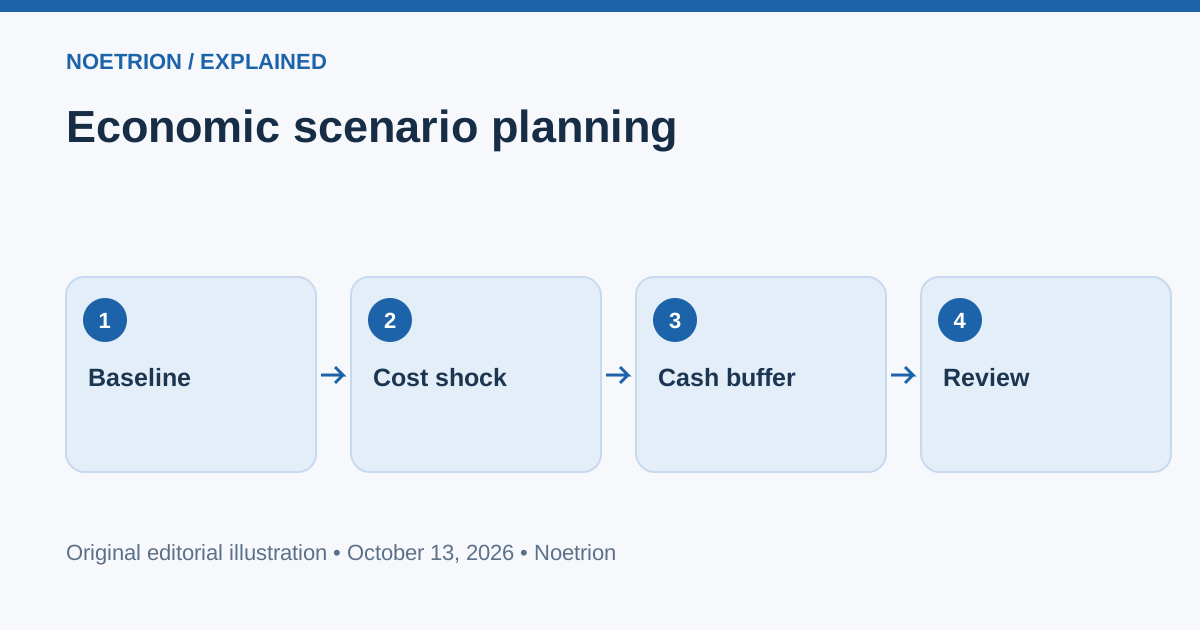
Consider a fictional retailer with $10,000 in monthly revenue and $8,500 in operating costs. Its starting operating surplus is $1,500. Compare three planning cases:
| Illustrative scenario | Revenue | Costs | Surplus |
|---|---|---|---|
| Base case | $10,000 | $8,500 | $1,500 |
| Higher operating costs | $10,000 | $9,200 | $800 |
| Lower demand and higher costs | $9,200 | $9,200 | $0 |
These are hypothetical calculations, not OECD estimates. They show why revenue alone is an incomplete measure of business health. A modest cost shock can erase a large portion of the operating margin.
A sensible response may include building a cash buffer, negotiating supplier terms, improving inventory forecasts, and testing price changes. Avoid making irreversible commitments based on one optimistic forecast.
Three mistakes to avoid when reading economic news
First, do not confuse GDP growth with stock-market returns. A growing economy does not guarantee that a particular investment will perform well. Second, do not confuse falling inflation with falling prices: a positive inflation rate still means the measured price level rises. Third, do not treat a forecast as a promise. The OECD explicitly highlights risks around energy markets, trade, and weather-related supply shocks.
FAQ
Is 2.9% the final global growth figure for 2026?
No. It is the OECD's September 2026 projection.
Does 3.6% inflation in 2027 mean prices fall?
No. It implies a slower rate of increase than 4.1%, assuming the projection holds.
What should an ordinary reader do with this report?
Use it to stress-test spending, debt, and business plans rather than trying to predict every market movement.