An Offline Payment Needs More Than a Phone That Can Display a Balance
Understand offline digital payments through the ECB's October 2026 pilot details, secure hardware, prefunding and an original outage-readiness worksheet.
Educational analysis, not a personal investment or payment recommendation. Check the dated sources and the rules that apply in your jurisdiction.
The network disappears just as a customer reaches the checkout. Their phone still shows a balance. Can they pay? The answer depends on what that balance represents, where the authority to spend it resides and whether the receiving device can verify a transfer without consulting a remote system.
The distinction is timely. The ECB's digital-euro pilot FAQ, updated 22 October 2026, describes offline beta payments using nearby devices, NFC and secure hardware. It also makes clear that preparing a pilot does not itself decide whether a digital euro will be issued. These are specifications for a controlled exercise, not an invitation to download a public digital-euro wallet.
A cached balance, a queued instruction and a locally completed transfer are different things.
Ask what offline actually means
A merchant device might record an instruction while disconnected and submit it later. Another arrangement could allow both payer and payee to exchange spendable value locally. The customer's experience may look similar while the risk and settlement process differ.
The BIS Innovation Hub's Project Polaris handbook, published in May 2023, distinguishes offline modes and stresses that design choices depend on policy and operational requirements. Its discussion is a design framework, not a certification of any deployed wallet.
For a procurement conversation, replace “works offline” with a concrete question: “When both parties lack internet access, what changes on each device, when may the recipient spend the value, and what must happen after reconnection?” That question exposes more than a demonstration in airplane mode.
Prefunding creates a usable outage budget
The ECB's current pilot FAQ says users must first fund the offline device, comparing the preparation step with obtaining banknotes before spending cash. It describes immediate proximity settlement once that device is funded.
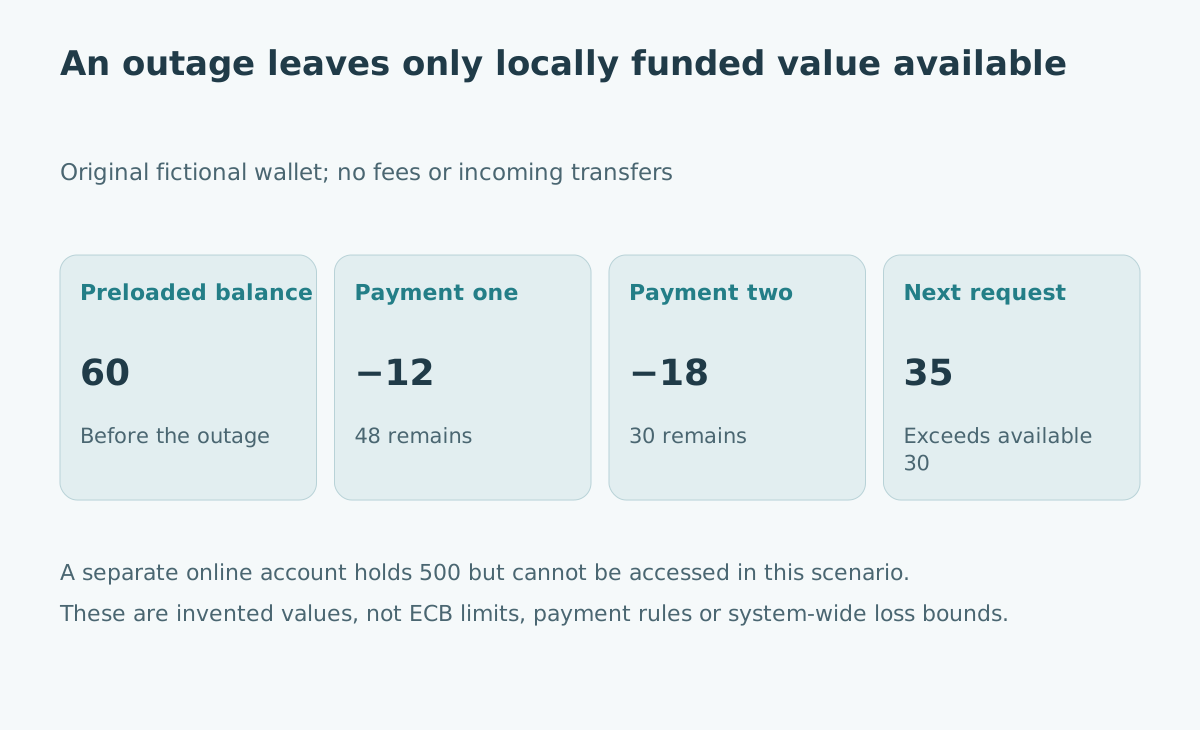
Consider an original fictional wallet with 60 currency units loaded before an outage. The user also has 500 in a separate online account that cannot be reached during the interruption. Under the example's rules, that online balance cannot silently refill the offline wallet.
After valid payments of 12 and 18, the offline balance is 30. A further request for 35 cannot be covered. The customer may be financially solvent and still lack enough locally spendable value. This is an availability constraint in the example, not evidence that a particular payment system has failed.
Read the device requirement as a deployment requirement
The ECB's 9 April 2026 offline-solution presentation separates the software running within a secure element from the software-development kit used for communication and integration. A bank app's interface and the protected payment logic are therefore different components.
That distinction changes rollout questions. Which device models support the relevant hardware? Who provisions it? Who maintains the applet? Can users move value when replacing a handset? A successful interface prototype does not establish answers about hardware availability or lifecycle support.
The current FAQ names embedded secure elements and eSIMs as possible forms. Its security description should be read as the intended protection of eligible components, not proof that every consumer device is suitable or that hardware eliminates every operational threat.
Separate replay prevention from customer confirmation
A robust design needs to stop the same payment instruction from being accepted twice. It also needs to tell an honest customer whether an interrupted exchange completed. Those are related but different requirements.
The Polaris handbook discusses double-spending controls, lost-value cases and interrupted exchanges. It also considers limits and device-side protections. Those concerns explain why the offline feature is a system design problem, not simply a command to save a balance locally.
For an original acceptance test, ask the supplier to interrupt an exchange after each defined protocol stage. Record the state seen by payer and recipient, then follow the documented recovery process. Do not improvise a second payment merely because one screen remained uncertain. The expected outcome must come from the arrangement's rules and implementation, not from this generic checklist.
Test the whole outage journey
Use a worksheet that records what is ready before connectivity fails and what remains possible afterward. The following is an original preparation aid; none of its entries asserts that the digital-euro pilot has a particular unresolved defect.
| Readiness question | Evidence to request | Failure scenario to test |
|---|---|---|
| Is value available locally? | Device funding confirmation | Online funds exist, offline purse is empty |
| Can both devices participate? | Supported hardware and software versions | One device is unsupported |
| Can the receiver verify completion? | Documented confirmation behavior | Connection breaks mid-exchange |
| What limits apply? | Current policy and device parameters | Balance remains but another control blocks payment |
| What happens after the outage? | Recovery and synchronization procedure | Device reconnects after a long interruption |
Power matters too. Losing mobile data is different from losing battery power, a merchant terminal or every local charging option. A resilience claim should specify which disruption was tested and for how long.
A limit is not a measure of fraud losses
The PayOff research preprint, submitted in August 2024, examines additional safeguards when secure hardware fails. Its abstract highlights a trade-off: offline message and storage requirements grow with transactions between online connections. This is research about a proposed design, not a security audit of the ECB pilot. Only the abstract was reviewed here.
Return to the fictional 60-unit wallet. Its initial funding tells us what that honest user can spend under the stated assumptions. It does not prove a maximum loss of 60 for every participant, every attack or the entire issuer. Extending that conclusion requires an explicit threat model and enforceable assumptions.
A useful business review distinguishes normal spending capacity, customer loss exposure, operator loss allocation and systemic counterfeit risk. Combining them into a single “safe up to this amount” label can conceal the very question decision-makers need answered.
Plan reconnection without promising unlimited recovery
After service returns, support teams need a documented way to handle uncertain payment status, replacement devices and any required updates. The evidence collected must match the architecture and privacy rules; do not assume that every offline design uploads a complete customer transaction history.
An original merchant drill can begin with a preloaded test device, include several legitimate purchases and one deliberately interrupted attempt, and end with a reconciliation against the arrangement's permitted records. Record who owns each exception and how the customer receives a clear outcome. Recovery is a product requirement that needs testing, not a comforting phrase in a launch deck.
For the broader issuer and money distinctions, read the digital-euro pilot overview. The narrower question here is whether a specific device-to-device payment journey remains usable under a defined outage.
Sources and evidence limits
- ECB, FAQs on the digital euro pilot, updated 22 October 2026, especially questions 2, 74 and 75; checked 28 October 2026.
- ECB, The offline digital euro, 9 April 2026 presentation; checked 28 October 2026.
- Beer and colleagues, PayOff, arXiv preprint submitted 13 August 2024; abstract reviewed 28 October 2026.
- BIS Innovation Hub, Project Polaris handbook, May 2023, selected offline-mode and risk-management sections; checked 28 October 2026.
The balance exercise and test worksheet are original illustrations. No final public digital-euro holding limit, universal refund guarantee, launch date or implementation defect is inferred from them.