Digital Euro in 2026: What the Pilot Means for Payments
The ECB's digital euro pilot is planned for 2027, not a public launch in 2026. Understand the timeline, payment design and open questions.
Updated October 13, 2026 · Fintech explainer
When people hear "digital euro," many picture a cryptocurrency issued by a central bank. Others assume Europeans will soon have to replace cash with an app. Neither description captures the current project. The European Central Bank is preparing infrastructure and testing payment experiences, but it has not announced a public digital-euro launch.
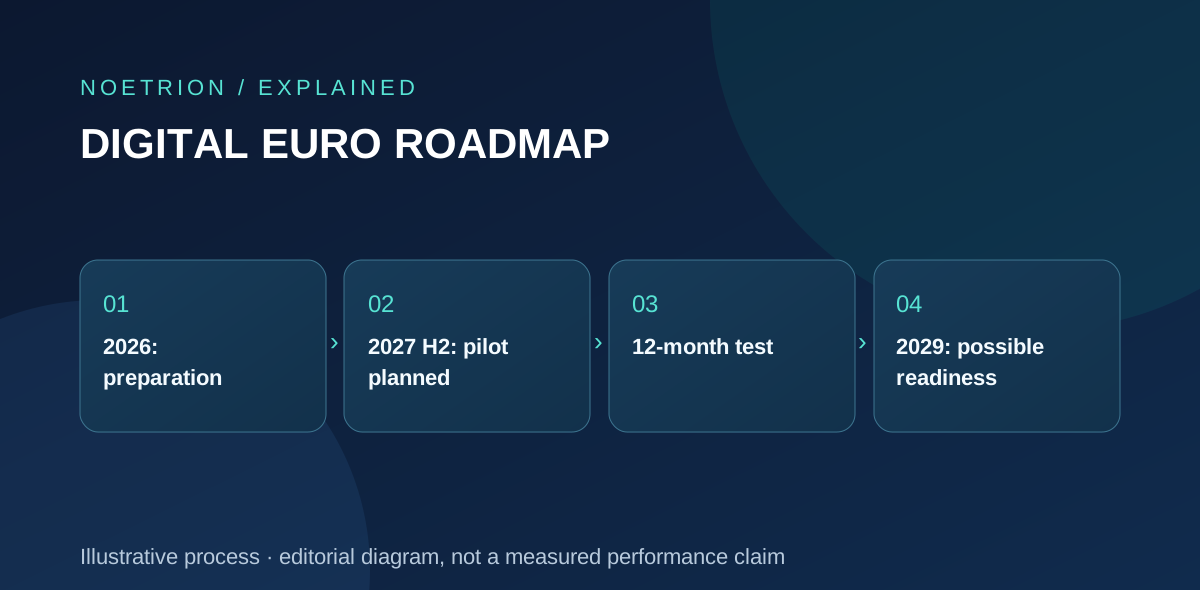
The ECB's digital euro pilot page says it plans a 12-month pilot starting in the second half of 2027. The ECB aims to be technically ready for a potential first issuance in 2029, assuming the relevant regulation is adopted in 2026. Crucially, the final decision to issue would come only after legislation is adopted. A readiness target is not a launch commitment.
What is a central bank digital currency?
A retail central bank digital currency, or CBDC, is a digital form of central bank money intended for public use. It differs from a bank deposit, which is a claim on a commercial bank, and from a private crypto token, whose value and governance depend on its issuer or network. These distinctions matter during stress: the identity of the issuer, the legal claim and the redemption arrangement determine what money a user actually holds.
A digital euro would sit alongside existing payment methods rather than being synonymous with all electronic payments. Europeans already pay digitally through cards and bank transfers. The policy question is whether a public digital payment instrument could offer additional resilience, access and strategic independence.
The timeline: what has happened and what remains conditional
| Milestone | Verified status as of Oct. 13, 2026 | Why it matters |
|---|---|---|
| Preparation phase | Concluded in October 2025 | Technical design moved forward |
| Pilot participants | 36 payment service providers selected in July 2026 | Real-world testing partners identified |
| Pilot | Planned for second half of 2027 | Controlled testing, not general release |
| Potential issuance | ECB aims for readiness during 2029 | Depends on legislation and a later decision |
The ECB's October 30, 2025 announcement describes the move into the next phase. The ECB's pilot information details the selected payment providers and merchant participation. Do not confuse a provider being selected to test infrastructure with consumers being invited to open accounts today.
What the pilot is designed to learn
The planned tests cover practical situations such as paying in a shop or transferring money between people. Engineers need to see whether the system works when a phone loses connectivity, a merchant's terminal is slow, or many users pay at once. Product designers need to understand whether the interface is accessible to people with limited digital experience. Policymakers need to examine privacy and financial stability implications.
Consider a commuter buying breakfast. A successful payment is not merely one that eventually settles; it must be understandable, quick enough for a queue, and recoverable when the network drops. The customer must know whether the payment completed, while the merchant needs reliable confirmation. This is why payment-system design cannot be reduced to a blockchain diagram.
Digital euro versus stablecoins and tokenized deposits
| Instrument | Typical issuer | Core question for users |
|---|---|---|
| Digital euro (if issued) | Eurosystem central bank | What are the legal rules and access conditions? |
| Bank deposit | Commercial bank | What protections and bank risks apply? |
| Stablecoin | Private issuer | What backs redemption and who supervises it? |
| Tokenized bank deposit | Commercial bank on a programmable platform | How does settlement integrate with banking law? |
The Bank for International Settlements' 2025 report argues that tokenized central-bank reserves, commercial-bank money and government bonds could be combined on a unified ledger. That is a financial-infrastructure blueprint, not proof that every proposed tokenized system is cheaper or safer. The retail digital-euro project and wholesale tokenization research address overlapping but distinct problems.
The unresolved trade-offs
Privacy must be balanced against financial-crime controls and the need to recover mistaken transactions. Offline usability must be weighed against fraud prevention and device security. Public digital money must be useful without unintentionally accelerating deposit outflows from commercial banks during crises. Accessibility also matters: a system that works only on a recent smartphone could exclude precisely the people a public option is meant to serve.
The answers will depend on the final legal framework and detailed technical design. Beware claims that the digital euro will necessarily provide anonymous unlimited payments, replace all cash, or launch on a fixed date. Those are not established by the ECB materials reviewed for this article.
What businesses and developers can do now
Merchants can study how a new payment rail might integrate with checkout, reconciliation and refunds. Developers can design payment interfaces that clearly distinguish pending, completed and reversed transactions. Policy analysts can follow legislative milestones instead of treating a prototype as a product launch. Consumers need not download an unofficial "digital euro wallet" advertised as an early access offer.
The real story in 2026 is preparation. A successful pilot would provide evidence about feasibility and usability; it would not by itself settle the political decision to issue a digital euro. The useful habit is to track what is tested, what is legally approved and what remains a proposal.
Sources and editorial notes
- ECB, Digital Euro Pilot, checked October 13, 2026.
- ECB, Moving to the Next Phase, October 30, 2025.
- BIS, Tokenised Unified Ledger, June 24, 2025.
Related reading: investment costs and economic forecasts. Reader action: Verify the regulatory status of any claimed digital-currency product before sharing financial details.