The Quiet Cost of Investing: How Fees Change Long-Term Decisions
Learn how investment fees reduce compounding, compare total costs and build a decision checklist without chasing advertised returns.
Educational analysis, not a personal investment or payment recommendation. Check the dated sources and the rules that apply in your jurisdiction.
Updated October 13, 2026 · Financial education, not personalized investment advice
A fund advertises a strong historical return. Another fund looks less exciting but charges lower fees. Which one is better? The answer cannot be found by comparing the largest percentage on a product page. You need to understand risk, what the fund owns, how long you may invest and what you actually pay.
The U.S. Securities and Exchange Commission's July 23, 2025 investor bulletin emphasizes that fees and expenses reduce the money left in a portfolio to earn future returns. Small recurring differences can become substantial over long periods. The lesson applies broadly, although product disclosures, taxes and fee structures vary by country.
Why a small annual fee compounds into a large difference
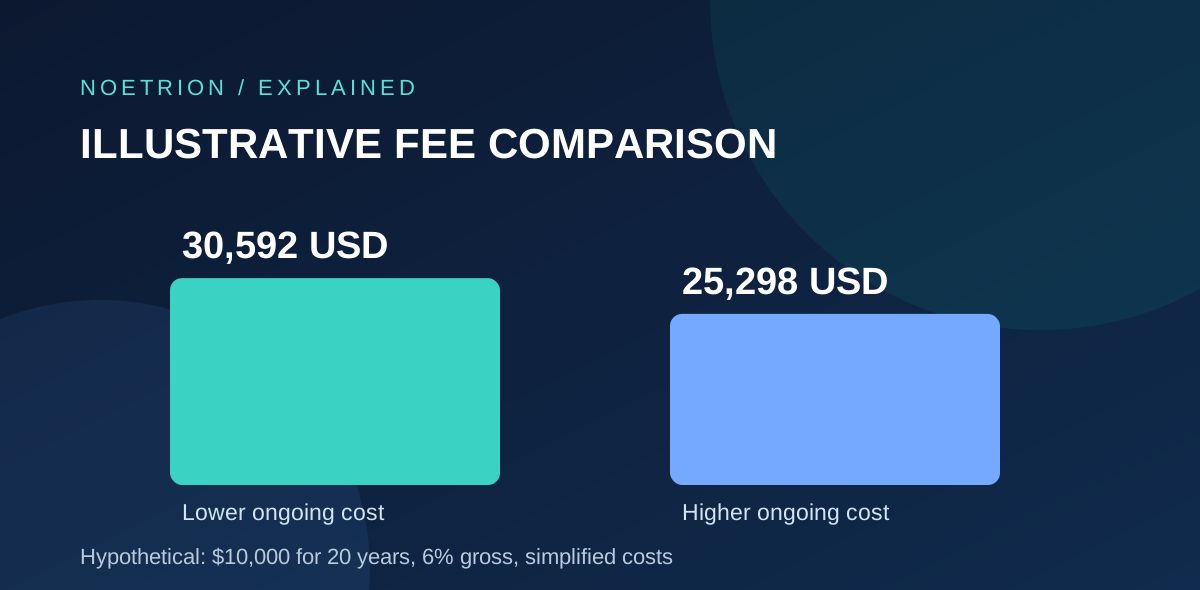
Consider a purely hypothetical initial investment of $10,000 held for 20 years. Assume a constant 6% annual gross return, with all gains reinvested, no taxes and no additional contributions. Compare annual ongoing costs of 0.25% and 1.25%, approximated as reductions to the annual return. Under this simplified model, the net rates are 5.75% and 4.75%.
| Scenario | Assumed net annual return | Approximate value after 20 years |
|---|---|---|
| Lower ongoing cost | 5.75% | $30,592 |
| Higher ongoing cost | 4.75% | $25,298 |
| Difference | 1 percentage point per year | About $5,300 |
These figures are illustrations, not expected returns or actual fund quotes. Real fees may be charged at different times, markets fluctuate and taxes can materially change outcomes. The important idea is that fees affect not only today's balance but also the future growth that the deducted money can no longer generate.
Look beyond the expense ratio
An expense ratio is important, but it is not the entire cost of investing. Depending on the product and platform, investors may encounter sales loads, trading commissions, spreads, custody charges, platform fees, currency-conversion costs and taxes. Some costs are already reflected in a fund's net asset value or published performance; subtracting them a second time would misstate the result.
| Cost type | Typical place to investigate | Question to ask |
|---|---|---|
| Ongoing fund expenses | Prospectus or fact sheet | Are returns shown before or after expenses? |
| Transaction fees | Broker or distributor schedule | Is there a minimum charge? |
| Bid–ask spread | Market quotation | What is the cost of entering and exiting? |
| FX conversion | Platform terms | What exchange rate and markup apply? |
| Tax | Applicable local rules | What is taxable and when? |
At small contribution sizes, fixed transaction fees can be disproportionately important. Paying a $2 fee to invest $10 consumes 20% of that contribution before any market movement. This is arithmetic, not an endorsement of any particular platform or product.
A better comparison starts with the goal
Before choosing a product, define when the money might be needed and how much loss you could tolerate. A fund holding short-term instruments, a diversified stock fund and a concentrated thematic fund do not carry equivalent risks. A higher historical return may simply reflect greater exposure to volatility, leverage or a favorable period.
Then compare products that serve similar purposes. Review their holdings, diversification, benchmark, fees, liquidity and historical behavior across different market conditions. Check whether reported performance is cumulative or annualized and whether it is quoted in the same currency. Avoid using a three-month winning streak to infer a reliable 20-year outcome.
Decision-making under uncertainty: use a checklist
People tend to overweight vivid recent gains and underestimate recurring costs. A structured checklist can slow that impulse. Ask: What problem is this investment meant to solve? What are the total costs? What could cause a permanent or temporary loss? How easily can I access the money? What evidence would make me reconsider? Is the product regulated and suitable for my jurisdiction?
Write down your reasons before purchasing. Revisit them on a reasonable schedule, not every time the price changes. This makes it easier to distinguish a changed investment thesis from ordinary volatility. For long-term goals, the process matters more than the emotional excitement of a single market day.
A practical example for a small monthly saver
Suppose someone sets aside $10 each month. The first decision is not necessarily which risky asset promises the highest return. It may be whether the money is needed for near-term emergencies, whether transaction minimums and fees make monthly purchases practical, and whether a diversified low-cost option exists. A person with no reliable cash buffer has different constraints from someone investing money they will not need for many years.
Dollar-cost averaging—investing a fixed amount at regular intervals—can support discipline, but it does not eliminate losses or guarantee superior performance. For people who prefer investments screened under religious or ethical principles, eligibility and supervision require separate verification; a product's marketing label is not enough.
What not to conclude from the illustration
The lower-fee product does not automatically outperform if it holds different assets or follows a different strategy. Nor is the lowest possible fee always worth sacrificing appropriate diversification, service or liquidity. Costs are one controllable variable in a larger decision. Treat them as a baseline screening factor, then evaluate risk and suitability.
The most powerful investment habit may be surprisingly unglamorous: understand what you own, keep avoidable costs low, stay within your risk capacity and revisit decisions using evidence rather than excitement. The arithmetic of fees will not predict markets, but it can prevent a predictable source of long-term drag.
Sources and editorial notes
- SEC Investor.gov, How Fees and Expenses Affect Your Investment Portfolio, July 23, 2025.
- SEC, Earlier Investor Bulletin on Fees, January 31, 2014.
Related reading: October economic outlook and scenario planning. Reader action: Compare the total all-in cost of two genuinely comparable products before focusing on their past returns.