Pandas merge_asof: Align Events Without Borrowing the Future
Build auditable temporal joins with explicit direction, entity boundaries, freshness limits, and matched timestamps.
Reviewed October 9, 2026. Examples target pandas 2.2.3 and use synthetic events.
A machine emits a temperature reading at 10:00 and another at 10:04. An inspection occurs at 10:03. Joining on equal timestamps finds nothing; choosing the closest reading selects 10:04, which had not happened when the inspection began. The arithmetic is simple, but the meaning of the match changes the answer. A temporal join needs a policy before it needs a function call.
merge_asof matches ordered numeric or datetime keys by distance, while retaining left-side observations. This tutorial treats each selected right-side row as an evidence attachment: its entity, time, age, and availability must be explainable. It also distinguishes a successful technical match from a valid business interpretation.
1. Define what was knowable at the decision time
Write the question in one sentence. For an inspection, it might be: attach the latest reading from the same machine that was available no more than two minutes before inspection. That sentence defines the entity boundary, search direction, time axis, and freshness limit. A nearest observation is appropriate for some offline reconstruction tasks, but it answers a different question.
Event time and availability time deserve separate columns. A reading observed at 10:00 but received at 10:05 was not available for a decision at 10:03. Joining backward on event time alone would still leak information in that situation. The API cannot infer the operational delay. Store both timestamps and choose the axis that matches the question being evaluated.
When reconstructing historical decisions, corrections introduce another dimension. A later correction can describe an earlier event. If the corrected value replaces the original without a version history, a backward join cannot recover what the system originally knew. An append-only history with publication time and revision identity is often necessary for that audit.
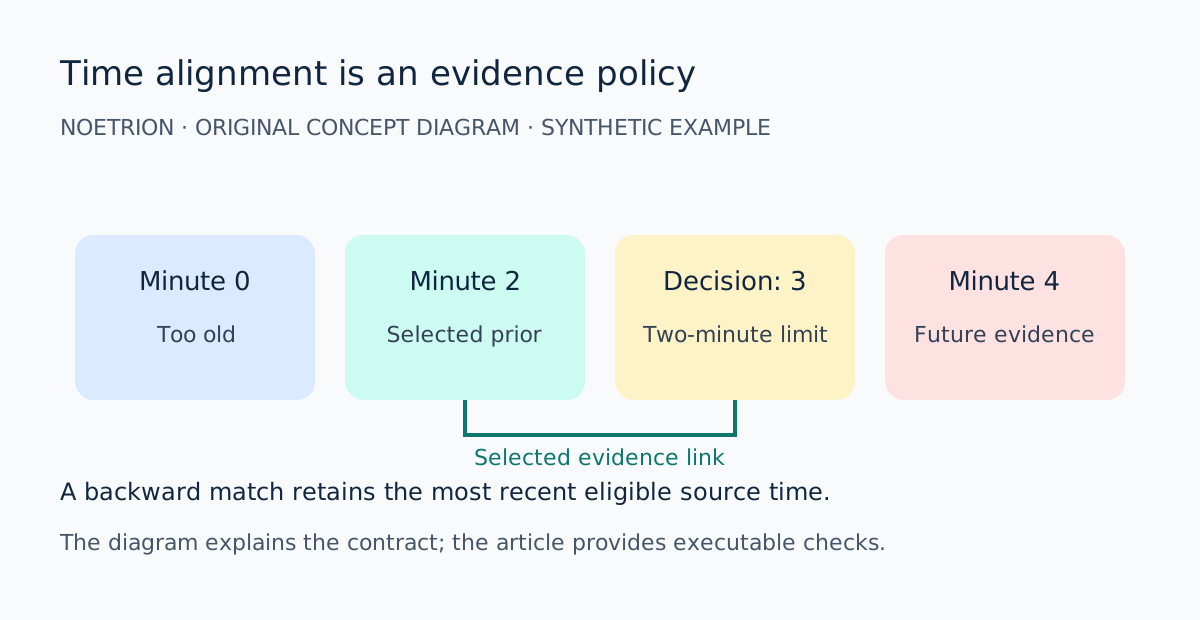
2. Make direction and equality explicit
Backward matching selects a preceding candidate, forward matching selects a subsequent candidate, and nearest matching selects by absolute distance. Exact equality is allowed by default. Set allow_exact_matches=False when the source observation must strictly precede the decision rather than share its timestamp. A coarse timestamp does not prove the order of two events within the same recorded second.
| Setting | Candidate interpretation | Question to resolve |
|---|---|---|
| Backward | Most recent eligible earlier or equal row | Was it already available? |
| Forward | First eligible later or equal row | Are future observations permitted? |
| Nearest | Smallest absolute time distance | Can either side of the event be used? |
| Exact matches disabled | Equality is excluded | Does timestamp equality hide ordering? |
| Tolerance specified | Maximum accepted distance | What makes a value too stale? |
The freshness threshold should follow the measurement process. A two-minute tolerance here is an illustrative rule, not a general recommendation for sensors. Report unmatched records instead of silently widening the threshold until every row receives a value. Coverage and freshness are different quality dimensions, and improving one can worsen the other.
import pandas as pd

events = pd.DataFrame({"event_id": [1, 2, 3], "t": [3, 4, 8]})
readings = pd.DataFrame({"reading_t": [0, 2, 4], "value": [10, 12, 14]})
joined = pd.merge_asof(events, readings, left_on="t", right_on="reading_t",
                       direction="backward", tolerance=2)
strict = pd.merge_asof(events, readings, left_on="t", right_on="reading_t",
                       direction="backward", tolerance=2,
                       allow_exact_matches=False)
assert joined["value"].iloc[:2].tolist() == [12.0, 14.0]
assert pd.isna(joined.loc[2, "value"])
assert strict["value"].iloc[:2].tolist() == [12.0, 12.0]
assert len(joined) == len(events)
print(joined)
The unmatched event at minute eight is deliberate: minute four is outside the accepted distance. The second result excludes the reading at exactly minute four and falls back to minute two. This is not interpolation. The output attaches a selected existing record; it does not estimate the temperature between readings.
3. Sort the temporal key globally, then restrict the entity
Both inputs must be ordered by their temporal merge key. With multiple entities, sorting primarily by entity can leave time decreasing across an entity boundary. Sorting by time first makes the global requirement explicit; by restricts candidate matching to the entity. Do not assume that visually neat groups satisfy the required ordering.
import pandas as pd

events = pd.DataFrame({"event_id": [10, 11, 12],
                       "machine": ["A", "B", "A"], "t": [5, 3, 1]})
source = pd.DataFrame({"machine": ["A", "B", "A"],
                       "source_t": [0, 2, 4], "reading": [100, 200, 104]})
left = events.sort_values("t", kind="stable")
right = source.sort_values("source_t", kind="stable")
out = pd.merge_asof(left, right, left_on="t", right_on="source_t",
                    by="machine", direction="backward", tolerance=2)
out["age"] = out["t"] - out["source_t"]
out = out.sort_values("event_id")
assert out["reading"].tolist() == [104, 200, 100]
assert out["age"].tolist() == [1, 1, 1]
assert out["event_id"].is_unique
assert (out["source_t"] <= out["t"]).all()
print(out)
The synthetic integer keys represent minutes, so tolerance is an integer. For datetime keys, use a compatible Timedelta. Parse both sides consistently, including timezone handling, before sorting. Reject missing merge keys and incompatible dtypes as input-quality issues; hiding them behind a broad exception handler prevents a reliable account of what was excluded.
4. Decide how duplicate source timestamps are resolved
Two readings for the same machine and timestamp may be revisions, duplicate transmissions, or independent observations. Their meaning determines whether to reject them, aggregate them, or choose a documented revision. A sort order can make a selection repeatable without making that selection substantively correct.
For a revision policy, retain an explicit revision number or publication sequence and establish the chosen record before the join. Verify uniqueness of the resulting entity-time key. For repeated independent measurements, an aggregate requires its own measurement contract: averaging might make sense for one sensor quantity and be misleading for another.
Nearest matching also raises ties when observations are equally distant. Avoid making a production business rule depend on an undocumented tie preference. If the use case requires a specific tie policy, make that policy explicit with candidate construction and validation, or use an unambiguous direction. Include a symmetric fixture in any check of the resulting workflow.
5. Audit matches with provenance and coverage
Keep the selected source timestamp under a distinct name. Reusing a single on column can hide the evidence time after the merge. A source record identifier, ingestion timestamp, revision, and computed age let a reviewer trace why a value was attached. The example preserves source_t precisely for this purpose.
Measure unmatched rates by entity and time period rather than only overall. A global coverage rate can conceal a device outage or a changed publication delay. Distinguish no prior candidate, a prior candidate outside tolerance, and candidates excluded by entity or equality rules. Those explanations lead to different operational fixes.
Reusing one source observation for many left events is expected in an as-of join. It does not create independent measurements. If subsequent analysis treats each attached value as a fresh sensor sample, it can exaggerate the amount of information collected. Preserve the original reading count alongside the event count when reporting such results.
6. Test the boundary cases that express the contract
A useful fixture includes the first event before all readings, an exact timestamp, a candidate exactly at tolerance, a candidate just beyond tolerance, and two entities with overlapping times. Assert left-row preservation, correct entity matching, allowed direction, and age limits. These checks test meaning rather than merely confirming that a function returned a DataFrame.
Test publication delay separately when the chosen time axis is availability. A late observation should remain unavailable to earlier decisions even if its event timestamp looks eligible. If the analysis intentionally uses retrospective information, label that purpose directly; it should not be presented as a simulation of real-time decisions.
These examples demonstrate deterministic matching on tiny artificial tables. They establish neither runtime on a large dataset nor the correct freshness policy for a particular business. Record actual row counts, missing-key exclusions, source revisions, software version, and policy settings when applying the workflow to real data. A reproducible match needs reproducible inputs as well as explicit parameters.
Sources and further reading
- pandas 2.2.3 merge_asof reference: direction, sorted keys, entity restrictions, tolerance, and equality.
- pandas 2.2.3 sort_values reference: ordering and stable sorting options.
- pandas 2.2.3 to_datetime reference: datetime parsing and UTC handling. Availability and audit recommendations above are workflow design conclusions, not guarantees supplied by pandas.