Pandas Rolling Windows: Count Observations or Measure Elapsed Time
Compare row-count and duration windows on irregular timestamps, test boundary inclusion, and audit whether a rolling feature is available at prediction time.
Reviewed October 8, 2026. Examples target pandas 2.2.3 and use irregular synthetic observations.
The phrase “recent average” leaves several questions unanswered. Recent by how many rows or by how much elapsed time? Must there be at least two valid values? Is a reading exactly thirty minutes old included? Can the current reading be known when the prediction is made? These questions define the feature before the averaging function does.
Pandas rolling operations can express a fixed observation count or a duration-based interval. Those choices agree on some regular datasets and diverge on irregular ones. This article uses a small irregular fixture to make the difference visible, then connects window construction to missingness, grouping, and prediction availability.
1. Write the window's meaning in words
A two-row window uses the current row and one preceding row under the usual trailing default. Their timestamps can be seconds apart or days apart. A thirty-minute window instead selects observations inside a time interval ending at the current timestamp. Its number of observations can vary from row to row.
Neither choice is inherently better. A last-two-observations summary can be appropriate when observations themselves define a sequence. A duration window can be appropriate when elapsed time defines recency. The problem is describing one as the other, especially when observation frequency changes with activity or data collection problems.
Sort and validate the time axis before constructing trailing features. Also state how ties are ordered and whether duplicate timestamps represent separate observations. A row-count window with tied times can depend on row order; a time interval may contain several rows at the same timestamp. The data's grain is still part of the calculation.
2. Compare both definitions on the same data
import pandas as pd

index = pd.to_datetime(["2026-01-01 00:00Z", "2026-01-01 00:10Z",
                        "2026-01-01 01:00Z"], utc=True)
values = pd.Series([2.0, 4.0, 8.0], index=index)
rows = values.rolling(2, min_periods=1).mean()
duration = values.rolling("30min", min_periods=1, closed="right").mean()
strict_duration = values.rolling("30min", min_periods=2,
                                closed="right").mean()
assert rows.tolist() == [2.0, 3.0, 6.0]
assert duration.tolist() == [2.0, 3.0, 8.0]
assert pd.isna(strict_duration.iloc[0])
assert strict_duration.iloc[1] == 3.0
assert pd.isna(strict_duration.iloc[2])
print(pd.DataFrame({"last_two_rows": rows, "last_30_minutes": duration,
                    "require_two_valid": strict_duration}))
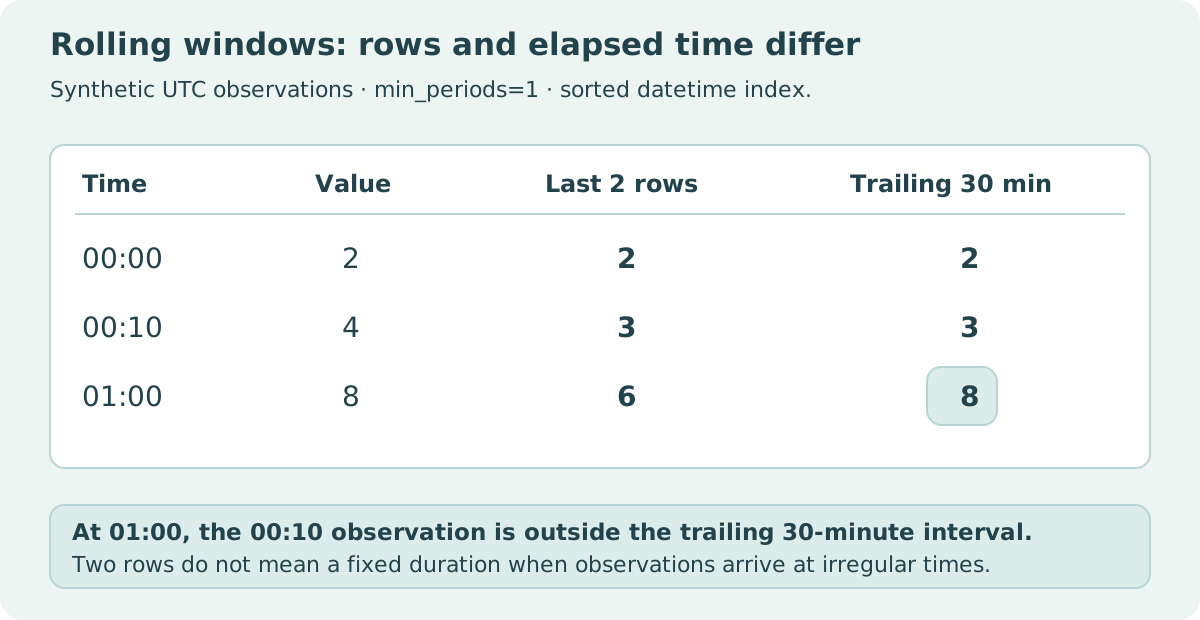
The final row-count window includes 00:10 and 01:00, even though those observations are fifty minutes apart. The thirty-minute window ending at 01:00 excludes 00:10. Requiring two valid values makes that final duration mean missing rather than presenting the single reading as sufficient evidence.
| Timestamp | Last two rows, minimum one | Last thirty minutes, minimum one | Last thirty minutes, minimum two |
|---|---|---|---|
| 00:00 | 2 | 2 | Missing |
| 00:10 | 3 | 3 | 3 |
| 01:00 | 6 | 8 | Missing |
These means are observation-weighted. A window containing irregular measurements does not automatically produce an average weighted by how long each value held. If the intended quantity is a time-weighted state, define durations and weighting separately.
3. Defaults can hide a change in minimum evidence
In pandas 2.2.3, an integer window defaults to requiring the window's full size, while an offset window defaults to one observation. Changing rolling(2) to rolling("30min") can therefore change both membership and the minimum evidence needed for a result. Set min_periods explicitly when comparing definitions.
For ordinary means, missing values do not contribute a valid observation. Requiring two valid values is different from requiring two rows, one of which contains a missing reading. Track window counts alongside the result when coverage matters. The minimum count is a policy threshold, not a confidence interval or a guarantee of stable estimation.
An early window also differs from a fully developed one. With a permissive minimum, the first result may use one observation while later results use many. A plot can hide that varying support unless the report includes counts or flags. Do not describe all displayed averages as equally informed merely because they share a column name.
4. Test inclusion at the exact time boundary
The default trailing duration interval is right-closed: the current time is included and the left boundary is excluded. A reading exactly thirty minutes old therefore drops out under closed="right". Including both boundaries changes that result.
import pandas as pd

index = pd.to_datetime(["2026-01-01 00:00Z", "2026-01-01 00:30Z"], utc=True)
values = pd.Series([2.0, 4.0], index=index)
right = values.rolling("30min", closed="right", min_periods=1).mean()
both = values.rolling("30min", closed="both", min_periods=1).mean()
assert right.iloc[-1] == 4.0
assert both.iloc[-1] == 3.0
default_count = values.rolling(2).mean()
assert pd.isna(default_count.iloc[0])
assert default_count.iloc[1] == 3.0
print("Right-closed:", right.tolist(), "Both boundaries:", both.tolist())
The difference is fully explained by interval membership. It is not numerical instability. Always include boundary cases in tests, because random timestamps are unlikely to land exactly on the point where two conventions diverge. Report the closure convention alongside the duration rather than relying on readers to recall a library default.
5. A trailing label does not establish availability
If a model predicts before the current observation arrives, including that observation is leakage even in a trailing window. One solution may be shifting the feature by one observation, but a row shift is not a universal time-delay solution. With irregular data, one row can represent a variable elapsed duration, and arrival delays can differ by record.
Define the prediction cutoff and identify which records were available before it. Then construct the window from those records. A current observation can be appropriate for predicting a later outcome if it was already known; the same observation can be inappropriate for predicting an outcome recorded before its arrival. Availability comes from the task's chronology, not the word “trailing.”
Centered windows can use observations after the displayed timestamp. They may be useful for descriptive smoothing of a completed series, but require particular care when used as predictive features. Forward-looking windows also need an explicit purpose, such as defining a future label rather than an input available at the prediction origin.
6. Keep entities and validation boundaries separate
Store the result's row identity explicitly when a transformation changes index structure. Grouped operations can introduce a multi-level index, and assigning that result back by position can attach a valid average to the wrong record. Check both labels and counts when joining derived features to the original table. A small fixture with two entities and deliberately interleaved input rows is useful because it exposes alignment assumptions that a single sorted entity cannot reveal.
A rolling feature for several devices should not let one device's final observation become another device's preceding observation. Partition by the appropriate entity, order within each partition, and verify output alignment after a grouped rolling operation. A global sort by timestamp alone does not solve that ownership problem.
Validation adds another boundary. Feature construction should respect the actual deployment history available at each validation point. Whether earlier test-period observations may contribute to later test predictions depends on the evaluation protocol and whether those readings would be available during deployment. Write that protocol explicitly rather than forcing every task into one rule.
For practice, insert a missing reading at 00:20 and compare valid counts, row membership, and means. Then add a second device with overlapping timestamps and verify that its observations cannot enter the first device's window. The exercise should end with a written feature contract: entity, ordering, duration or row count, boundary inclusion, minimum valid count, weighting, and availability cutoff.
Sources and scope
- pandas 2.2.3: rolling parameters.
- pandas 2.2.3: windowing operations.
- pandas 2.2.3: time-series guide.
The calculations illustrate window mechanics. They do not justify a thirty-minute horizon, a minimum sample count, or a predictive design for a real application.