A Payment Infrastructure Can Survive Participant Default and Still Face a Business Loss
Understand the October 2026 CPMI-IOSCO guidance on financial market infrastructure business losses. Separate participant-default resources from operating resilience.
Educational analysis, not a personal investment or payment recommendation. Check the dated sources and the rules that apply in your jurisdiction.
A financial infrastructure has carefully designed resources for a participant default. Its own revenue then falls while legal, technology and staffing costs continue. Can it use the same resources to keep operating? The answer depends on what those resources are for, who owns them and which rules govern their use.
This is why business resilience is a separate topic from the ability to process today's transactions. Payment systems, securities settlement systems and other financial market infrastructures can face losses as operating enterprises as well as risks arising from their participants.
On October 14, 2026, CPMI and IOSCO published final guidance on general business risks and losses. This article explains the boundary and develops an original liquidity worksheet. It does not determine any institution's regulatory capital requirement.
What the final report clarifies
The final report's summary describes general business losses as distinct from participant-default losses and losses separately covered under the credit- and liquidity-risk principles. It addresses identifying and managing business risk, determining liquid net assets funded by equity, and governance and transparency.
The report says it provides further clarity on observing the Principles for Financial Market Infrastructures rather than introducing additional standards. The final publication should not be confused with its November 2025 consultation.
Those statements define the policy context. The worksheet below is deliberately simpler than an FMI's full assessment and should not be treated as a compliance calculation.
Separate three questions
First, can the system settle obligations when a participant fails? Second, can the operating entity meet its own expenses and losses? Third, can essential services continue or be wound down in an orderly way if the operating model is no longer viable?
The questions interact, but they do not have identical resource pools or decision rights. An asset shown somewhere on a balance sheet may be restricted, unavailable in time or earmarked for another purpose.
| Resource or claim | Question before counting it |
|---|---|
| Participant-default resources | What losses may these resources legally absorb? |
| Equity-funded liquid assets | Are they available to absorb the entity's business losses? |
| Client or participant funds | Who owns them, and are they protected or restricted? |
| Future revenue | Is it contracted, collectible and available when needed? |
| External support | Is it committed and usable under stress? |
A dashboard showing a large aggregate balance is not a substitute for these distinctions. Build a resource inventory with restrictions and timing visible.
Model cash needs before calculating runway
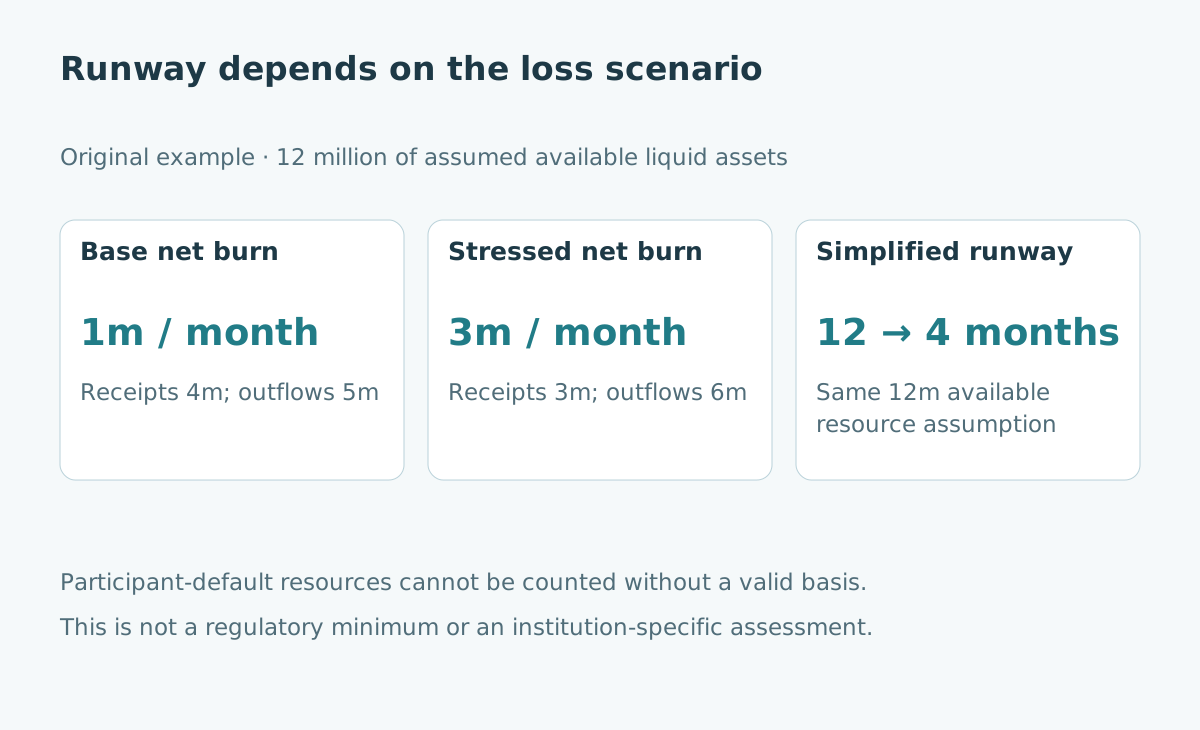
Suppose an invented operating entity has monthly cash operating outflows of 5 million and receipts of 4 million. Its net monthly cash burn is 1 million. With 12 million of assumed available equity-funded liquid assets, a constant-burn calculation gives twelve months.
Now suppose receipts fall to 3 million while outflows rise to 6 million. Net burn becomes 3 million, and the same liquid assets cover four months. The asset balance did not change; the business conditions did.
| Synthetic case | Monthly receipts | Monthly outflows | Net burn | Simplified runway |
|---|---|---|---|---|
| Base | 4m | 5m | 1m | 12 months |
| Stress | 3m | 6m | 3m | 4 months |
The calculation assumes constant cash flows and full availability of the 12 million. It excludes valuation changes, restrictions, extraordinary costs and timing within the month. It illustrates sensitivity, not an acceptable regulatory buffer.
Add the timing that an average conceals
Monthly net cash flow can hide a large payment due before receipts arrive. Record major dates for staff, technology contracts, insurance, taxes and other obligations. A positive month-end balance does not guarantee the ability to meet every earlier payment.
Stress can also alter when funds are available. A receivable may be valid yet slow to collect. An asset may be liquid in normal markets but expensive to sell under the assumed conditions. Specify the conversion and settlement time rather than using the word liquid as an all-purpose assurance.
Keep accounting losses and cash requirements connected but separate. A noncash charge and an immediate cash payment create different timing demands even when both reduce reported performance.
Make recovery actions credible
A proposed cost reduction needs an owner, a decision date and an implementation lag. Cancelling a contract may require notice or a termination payment. Raising fees may need approval and could affect volumes. New equity may be uncertain exactly when stress makes it necessary.
Model actions in the order they can actually happen. Avoid subtracting a saving from the first stressed month when the action would take three months to implement. Include the cost of the action itself.
A credible plan should also identify which essential services must continue while changes occur. Reducing an expense that supports critical operations can create another loss mechanism rather than a clean saving.
Explain governance to the people who depend on the system
A participant needs to understand what happens if the infrastructure faces business stress, including relevant rules, notices and responsibilities. Transparency is useful when it makes decisions and limitations understandable, not merely when it adds another long document.
Internally, assign responsibility for monitoring the indicators, escalating a problem and approving an action. A threshold without an authorized response can become a decorative number in a report.
Test how the organization distinguishes a temporary earnings setback from a threat to continued service. The evidence and decisions should be traceable enough that another responsible person can review them.
Build an original review worksheet
For each scenario, record starting available resources, restricted balances, cash receipts, outflows, action lags and the point at which another decision is required. Preserve the assumptions and the date of the analysis.
Ask whether several actions depend on the same optimistic assumption. For example, a plan may assume strong future volumes both to restore revenue and to support a fee increase. Stress those dependencies together rather than treating them as independent cushions.
As a self-check, can participant collateral automatically be added to the operating runway calculation? No. Its ownership, restrictions and purpose must first establish whether it is available for that use.
For related operational thinking, see financial AI vendor exit planning. Both topics require a recovery route whose resources and execution can be demonstrated.
Sources and limits
- CPMI-IOSCO press release, October 14, 2026.
- Final guidance on general business risks and losses, October 14, 2026.
Checked October 23, 2026. The runway model is an original illustration. Institution-specific obligations require the applicable framework, rules and qualified assessment.