A Small Net Payment Can Hide a Much Larger Intraday Funding Need
Calculate payment netting and trace gross settlement in order. See why a small end-of-day obligation does not establish the liquidity needed during the day.
Educational analysis, not a personal investment or payment recommendation. Check the dated sources and the rules that apply in your jurisdiction.
A payment platform advertises a large reduction in settlement volume after netting. The arithmetic may be correct. A participant can still need substantial money earlier in the day, before the incoming payment that would eventually offset its outgoing obligation.
The CPMI's 29 October 2026 analysis of the evolving payments ecosystem is timely context. It examines innovation alongside changing credit, liquidity and operational interdependencies. Its release reaffirms the role of central bank money in settlement; it does not declare that a new technology removes the need to fund payments.
The practical reader task is to separate three quantities: gross instructions, net obligations at a defined point, and the funds needed to execute a specified sequence. The original three-participant exercise below keeps those boundaries visible.
Define what is being netted
Suppose three fictional participants have obligations in one currency: A must pay B 100 units, B must pay C 90, and C must pay A 80. All obligations are valid and due within the exercise. Ignore fees, collateral, interest and credit facilities.
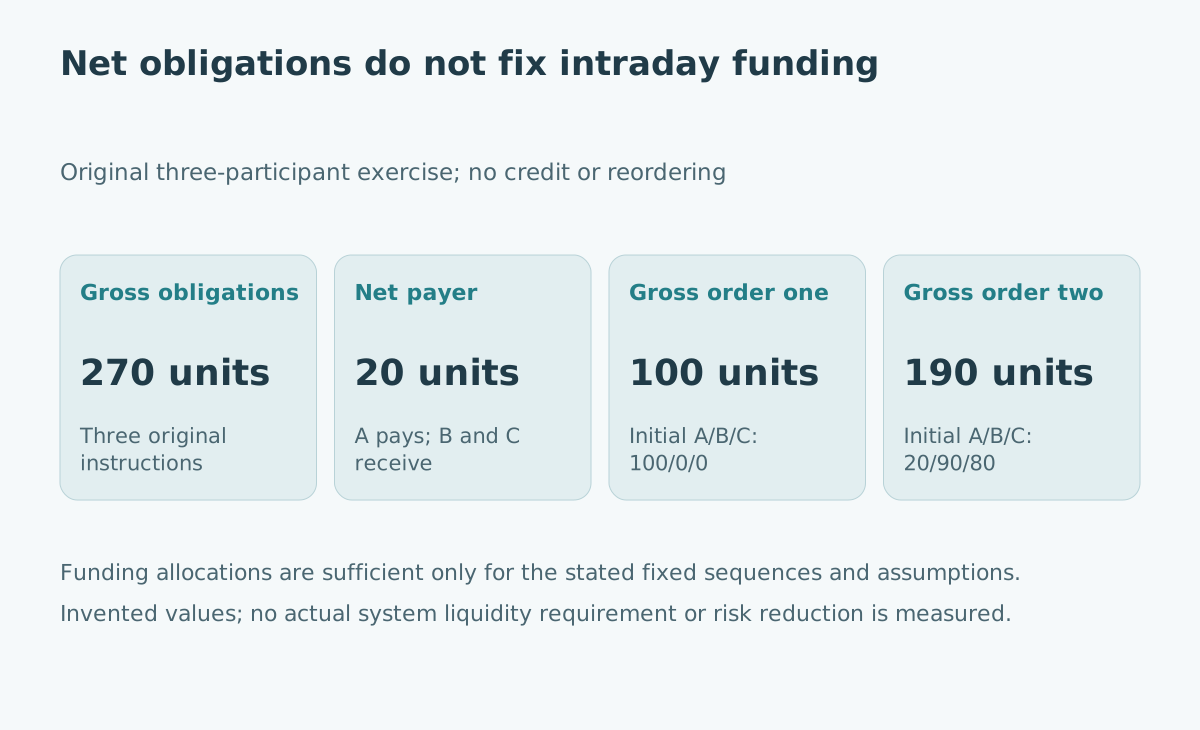
The gross instruction total is 100+90+80=270. At the end of the obligation set, A owes 100 and receives 80, so A is a net payer of 20. B receives 100 and owes 90, a net receipt of 10. C receives 90 and owes 80, also a net receipt of 10.
| Participant | Gross outgoing | Gross incoming | Net position, incoming minus outgoing |
|---|---|---|---|
| A | 100 | 80 | −20 |
| B | 90 | 100 | +10 |
| C | 80 | 90 | +10 |
| Total | 270 | 270 | 0 |
A suitable multilateral arrangement could settle the net payer's 20-unit obligation and allocate 10 to each net receiver. That description assumes enforceable rules and a working settlement arrangement. It does not establish that any arbitrary set of invoices can legally be replaced by those net transfers.
Trace a gross sequence with recycled receipts
Now settle the original instructions individually and immediately in the order A→B, B→C, C→A. Assume an outgoing instruction cannot execute without available funds and that received funds become immediately usable. No one can borrow, and payments are not reordered.
One sufficient initial allocation is A 100, B 0 and C 0. After A pays 100, B has 100. B can pay 90, leaving 10. C then has 90 and can pay 80, leaving 10. A ends with 80. Total initial funding was 100, and total final balances still equal 100.
The same 100 units supported 270 units of gross payments through reuse. It would therefore be incorrect to assume that gross settlement always requires fresh external money equal to the sum of every instruction. Recycling is possible under these assumptions.
It would also be incorrect to replace the 100 with the end-net 20 while leaving this sequence unchanged. A's first payment requires 100 before the 80-unit receipt has arrived.
Change only the order and observe the difference
Keep the obligations but fix the sequence as C→A 80, B→C 90, A→B 100. A sufficient initial allocation is now A 20, B 90 and C 80:190 in total.
C first pays 80 to A, raising A's balance from 20 to 100. B next pays 90 to C. A can then pay 100 to B. The final balances are A 0, B 100 and C 90, again totaling 190. Relative to their starting balances, A loses 20, B gains 10 and C gains 10—the same net economic positions as before.
| Fixed execution order | Initial allocation A/B/C | Total initial funding |
|---|---|---|
| A→B, B→C, C→A | 100 /0 /0 | 100 |
| C→A, B→C, A→B | 20 /90 /80 | 190 |
These are sufficient allocations for this deliberately restricted exercise, not universal funding requirements. Allowing credit, different release rules, simultaneous offsetting or another order changes the problem. The end-net position alone does not identify the answer.
Connect the arithmetic to the actual funding mechanism
The authors of BIS Working Paper 1089, Intraday liquidity around the world, explain that timing mismatches between outgoing and incoming payments create intraday funding needs. Their study discusses reserve balances, intraday credit and recycled incoming payments, as well as liquidity-saving mechanisms whose designs differ.
That supports a concrete investigation, not the transplantation of a historical average into your platform. Ask where usable funds come from, when they become available and whether the participant can access them under stress. A balance in another currency, institution or restricted account may not be available at the required moment.
Record the cost and conditions of any credit facility separately. A facility that requires collateral or approval is different from an unlimited, immediate funding source assumed by a spreadsheet.
Netting moves the risk questions rather than answering all of them
Deferring settlement while accumulating a net position can economize on transfers, but a participant's failure before settlement still needs a defined treatment. Ask which obligations are final, what happens to a failed participant's position and which resources cover a shortfall.
The CPSS–IOSCO Principles for Financial Market Infrastructures treats liquidity resources and settlement finality as distinct principles. A shorter transfer list does not itself establish either sufficient resources or a legally certain settlement outcome. The framework addresses financial infrastructures; this article does not determine its applicability to a particular service.
For a related technical promise, see atomic settlement and liquidity. Coordinating an exchange and supplying the resources to complete it remain separate engineering and financial questions.
Test a delay before celebrating a volume reduction
Return to the first gross sequence. Delay A's incoming 80 until after a separate deadline for another outgoing payment. A may need extra available funds despite its unchanged end-of-day net obligation. The additional amount depends on the new instruction and its timing; do not invent it without a trace.
An original test plan should preserve instruction identifiers, due times, release order, available balances and the status of credit lines. Simulate a delayed receipt and an unavailable participant under the arrangement's actual rules. Report unmet deadlines and peak funding use alongside successful completion.
Do not label a queued instruction settled. A queue can reduce immediate funding demand by postponing execution, but that postponement may have a business cost or violate a time-specific commitment.
Report the quantities that support the claim
If the only verified result is that 270 units of obligations become 20 units of net payer funding at a particular settlement point, report that exact result and its rule assumptions. Do not turn it into a claim of equivalent reductions in credit risk, fraud losses or intraday cash requirements.
For operational planning, add the worst observed or tested cumulative funding shortfall, the period covered and the scenarios considered. Preserve unresolved dependencies. A useful comparison explains both what the netting algorithm calculates and what the participant must have available when the next instruction is due.
Sources and scope
- CPMI release on central banks and the evolving payments ecosystem, 29 October 2026; official release reviewed for current context.
- BIS Working Paper 1089, Intraday liquidity around the world, 2023; selected mechanism and liquidity-saving discussion reviewed, not used to estimate a current system's requirements.
- CPSS–IOSCO Principles for Financial Market Infrastructures, April 2012; liquidity and finality principles consulted.
Checked 31 October 2026. Participants, amounts and execution orders are invented. No actual platform's liquidity need, legal enforceability or regulatory compliance is established by the exercise.