Tokenised Bonds: Faster Settlement Still Needs Cash, Liquidity and Legal Certainty
Understand tokenised bond settlement beyond the blockchain label. Compare principal exposure, prefunding, netting and the legal rights behind a digital token.
Educational analysis, not a personal investment or payment recommendation. Check the dated sources and the rules that apply in your jurisdiction.
A bond and its payment move together on a programmable platform. The demonstration looks simple: either both transfers happen or neither happens. That can address an important settlement problem, but it leaves a less visible question—where does the buyer's money wait before the transaction completes?
Tokenised finance is worth following because it changes how claims, money and transaction rules can interact. Evaluating it requires looking beyond transaction speed to liquidity, access, legal finality and the ability to recover when something goes wrong.
The BIS's 2026 discussion of trust in money provides current policy context. Its 2025 government-bond tokenisation bulletin documents an earlier stage of development. The cash-flow examples here are original and deliberately simplified.
Distinguish the asset claim from its representation
A token may represent a claim on a bond, but the investor still needs to know who owes what, under which law, and who maintains the authoritative record. A convenient wallet interface does not establish the priority of a claim in insolvency.
Ask whether the token directly represents the security or an intermediary's entitlement to it. Check custody, transfer restrictions, corporate actions and recovery if access credentials are lost. Coupon payments and redemption must connect the digital record to enforceable obligations.
For a treasury team, those details matter more than whether the platform calls itself public, private or distributed. The architecture is one part of the service, not a substitute for the instrument's terms.
Identify what atomic settlement changes
Atomic delivery-versus-payment links delivery of the asset with payment under the system's rules. The purpose is to avoid one party making its transfer while the counter-transfer fails. It does not mean every source of risk disappears.
The payment asset still matters. Central bank money, a commercial bank claim and another private money instrument can have different credit, liquidity and access characteristics. The BIS's 2026 chapter discusses tokenisation while emphasizing the monetary arrangements and safeguards needed to preserve trust.
| Question | Why speed alone does not answer it |
|---|---|
| What is transferred as payment? | The cash leg has its own issuer and redemption terms |
| When is transfer legally final? | Technical completion and legal finality need alignment |
| Who may participate? | Access restrictions affect available counterparties |
| What happens on failure? | Recovery, dispute handling and operational continuity remain |
| Can positions move elsewhere? | Interoperability affects usable liquidity |
Work a liquidity example
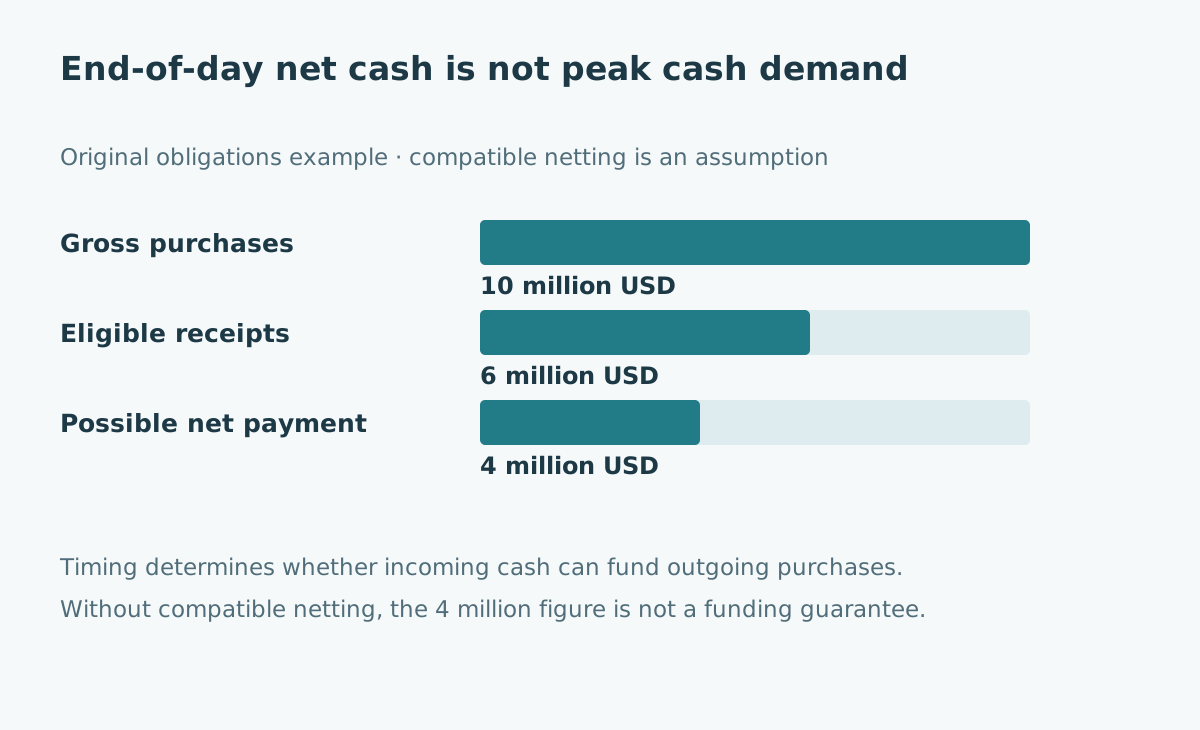
Suppose a dealer must pay $4 million, $3 million and $3 million on three purchases today. Gross outgoing obligations total $10 million. It also expects $6 million of incoming payments.
Under a compatible netting arrangement for the relevant participants, currency and settlement window, the net outgoing amount could be $4 million. Under a gross arrangement, the dealer may need enough usable funds for each purchase at its scheduled time. The actual peak requirement depends on sequencing and whether incoming funds can be reused.
| Synthetic arrangement | Calculation | What is still unknown |
|---|---|---|
| Gross purchases | 4 + 3 + 3 = $10m | Timing and reuse of receipts |
| Eligible receipts | $6m | Whether receipts arrive when needed |
| Possible net obligation | 10 − 6 = $4m | Eligibility and enforceability of netting |
| All purchases before receipts | Up to $10m for these payments | Other obligations and available credit |
The example does not establish that tokenised markets always need more liquidity. A platform might support credit, liquidity-saving arrangements or different settlement scheduling. The point is to inspect those arrangements rather than assume an atomic transaction is automatically cash-efficient.
Price prefunding explicitly
Assume an institution holds an extra $2 million for one day to satisfy a particular arrangement. At a hypothetical annual funding rate of 5%, using a 365-day convention, the simple one-day carrying amount is approximately $273.97.
This is $2,000,000 × 0.05 / 365. It is an illustrative opportunity-cost calculation, not a quoted lending rate or the full cost of participating. Fees, collateral requirements, operational savings and avoided losses also belong in the comparison.
For a pilot, calculate the cost per completed transaction and the peak cash requirement under realistic timing. A small per-transaction saving can coexist with an inconvenient liquidity commitment. Conversely, reduced reconciliation work or faster reuse of collateral may justify costs elsewhere.
Treat early market evidence as dated evidence
The July 10, 2025 BIS Bulletin described tokenised bond issuance as early-stage and identified regulatory and infrastructure challenges. Its historical issuance amount should not be relabeled as the market size in October 2026.
Likewise, a finding from a sample of instruments does not prove that every future bond will have a lower spread. Liquidity depends on participants, instrument design, trading availability and integration with the wider market. Distinguish an observed sample comparison from a guaranteed saving in your own issuance.
A supplier's pilot can demonstrate a functioning workflow without establishing commercial scale. Ask how many independent counterparties participated, how exceptions were handled and whether the arrangement used ordinary production processes.
Test the full lifecycle
A useful evaluation includes issuance, transfer, coupon payment, redemption and failure recovery. Add scenarios for a participant outage, a blocked transfer and a disputed instruction. Confirm whether a transaction can be corrected and who has authority to do so.
Test interoperability in both directions. Moving an asset into a platform is less useful if it cannot later reach the custodian or collateral venue needed by the investor. Technical connectivity and legal permission are separate requirements.
An institution should also know which responsibilities remain with its own team. A programmable settlement rule may reduce manual steps while increasing the importance of software governance and access control.
A decision worksheet for treasury teams
Compare the proposed platform with the current process using settlement exposure, peak cash, funding cost, reconciliation workload, access and recovery. Preserve the same currency, volume and service level in both scenarios.
As a self-check, a platform promises immediate settlement but requires funds before incoming receipts are available. What number is missing from the presentation? The peak funding requirement over time. The final net position at the end of the day cannot answer it.
For the operational side of international payments, see comparing total cross-border transfer costs. In both cases, follow the usable money through the whole transaction.
Sources and scope
- BIS Annual Economic Report 2026, Chapter III: monetary trust and tokenisation architecture.
- BIS Bulletin 107, July 10, 2025: early government-bond evidence and development challenges.
Checked October 22, 2026. Dollar amounts, funding rates and settlement schedules are invented teaching scenarios. No instrument recommendation or current market-size estimate is provided.