A Token Record Shows a Digital Position. The Asset Rights Still Need Evidence.
Examine what a tokenised position represents, who owes the underlying claim and how custody records match. Use an original twelve-position reconciliation worksheet.
Educational analysis, not a personal investment or payment recommendation. Check the dated sources and the rules that apply in your jurisdiction.
A wallet displays a token balance linked to a financial asset. The display may be technically accurate while leaving essential questions unanswered: What right does the holder have? Against whom? Which record determines entitlement? What happens if the platform or custodian fails?
These questions matter whether tokenised assets are bought as investments, pledged as collateral, or moved within payment-related arrangements. A ledger can provide useful evidence of a digital state. The legal and operational meaning of that state depends on the arrangement around it. This article offers an original review worksheet, not a legal classification of all tokens or an investment recommendation.
The current regulatory discussion makes the issue concrete. On October 9, 2026, ESMA sought evidence on tokenised collateral in central clearing, including protection and lifecycle questions. Responses are due January 15, 2027. A call for evidence is not a blanket approval of tokenised collateral or a final rule for every asset.
Identify what the token is intended to represent
The FSB's October 2024 tokenisation report distinguishes assets issued directly on distributed ledgers from digital representations of assets issued elsewhere. It notes that claims on issuers or underlying assets can face legal uncertainty, and that custody or redemption may still involve third parties. The report is financial-stability analysis, not a determination that a particular token is legally enforceable.
For an original review, begin with a plain-language sentence: “This position is intended to give its holder the following right against the following party.” If that sentence cannot be completed from the documents, a token symbol or a familiar asset name does not fill the gap.
Separate the right from the displayed label
A label such as “bond token” could refer to different structures. The holder might have a direct entitlement under a particular issuance arrangement, an intermediary-held position, or a contractual claim against a separate issuer. These possibilities are questions to investigate, not classifications assigned here.
| Original review field | Evidence to request |
|---|---|
| Nature of the right | Issuance and entitlement terms for the exact instrument |
| Party that owes performance | Identified issuer or other responsible legal entity |
| Authoritative ownership record | Documents specifying the register and how it is maintained |
| Transfer effect | Terms describing what changes when the token moves |
| Recovery or redemption | Conditions, responsible party, and relevant procedure |
Preserve the instrument identifier and document version. A generic platform description may explain the technology without establishing the rights attached to a specific issuance.
Ask what changes when the token moves
Imagine a fictional arrangement where a token balance updates immediately but a separate holder register is reconciled later. The operational question is not merely whether the ledger transaction succeeded. It is whether the intended entitlement changed in the manner required by that arrangement.
Other structures may make the distributed ledger itself the relevant register. Do not assume that a parallel off-chain register always exists, or that it is always authoritative. Request the rule that identifies the controlling record and the process for resolving a conflict. The architecture should follow the actual rights structure, not a preferred diagram.
Distinguish custody layers
Control of the private keys, administration of the token position, and safekeeping of a reference asset can be separate functions. Ask who performs each one and what evidence connects them. For an asset represented through an intermediary, identify the chain of responsibility rather than stopping at the first wallet address.
As one jurisdiction-specific example, FINMA's January 12, 2026 custody guidance announcement emphasizes technical safeguards, appropriate providers, and protection when a custodian becomes insolvent. That Swiss supervisory context is not a universal guarantee for every token or foreign arrangement. It illustrates why key security and legally effective client-asset protection are separate inquiries.
Reconcile twelve fictional position records
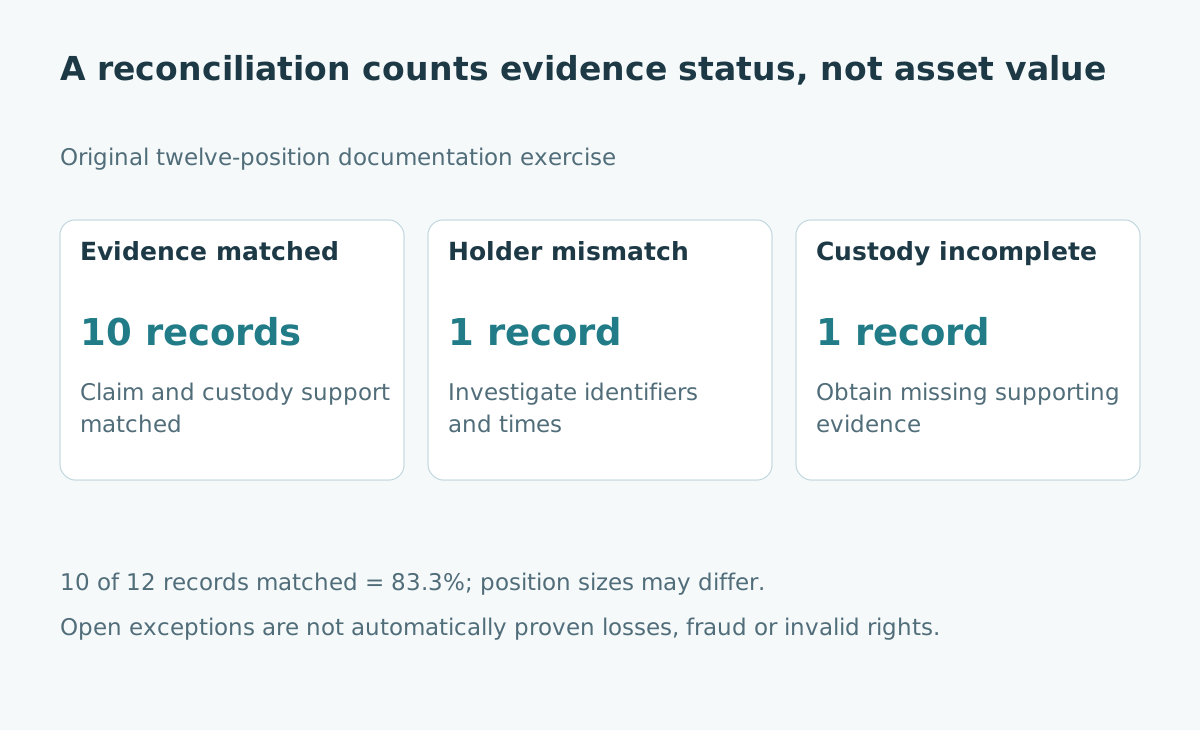
Suppose an original internal review examines twelve tokenised bond-position records. Ten have matching instrument identifiers, quantities, holder information, and the supporting evidence required by the fictional arrangement. One record differs from the holder register. Another lacks the custody confirmation needed to complete the review.
| Original documentation state | Records | Review action |
|---|---|---|
| Required evidence matched | 10 | Retain the dated evidence and reviewer record |
| Holder-register mismatch | 1 | Investigate the conflicting identifiers and effective dates |
| Custody support incomplete | 1 | Obtain the missing confirmation from the responsible party |
| Total reviewed | 12 | Keep both open cases in the reconciliation |
Ten of twelve records are matched, or 83.3% rounded to one decimal place. Two remain unresolved. This does not mean 83.3% of asset value is verified: position sizes may differ. It also does not establish that the other two positions are missing, fraudulent, or worthless. The review identifies evidence gaps that require investigation.
Preserve effective time as well as identifiers
A mismatch can arise because records describe different moments. A transfer may have occurred after one report's cutoff but before another's. An original reconciliation should therefore compare instrument, quantity, holder mapping, record source, and effective time together.
Do not overwrite an exception simply because the next export agrees. Record the explanation and the evidence that resolved it. Conversely, an unresolved mismatch must not be closed with an unsupported “timing difference” label. Someone should be able to reconstruct the reconciliation without relying on the original reviewer's memory.
Test a failure that the ledger cannot answer alone
For a fictional tabletop exercise, suppose the platform stops operating while an investor needs proof of entitlement. Identify which records can still be accessed, which party must provide them, and how the relevant claim would be pursued under the actual documents and law.
Then consider a different failure: the wallet remains accessible, but the responsible intermediary disputes the holder mapping. These scenarios test different dependencies. A successful demonstration of a token transfer does not test either recovery path. The exercise should be reviewed by the relevant legal, custody, and operational specialists before any conclusion about enforceability is drawn.
Give unresolved rights questions a decision owner
Technical staff can establish a ledger state; custody operations can provide position evidence; legal specialists can assess the documents and applicable jurisdiction. The final review should show which conclusion belongs to which evidence and expertise.
Before accepting a tokenised position into a process, document the right being relied on and how a record conflict is handled. That discipline makes the asset story reviewable even when the interface is impressive. For related issues, see tokenised bond settlement and liquidity and payment-rail completion boundaries.
Sources and reading notes
- ESMA call-for-evidence announcement, October 9, 2026. Consultation status and deadline checked October 27.
- FSB, The Financial Stability Implications of Tokenisation, October 22, 2024, especially definitions, legal-framework considerations, and custody discussion.
- FINMA custody guidance announcement, January 12, 2026. Swiss supervisory guidance is used only as a bounded example; the original worksheet does not assign legal status to a product.