Prescribed Fire: Using Controlled Burns to Change Future Wildfire
Understand burn prescriptions, fuel treatments, ecological goals, smoke trade-offs, and why controlled fire changes risk rather than eliminating wildfire.
Reviewed October 12, 2026.
Understand burn prescriptions, fuel treatments, ecological goals, smoke trade-offs, and why controlled fire changes risk rather than eliminating wildfire.
| Concept | What it means | Important limit |
|---|---|---|
| Prescribed fire | Planned ignition under an approved prescription | Fire still carries operational risk |
| Fuel load | Burnable live and dead vegetation | Amount alone does not determine behavior |
| Fire severity | Ecological change caused by fire | Differs from flame intensity |
| Treatment effect | Changed fuels and ecosystem structure | Declines as vegetation regrows |
1. Fire is both a process and a hazard
Many grasslands, shrublands, and forests evolved with recurring fire that recycles nutrients, opens habitat, and influences species composition. The same process can threaten lives, homes, water supplies, and cultural resources when intensity, location, or timing is unfavorable. A prescribed fire is deliberately ignited to meet stated objectives under a plan. It is not “letting nature do anything,” nor is it simply a smaller wildfire. Managers specify acceptable weather, fuels, staffing, smoke, and contingency conditions.
2. Fuel has amount, arrangement, and moisture
Fire behavior depends on fine grasses, leaves, branches, logs, live vegetation, vertical connections into crowns, and how those materials are distributed. Dry, continuous fine fuels can spread flame rapidly; heavy logs influence duration and heat. Fuel moisture responds to weather and season. Thinning may reduce ladder fuels but can leave slash unless treated. Prescribed burning changes several components at once. Measuring only tonnes of biomass can miss the arrangement that controls spread and the ecological roles of retained material.
3. A prescription defines an operating window
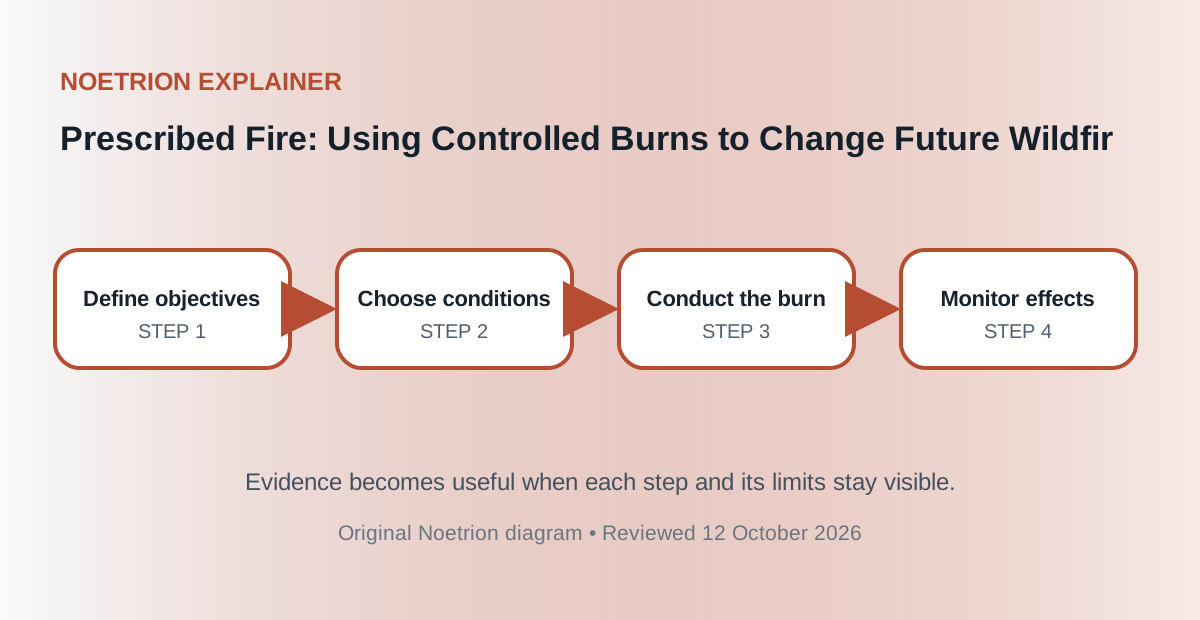
A burn plan states objectives, unit boundaries, ignition pattern, personnel, equipment, weather and fuel-moisture limits, smoke considerations, communication, and contingency actions. Conditions must be dry enough to carry fire and accomplish work but not so extreme that control becomes unacceptable. Forecasts are updated, test fires are observed, and managers can postpone ignition. This go/no-go process manages uncertainty; it cannot make uncertainty zero. Transparent review of escapes and near misses is essential to improving practice.
4. Ignition patterns shape fire behavior
Crews may light backing fire that moves against wind or slope, flanking lines, or strips that interact across the unit. Pattern and timing influence flame length, residence time, smoke production, and coverage. Control lines, roads, wet features, and previously burned areas help contain spread. A low flame is not automatically low ecological effect if heat persists near roots or soil, while dramatic flames can pass quickly through adapted grass. Monitoring must connect operational observations with desired ecological outcomes.
5. Treatments change probability and consequence, not fate
Reducing surface and ladder fuels can lower expected intensity and create safer options for suppression or managed wildfire. It cannot guarantee that a future fire will stop, especially during extreme wind, drought, or ember transport. Effectiveness depends on treatment location, size, maintenance, and encounter conditions. Risk statements should specify whether the goal is lower flame length, less crown-fire potential, protection around communities, improved firefighter access, or ecosystem restoration. “Prevents wildfire” is usually the wrong metric.
6. Smoke creates a real public-health trade-off
Prescribed burns emit particulate matter and can affect sensitive people, roads, schools, and communities. Managers use dispersion forecasts, timing, ignition strategy, notifications, and air-quality rules to reduce exposure. The comparison is not clean air versus smoke in every case; untreated fuels may contribute to larger, less controllable wildfire smoke later. That future benefit is uncertain and unevenly distributed. Decisions should consider cumulative exposure, vulnerable populations, ventilation access, and who bears present and future risks.
7. Indigenous burning adds knowledge and governance questions
Indigenous communities have long used cultural fire for food, materials, habitat, access, ceremony, and stewardship. Suppression policies often disrupted these practices and altered landscapes. Partnerships can restore place-based knowledge, but agencies should not extract techniques while excluding sovereignty and community objectives. Cultural burning may differ from agency fuel reduction in season, frequency, scale, and purpose. Respectful co-governance treats practitioners as decision makers and knowledge holders rather than a source of optional advice.
8. Monitoring determines whether treatment worked
Before-and-after plots, fuel inventories, tree mortality, regeneration, invasive species, wildlife indicators, smoke data, and later wildfire behavior can test objectives. Short-term completion—acres burned—is an output, not necessarily an outcome. Effects fade as vegetation regrows, so maintenance intervals matter. Comparative studies should account for site conditions and treatment selection. Learning systems publish both successes and adverse effects, allowing future plans to adjust intensity, season, frequency, and complementary mechanical work.
Conclusion
Prescribed fire is a planned intervention in a landscape where fire cannot always be excluded. Its value comes from changing fuels and restoring ecological processes under chosen conditions. Its limits—escape risk, smoke, variable effectiveness, and regrowth—demand careful prescriptions, community governance, and monitoring rather than promises that one burn will eliminate wildfire danger.