Prescription Drug Apps: What FDA’s Final Guidance Means for Product Claims
Understand FDA’s October 2026 prescription drug app guidance, distinguish engagement from benefit, and build a practical software claim evidence worksheet.
This guide explains research and technology. It does not provide diagnosis or treatment, and regulatory status should be checked with the relevant authority.
An app can remind someone to take a medicine, display information from a connected delivery device, or present a progress chart. Those functions may sit on the same phone, but they make different claims and create different evidence questions. A reminder opening is not a medication taken, and either event is different from a better health outcome.
On October 20, 2026, the US Food and Drug Administration announced final guidance on prescription drug use-related software. The development is relevant to pharmaceutical product teams, digital health developers, and readers trying to understand what an app's presence beside a medicine actually means.
The practical opportunity is to make software claims easier to inspect. This article explains the scope, then develops an original evidence worksheet and a synthetic example showing how a persuasive percentage can depend on who disappears from the denominator.
The news: final guidance, with a specific scope
The FDA guidance landing page identifies the October 2026 document as final Level 1 guidance. Its subject is drug labeling authorities applied to certain software outputs distributed by or on behalf of drug sponsors for use with prescription drugs or qualifying drug-led combination products.
The October 20 announcement describes a framework for app content, prescribing information, and submissions. This replaces the uncertainty of relying only on commentary about the 2023 draft. An old search result can still point to the draft history while the current PDF carries the final text.
A final guidance is not a blanket authorization of medication apps. The final document contains nonbinding recommendations and does not replace the device regulatory framework. Its US jurisdiction also matters: developers selling in other markets need the relevant local assessment.
Separate the software function from its output
The final guidance distinguishes a software function from the material it presents to a user. It discusses FDA-required labeling and promotional labeling, as well as device-connected and standalone functions. Whether software is itself a regulated device is a separate question.
This gives a product team a useful way to organize a review. One row can describe what the software does, another what it says, and another what a user might reasonably infer. A calendar alert and a chart claiming improved disease control should not share one vague description such as patient support.
For example, an original fictional feature might display a timestamp received from an injection device. The interface could accurately state that a record was received. A statement that the medicine was administered correctly would require more evidence than successful data transfer. A statement about improved health would require a different evidence chain again.
A careful review starts with the narrowest observable fact. It then identifies every additional assumption needed to support a broader claim.
What should a product claim record contain?
The FDA announcement distinguishes apps connected to devices from standalone tools such as trackers and reminders. It describes circumstances in which software belongs in prescribing information, including essential use or evidence of meaningful clinical benefit for standalone tools.
The practical worksheet below is editorial guidance for organizing questions, not a legal classification tool. A qualified regulatory team should apply the final document to a real product.
| Record field | Concrete question | Evidence to retain |
|---|---|---|
| Function | What action does the software perform? | Versioned function specification |
| Input | Device transfer, manual entry, or another source? | Data provenance and validation records |
| Output | What does each screen, alert, or chart state? | Exact content and screenshots |
| Claim | What benefit is asserted or implied? | Claim wording and intended audience |
| Comparator | Better than what, under which conditions? | Evaluation protocol and analysis plan |
| Boundary | What is untested or outside intended use? | Explicit exclusions and limitations |
| Change | Which later edits could affect interpretation? | Release history and review owner |
This record prevents a common failure: letting an accurate technical statement inherit an unsupported clinical meaning through surrounding design or marketing language.
Engagement is a useful signal with a narrow meaning
A team may celebrate downloads, activation, weekly use, or completed records. Those are useful operational observations. They can identify friction and help explain whether people encounter a feature. They do not, by themselves, demonstrate a meaningful improvement in a clinical outcome.
Suppose a fictional support programme invites 200 people to use a mock app. Of those, 180 install it, 126 open it weekly, and 84 finish a 14-day logging task. Completion is 84/200, or 42% of invitees. It is also 84/126, or 66.7% of weekly users. Both fractions are correct, but they answer different questions.
If a slide says two-thirds complete the programme without naming the denominator, it can create an impression of reach that the invitation-level result does not support. The same numerical discipline should apply before any discussion of clinical effectiveness.
A useful dashboard keeps the funnel visible. It reports each stage, defines what counts as completion, and explains whether participation was observed directly or entered by the user. None of these choices should change silently between reports.
Worked example: missing observations can reverse the story
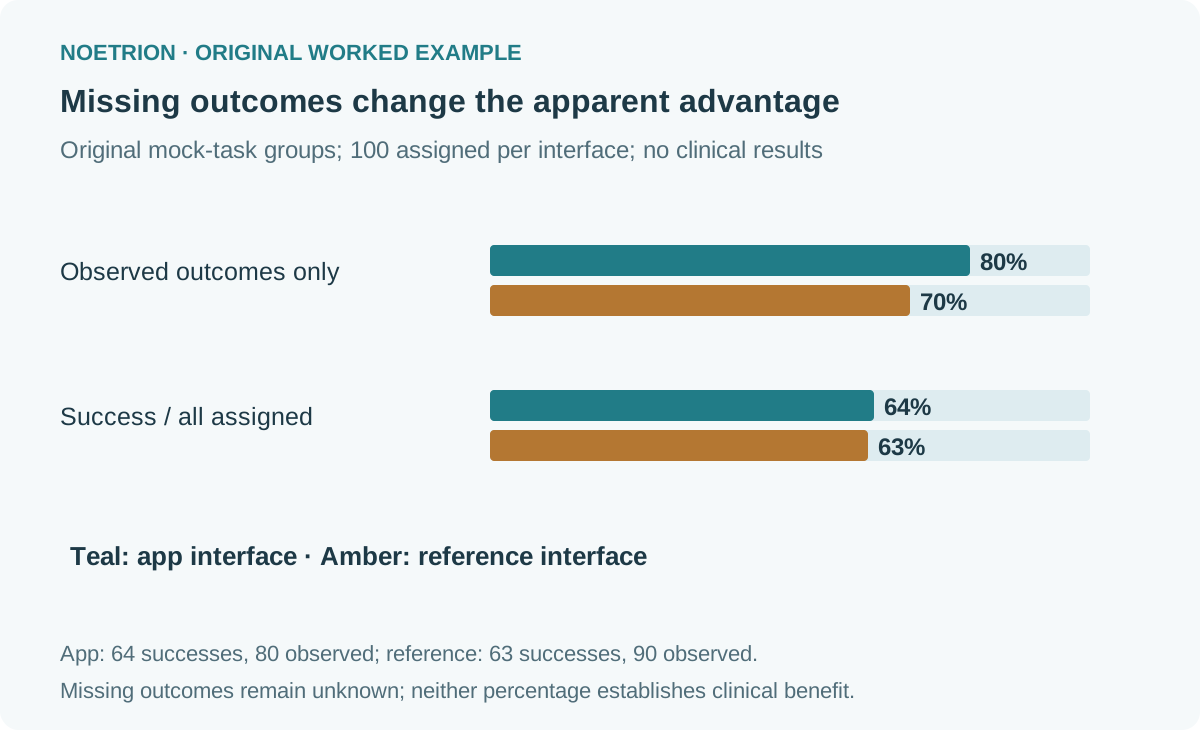
Consider a second, separate synthetic usability exercise. It uses a simulated recordkeeping task with no real medicines, patients, or treatment decisions. Two groups each contain 100 assigned participants. One uses a fictional app interface and the other a simpler reference interface.
| Mock-task result | App interface | Reference interface |
|---|---|---|
| Assigned participants | 100 | 100 |
| Participants with observed task outcome | 80 | 90 |
| Observed successes | 64 | 63 |
| Success among observed outcomes | 80% | 70% |
| Observed success among everyone assigned | 64% | 63% |
| Outcomes missing | 20 | 10 |
Among observed participants, the app appears 10 percentage points ahead. Among everyone assigned, the observed success difference is only one percentage point. The latter is not a complete estimate of true success either, because missing outcomes remain unknown.
Simple bounds make that uncertainty visible. If none of the 20 missing app participants succeeded, its all-assigned success rate is 64%; if all succeeded, it is 84%. The reference group's corresponding range is 63% to 73%. These overlapping ranges show why the observed-only advantage cannot settle the question.
Investigate missingness rather than selecting a favourite fraction
The next step is to ask why observations are missing. Did people find the interface difficult? Did the logging requirement exclude people with poor connectivity? Did a technical fault erase completed tasks? Different explanations imply different problems and follow-up work.
Predefine how outcomes will be collected and analyzed. Keep assignment, activation, observation, and success as distinct fields. Report exclusions with reasons, and preserve the original group counts. A percentage should be reproducible from the underlying table rather than copied from an analytics screenshot.
In a real clinical study, the design and handling of missing data require appropriate statistical and clinical expertise. The mock-task calculation is only an explanation of denominator sensitivity. It does not reproduce the regulatory evidence standard for a clinical claim, establish causality, or suggest that worst-case bounds alone are a complete analysis.
The principle is straightforward: a claim should survive a reasonable inspection of who was included and what was actually measured.
Review changes at the claim level
Software teams often organize releases by code changes. Readers experience releases through changed instructions, alerts, and interpretations. A small edit can therefore deserve attention even if the underlying algorithm stays the same.
Imagine changing a fictional message from record received to dose successfully taken. The second statement asserts something beyond a successful upload. An evidence review should identify that change before it reaches users. The question is not how many lines of code changed, but whether the product now asks a user to believe something different.
An internal release checklist can link each output to its evidence record and reviewer. It can also distinguish technical verification, usability testing, and clinical evidence. Keeping those categories visible makes collaboration between developers, medical teams, and regulatory specialists more precise.
A versioned claim inventory is especially useful when localization, notifications, and web dashboards are maintained by different teams. Otherwise, the carefully reviewed main screen may coexist with a broader claim in an email or push notification.
A practical next step for readers and builders
For builders, start with ten representative outputs rather than the entire codebase. Write down the exact wording, the input source, what the output proves, and what a reasonable user might infer. Resolve the largest gap first. That creates a concrete review artifact before discussions become abstract.
For readers, ask whether a claim concerns convenience, engagement, correct use, or a measured health outcome. Look for the exact product version, population, comparator, and evidence source. The presence of an app in a medication ecosystem does not answer those questions automatically.
The final FDA guidance is a timely reason to tighten that connection between words and evidence. A useful drug-related app should communicate what it knows clearly, while leaving uncertainty visible rather than covering it with a precise-looking chart.
The medical device evidence guide develops the distinction between a technical capability and a supported product claim.
Sources and scope
- FDA, Regulatory Considerations for Prescription Drug Use-Related Software, final guidance, October 2026; final PDF.
- FDA, final guidance announcement, October 20, 2026. The announcement was available in the official search result; the guidance landing page and PDF were directly reviewed.
Checked October 20, 2026. Worksheets, feature examples, engagement counts, and usability data are original synthetic teaching material. This article does not determine a product's legal status or provide treatment advice.