Pretesting Before a Lesson: Make the Wrong Answer Useful
Learn when pretesting can help, why correct-answer feedback matters, and how to build a short before-lesson exercise without turning study into guesswork.
You open a new lesson and meet a question you cannot yet answer. Should you make an attempt or read the explanation immediately? The answer depends on what happens after the attempt.
Pretesting asks learners to answer before studying the target information, then supplies the correct answer or instruction. Its value is not the mistake itself. The attempt can create a specific question for the explanation to resolve. Without correction, an unsupported guess remains an unsupported guess.
Research published in 2026 adds evidence for word-and-picture learning, but it does not show that all subjects should begin with prolonged struggle. A useful study routine keeps the initial attempt short, makes correction explicit, and tests whether the correct idea can be used afterward.
What counts as pretesting
A pretest comes before exposure to the target material. It might ask you to guess a foreign word's meaning, predict a program's output, or choose which physical quantity a diagram represents. The response is recorded before the answer is revealed.
This differs from testing yourself on yesterday's lesson, which attempts to retrieve already studied material. It also differs from a diagnostic examination used to place students into courses. A learning pretest can include questions a learner is expected to miss, with no penalty attached.
What a 2026 vocabulary experiment actually tested
In a March 6, 2026 paper, Chua and Pan reported four experiments involving adult online learners learning Spanish vocabulary through words and pictures. Participants either guessed from alternatives and received correct-answer feedback or studied the correct pairing directly. Subsequent cued recall favored pretesting; most multiple-choice comparisons also did.
The experimental setting matters. These were concrete vocabulary items, not an evaluation of a commercial app's full curriculum or evidence of conversational fluency. The first experiment's guessing condition also involved additional exposure time: eight seconds to guess, followed by five seconds of feedback, versus five seconds studying the pairing in the reading condition. Correct-pair viewing time was matched, but total trial time was not.
That distinction prevents a misleading efficiency claim. The findings support the usefulness of guessing with feedback under the tested conditions; they do not establish that the technique always produces more learning per minute. The practical routines below are editorial adaptations, not replications of that protocol.
The evidence does not make pretesting the universal winner
Mera, Dianova, and Marin-Garcia compared testing schedules with copying in laboratory word-pair learning. The article was published online November 6, 2025, and assigned to a May 2026 issue. Its first experiment found better recall with pretesting than copying, but no significant pretest–post-test difference.
A useful qualification appears in Experiment 2: the pretest–copy contrast did not survive the authors' multiple-comparison correction. Testing schedules also did not significantly differ from each other. A headline that says “testing before learning beats testing afterward” would go beyond these results.
Those laboratory tasks and short retention conditions do not settle what works best for a semester-long mathematics course. Use the evidence to justify trying a bounded learning activity, while checking its fit to your material and time budget. An apparently smooth lesson and a difficult attempt are both poor substitutes for examining subsequent performance.
Separate pretesting from productive failure
Productive failure usually describes a larger instructional sequence: learners attempt a challenging problem, then receive instruction that develops and compares the relevant ideas. It involves more than answering a vocabulary question before seeing its definition.
A 2021 experiment by Hartmann, van Gog, and Rummel compared generating failed solutions with observing failed attempts before instruction. Observing the full problem-solving process outperformed generating attempts on the study's conceptual outcome. The examples were failed attempts, not demonstrations of the correct procedure. This is a reason to distinguish the instructional designs, rather than assume personal struggle is indispensable.
| Activity | Starting point | Required next step | Main risk |
|---|---|---|---|
| Brief pretest | Target information not yet studied | Correct answer and explanation | Guess remembered without correction |
| Productive-failure sequence | Challenging conceptual problem | Structured consolidation and instruction | Unproductive time without a clear learning target |
| Correct worked example | Model solution provided | Explain the reasoning, then attempt a related task | Copying steps without understanding conditions |
For an independent learner, a teacher-designed productive-failure activity may be hard to reproduce. A two-question pretest is simpler to control. If you cannot understand the question's vocabulary or identify a meaningful distinction, begin with orientation or an example instead.
An original pretest about averaging rates
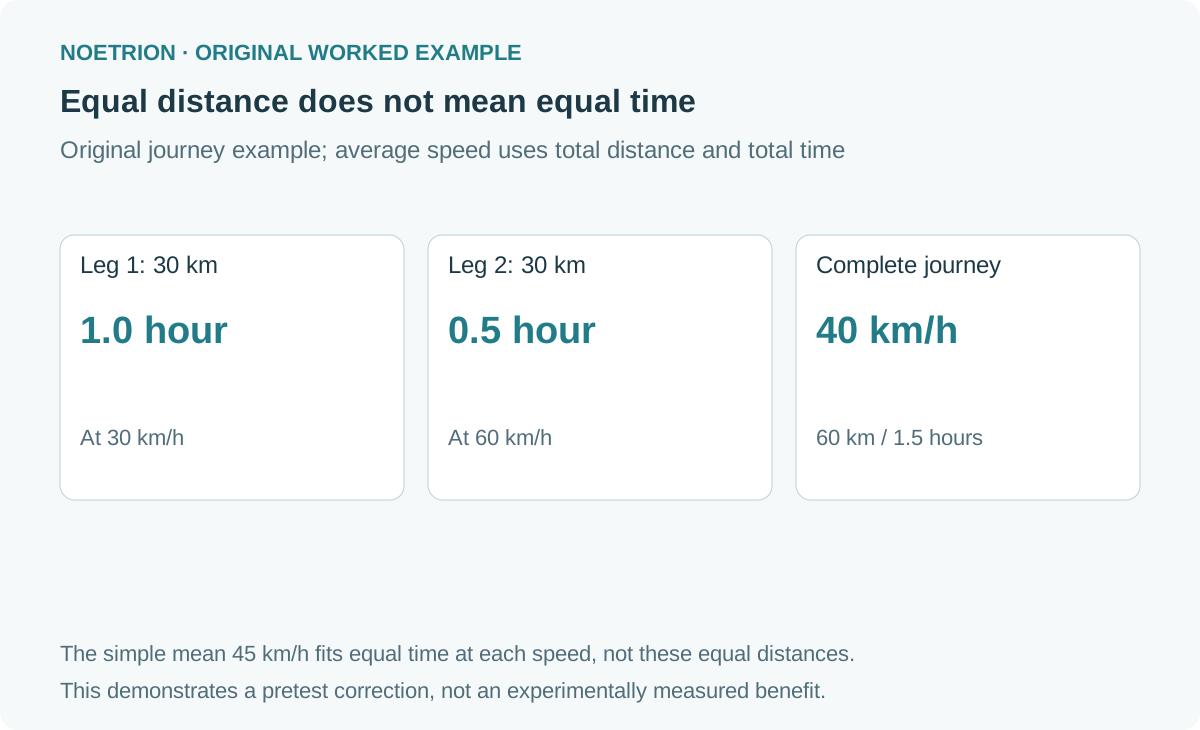
Suppose a delivery vehicle travels 30 kilometers at 30 km/h and another 30 kilometers at 60 km/h. Before reading further, choose its average speed for the complete trip: 40, 45, or 50 km/h. Write a reason, even if you are uncertain.
A tempting answer is 45, the arithmetic mean of the two speeds. The correction begins with the definition: average speed is total distance divided by total time. The first leg takes one hour; the second takes half an hour. Total distance is 60 km, total time is 1.5 hours, and average speed is 40 km/h.
The initial question is useful if the explanation resolves the exact issue your attempt exposed: the two speeds apply for unequal durations. The arithmetic mean works for equal time spent at each speed, not for equal distances in this example.
| Journey | Total distance | Total time | Average speed |
|---|---|---|---|
| 30 km at 30, then 30 km at 60 km/h | 60 km | 1.5 h | 40 km/h |
| 1 hour at 30, then 1 hour at 60 km/h | 90 km | 2 h | 45 km/h |
| 20 km at 40, then 20 km at 80 km/h | 40 km | 0.75 h | About 53.33 km/h |
Design the feedback before the question
Start by writing the correct answer and the distinction it should teach. Then create a question that makes that distinction visible. This reverses the common habit of collecting difficult questions first and hoping an answer key will supply the lesson.
Useful feedback identifies the governing idea, explains the tempting alternative, and shows a check. For the rate example, the governing idea is distance divided by time; the tempting alternative is an unweighted mean; the check asks whether the slower leg occupies more time.
Do not present a wrong answer repeatedly without clearly marking the correction. Keep the original attempt as a record, then write the corrected rule beneath it in unambiguous language. If an AI tool generates the explanation, verify it against a trustworthy textbook or authoritative course material before relying on it.
The feedback should be ready before you attempt the exercise. If the source cannot establish the correct answer, the activity is not suitable for a quick independent pretest.
Budget the attempt instead of rewarding endurance
Try a small before-lesson routine: two minutes to attempt a focused question, five minutes to study the explanation, and three minutes to answer a fresh related question. These durations are practical suggestions, not experimentally established optimal timings.
A wrong initial response can still lead to a useful ten-minute session. A correct initial guess can still leave you unable to explain the idea. Score the follow-up and inspect the reasoning rather than treating the initial result as the success measure.
For example, six such sessions take 60 minutes. If you spend six minutes guessing in each session while keeping the other stages unchanged, the total rises to 84 minutes. The extra 24 minutes need to earn their place through better subsequent performance. More struggle is not automatically more instruction.
Stop the initial attempt when it stops generating relevant ideas. If every proposed answer is random because you lack the necessary terms, read a short orientation and restart with a simpler prompt.
Keep a worksheet focused on correction
Use five fields: target distinction, initial answer, corrected explanation, fresh follow-up, and unresolved question. For the rate example, the target distinction is equal distance versus equal time. The unresolved question might be whether waiting time belongs in the journey total.
For a topic with several prerequisites, list them separately. If calculating travel time is itself unfamiliar, first study a correct example of distance divided by speed. Pretesting the average before you can interpret its components may create confusion rather than a productive question.
Check the routine on your own material
Choose four comparable lesson sections. Use a brief pretest for two and start directly with an explanation for two, keeping total study time similar. Afterward, answer new questions without viewing the solutions. Rotate the order on a later set to reduce the influence of fatigue or topic difficulty.
This is a small personal comparison, not a controlled experiment. Different topics, unequal question difficulty, and familiarity can affect the results. Its purpose is to notice whether the routine helps you engage with explanations and correct errors within the time available.
Try the following exercise: a cyclist rides 12 km at 12 km/h, then 12 km at 24 km/h. Predict, explain, calculate, and check. The trip takes 1.5 hours over 24 km, giving 16 km/h. Now explain what would need to change for the arithmetic mean, 18 km/h, to apply.
A useful pretest ends with a better explanation than you started with. The wrong answer is an opening for instruction; the corrected idea and its later use are the work that matters.
The learning transfer exercise helps design the fresh follow-up question after the correction.
Primary sources and limits
- Chua and Pan, Duolingo-inspired pretesting with words and pictures improves vocabulary learning, March 6, 2026. Four vocabulary experiments; correct-answer feedback; not a whole-app effectiveness evaluation.
- Mera, Dianova, and Marin-Garcia, Testing before learning, online November 6, 2025; May 2026 issue. Laboratory memory tasks; corrected-null comparison in Experiment 2 retained.
- Hartmann, van Gog, and Rummel, Preparatory effects of problem solving versus studying examples prior to instruction, January 4, 2021. Failed-process examples must not be confused with correct worked examples.
Sources checked October 20, 2026. Journey values, time budgets, worksheet, and exercises are original illustrations; no improvement percentage is claimed for this routine.