Pulse Oximeter Accuracy: What Skin-Tone Evidence Can—and Cannot—Tell You
Understand pulse oximeter accuracy, skin-tone evidence, bias versus individual error, and the questions buyers should ask about device validation.
This guide explains research and technology. It does not provide diagnosis or treatment, and regulatory status should be checked with the relevant authority.
A fingertip monitor shows a clean percentage. The uncertainty behind that number is much less tidy. Pulse oximeters estimate blood oxygen saturation using an optical signal; the display does not reveal the population used to validate the device, the conditions in which it was tested, or how individual errors vary.
That gap matters when a reassuring number influences what happens next. It also makes pulse oximetry a useful case study in medical technology: an accessible sensor can be valuable while still needing better evidence about whom it serves reliably.
Two studies published in 2026 sharpen the question of how pulse oximeters should be evaluated. As of October 21, 2026, the FDA page for its January 2025 recommendations still identifies the document as draft, non-binding, and not for implementation. A study evaluating proposed criteria is not a regulatory decision about every device on the market. FDA draft guidance.
What the instrument actually measures
A pulse oximeter commonly clips onto a finger and uses light to estimate oxygen saturation, displayed as SpO2, alongside a pulse rate. It does not directly analyze an arterial blood sample. The FDA describes it as an estimate and emphasizes that readings need interpretation alongside symptoms and other information. FDA consumer explanation.
For a technology buyer, that distinction changes the question. “Does it display oxygen?” is a feature question. “How closely does this device agree with a suitable reference under the conditions in which we will use it?” is a validation question. The second requires evidence for the model and sensor combination being purchased.
An impressive demonstration on a healthy colleague does not answer it. A demonstration tells you that the interface works in one moment. Validation evaluates how measurement errors behave across many observations, people, and conditions.
Why the 2026 research deserves careful reading
A study published online on April 20, 2026 compared 34 oximeters under controlled desaturation in healthy adults. It assessed performance using existing and anticipated regulatory frameworks. Its results varied substantially with the criteria and participant cohorts used. The authors reported that 18 devices could pass or fail depending on cohort selection. They also cautioned that whether revised frameworks improve real-world outcomes remains undetermined. Hughes and colleagues, primary study.
The defensible takeaway is that validation design influences conclusions. It is not that one laboratory comparison proves which device should guide an individual patient's care, or that a proposed criterion has automatically revoked existing clearance.
A separate 2026 prospective ICU study compared three cleared devices with arterial blood gas analysis. It reported different performance across the devices, including lower error for the bedside monitor than the two low-cost devices in that study. Its clinical setting adds a different kind of evidence from a controlled healthy-volunteer experiment, but three evaluated products cannot represent an entire market. ICU study.
Separate average bias from individual error
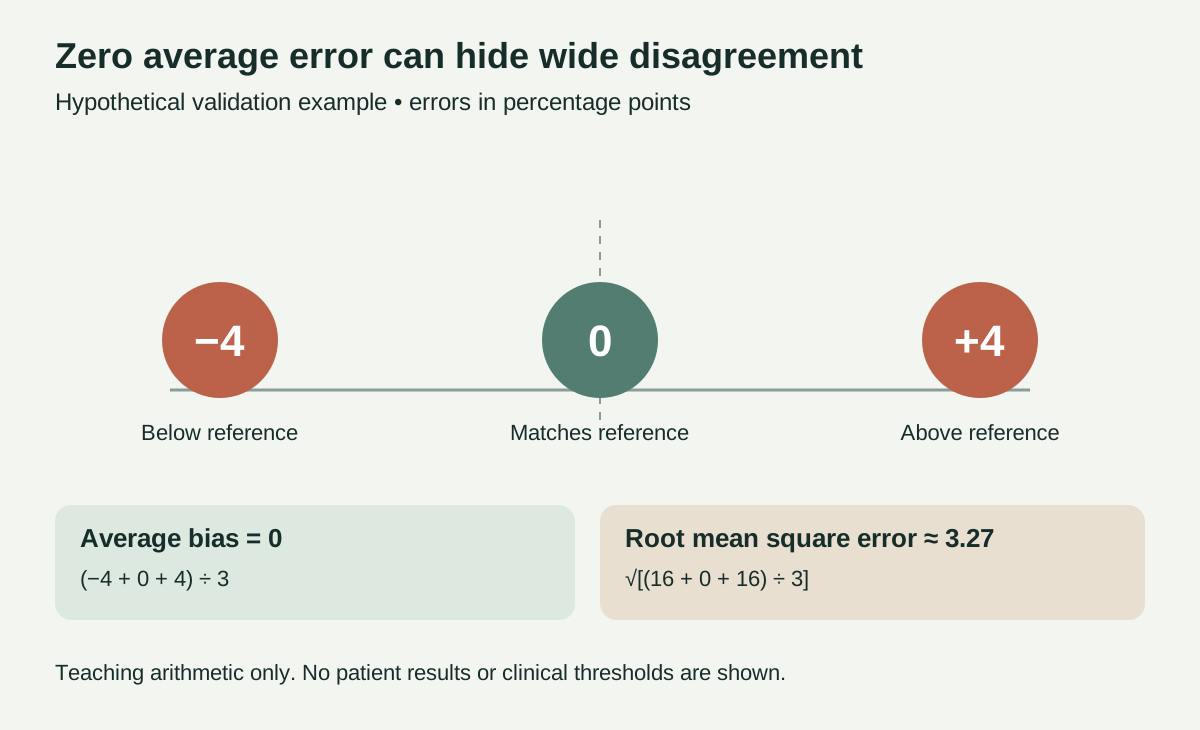
Bias asks whether readings tend to run high or low relative to a reference. Variation asks how widely the errors are spread. Both matter. A near-zero mean error can coexist with substantial individual disagreement.
Consider an invented validation exercise, with three errors measured in percentage points: −4, 0, and +4. Their average is zero. Their root mean square error is the square root of (16 + 0 + 16) / 3, approximately 3.27 percentage points. No patient conclusion follows from this arithmetic; it simply shows why an average alone is incomplete.
Now imagine a second invented device with errors −1, 0, and +1. Its average is also zero, but its root mean square error is about 0.82 percentage points. The headline “zero average bias” would obscure a meaningful difference between the two patterns.
| Evidence item | Question it answers | What it leaves unresolved |
|---|---|---|
| Mean bias | Do readings tend to run high or low? | How large can individual errors be? |
| Error distribution or limits of agreement | How dispersed are differences? | Will a different population behave similarly? |
| Subgroup analysis | Do observed errors differ across groups? | Are subgroup samples large and representative enough? |
| Controlled laboratory testing | How does performance behave in a defined protocol? | Does it transfer to clinical use? |
| Clinical setting study | What happened in the evaluated care environment? | Does it generalize to other settings and devices? |
The table is an editorial reading framework, not a replacement for a device standard or a hospital evaluation protocol.
Skin pigmentation requires its own measurement discipline
Skin tone is not interchangeable with race or ethnicity. A study may need both clinical context about populations and a defensible measurement of the optical characteristic being investigated.
A 2024 Communications Medicine primary analysis examined optical melanometry for pulse-oximetry studies. It described limitations in instruments and measurement approaches while identifying potential benefits for characterizing pigmentation more objectively. The point is not that any instrument produces an unquestionable ground truth; characterization itself has uncertainty. Melanometry study.
When reading a subgroup claim, ask how pigmentation was measured, at which body site, and whether the selected categories were specified before analysis. Then ask how many participants support each estimate. Repeated readings from a small number of people add observations, but do not automatically provide the diversity of a much larger participant cohort.
A practical evidence checklist for procurement
Start with the intended workflow. An emergency department, a home-monitoring program, and a student demonstration have different consequences when a measurement is misleading. Write down the setting before comparing specifications.
Request the exact model, compatible sensor, software version where relevant, intended use, and accessible validation documentation. Ask whether the study population and measurement conditions resemble the intended deployment. Record missing information explicitly rather than treating an absent answer as favorable evidence.
For each candidate, create a short evidence sheet with four fields: claim, source, applicability, and unresolved question. For example, a hypothetical vendor may cite a healthy-adult study for a critical-care purchase. The source may be legitimate while the transfer to the proposed setting remains uncertain. That is a reason for clinical and biomedical engineering review, not an accusation that the study is invalid.
Price belongs in this comparison, but so do training, sensor replacement, maintenance, and escalation procedures. A low purchase price cannot compensate for an undefined response when readings conflict with the patient's condition.
What users should do with an uncertain reading
The FDA advises following professional guidance and the manufacturer's instructions, keeping track of symptoms as well as readings, and contacting a health professional when symptoms are serious, worsen, or a reading is concerning. It also identifies factors such as poor circulation, skin temperature, pigmentation, and fingernail polish that can affect accuracy. FDA use guidance.
Do not turn the evidence about subgroup differences into a homemade correction formula. Adding or subtracting a fixed number assumes a predictable error for a particular person and circumstance. The studies discussed here do not establish that rule. Serious or worsening symptoms should prompt medical assessment rather than repeated attempts to obtain a comforting display.
Frequently asked questions
Does a medical-purpose device equal a wellness gadget? No. The FDA distinguishes medical-purpose products from general wellness and sporting products that it does not review for clinical decision-making. Product appearance and online availability do not resolve that distinction. FDA product categories.
Do these studies show every device has the same skin-tone error? No. The 34-device study reported variation across models and participants. A broad concern should lead to model-specific evidence, not a universal numerical adjustment.
Is a laboratory result useless if it is not a clinical outcome trial? No. It answers a bounded measurement question. The mistake is extending that answer to outcomes or settings the study did not evaluate.
Sources and review scope
Sources were checked on October 21, 2026: FDA draft performance guidance (January 2025); FDA Pulse Oximeter Basics; Hughes et al. (2026, DOI 10.1213/ANE.0000000000008048); the 2026 ICU study (DOI 10.1088/1361-6579/ae622c); and the 2024 melanometry study (DOI 10.1038/s43856-024-00550-7). Links above support the associated claims. This article explains evidence evaluation; it does not set treatment or escalation thresholds for an individual patient.