Python Model Persistence: Restore the Whole Pipeline Before Upgrading
Save and restore a complete scikit-learn pipeline, check trusted artifacts and dependency versions, and separate prediction parity from model quality.
The training notebook runs. The model file exists. A colleague downloads it, calls predict, and gets a number. That can feel like a successful handoff until someone notices that the input was measured in kilometres while the training pipeline expected a standardized value.
Saving a Python model is easy to demonstrate. Preserving the meaning of its predictions takes more work. You need the fitted transformations, input contract, executable dependencies, and evidence that restoration behaves as intended. You also need to decide whether loading the file is an acceptable trust decision before you inspect its predictions.
That question is timely during upgrades. Python 3.15's October 9, 2026 release and scikit-learn's September 2026 version 1.9.1 fixes create sensible reasons to review an environment. Neither release turns an old fitted artifact into a supported cross-version deployment.
Separate four questions before loading anything
A useful deployment review asks four questions in order: who supplied this artifact; what environment interprets it; what inputs it expects; and what outputs would demonstrate a successful restoration. These questions require different evidence.
The Python pickle documentation warns that unpickling can execute arbitrary code. A .joblib extension does not remove that concern: scikit-learn's persistence guide identifies joblib as pickle based. Treat a trusted model handoff like an executable dependency, with controlled distribution and review.
A SHA-256 digest can detect that bytes differ from a reference. It cannot make an unknown publisher trustworthy. If an attacker can replace both a model and an unsigned manifest, matching the new digest proves little about authenticity. Record where the reference came from and how it is protected; do not describe a successful checksum as malware detection.
| Question | Useful evidence | What it does not establish |
|---|---|---|
| Is this an approved artifact? | Authorized producer and protected release record | Good predictions |
| Is this the intended runtime? | Python and dependency versions, platform details | Complete semantic compatibility |
| Does the input mean the same thing? | Names, order, units, missing-value and category rules | Similar future data |
| Does restoration preserve outputs? | Fixed inputs and approved expected outputs | Generalization or business value |
Persist the fitted transformations with the estimator
Suppose training uses four invented input values: 0, 10, 20, and 30. The corresponding targets are 5, 25, 45, and 65. A fitted standard scaler transforms the input before linear regression learns the relationship. In this simple dataset, the complete pipeline reproduces y = 2*x + 5.
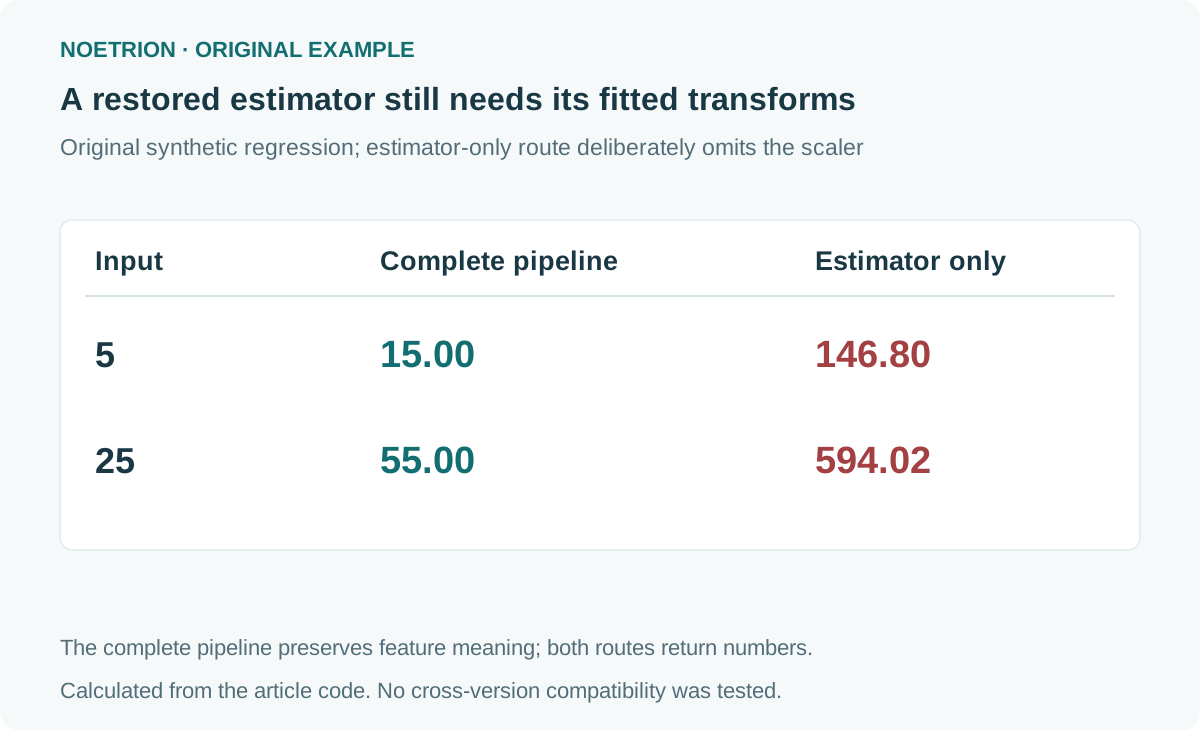
For inputs 5 and 25, the pipeline therefore returns 15 and 55. The final regression object alone expects standardized inputs. Giving it the original values produces approximately 146.80 and 594.02 instead. Nothing about a successful method call reveals that mismatch.
The Pipeline API composes intermediate transformations and a final estimator. Scikit-learn's common pitfalls guide explains why transformations learned during training also need to be applied to subsequent data. Packaging the fitted sequence makes that relationship harder to lose during handoff.
This does not mean a pipeline automatically validates units or every external dependency. A separate feature computation performed before the pipeline still belongs in the release contract. So does a custom transform implemented in your own importable package.
Run a small same-environment restoration example
This original example creates its own trusted artifact inside a temporary directory, immediately restores it in the same process, and compares predictions with independently specified expected values. It does not accept an uploaded file or demonstrate safe loading of an unknown model.
from io import BytesIO
from pathlib import Path
from tempfile import TemporaryDirectory
import hashlib
import joblib
import numpy as np
from sklearn.linear_model import LinearRegression
from sklearn.pipeline import make_pipeline
from sklearn.preprocessing import StandardScaler

train_x = np.array([[0.0], [10.0], [20.0], [30.0]])
train_y = np.array([5.0, 25.0, 45.0, 65.0])
probe = np.array([[5.0], [25.0]])
expected = np.array([15.0, 55.0])

pipeline = make_pipeline(StandardScaler(), LinearRegression())
pipeline.fit(train_x, train_y)

with TemporaryDirectory() as folder:
    path = Path(folder) / "own-trusted-pipeline.joblib"
    joblib.dump(pipeline, path)
    payload = path.read_bytes()
    digest = hashlib.sha256(payload).hexdigest()
    restored = joblib.load(BytesIO(payload))
    actual = restored.predict(probe)
    np.testing.assert_allclose(actual, expected, rtol=1e-12, atol=1e-12)
    print("Restored:", np.round(actual, 2).tolist())
    print("SHA-256:", digest)

wrong = pipeline[-1].predict(probe)  # Deliberately bypasses scaling.
print("Estimator only:", np.round(wrong, 2).tolist())
The printed predictions are Restored: [15.0, 55.0] and Estimator only: [146.8, 594.02]. The digest identifies the bytes from that run; it is not a universal expected checksum. The tolerance is deliberately tight for this tiny numerical example, rather than a recommended tolerance for every estimator or platform.
We executed this example with Python 3.12.14, scikit-learn 1.8.0, NumPy 2.3.5, and joblib 1.5.3. Current documentation was checked separately. We did not test cross-version restoration into Python 3.15 or scikit-learn 1.9.1, and the example makes no such compatibility claim.
Build a release bundle someone else can reconstruct
A real release needs more than the two probes above. Store an approved model identifier, protected artifact digest, training-code revision, dependency lock information, input specification, and reference to an immutable training-data snapshot where appropriate. Preserve privacy and access controls around that snapshot; reproducibility does not require making sensitive training data public.
Add a small, non-sensitive fixture with expected outputs. Include ordinary cases, relevant boundaries, and supported missing-value behavior. A categorical model should exercise known and unknown category handling. A numeric model should include unit-sensitive cases and unacceptable non-finite inputs where your serving contract rejects them.
Describe where validation happens. If the service rejects a missing column before calling the estimator, the restoration test should exercise that service boundary. A notebook that always constructs the right array cannot prove that an API rejects a scrambled request.
| Bundle item | Example entry | Failure it helps investigate |
|---|---|---|
| Input schema | One numeric feature, original units, fixed order | Wrong feature meaning |
| Runtime record | Exact tested Python and package versions | Environment drift |
| Golden fixture | Inputs 5 and 25; expected 15 and 55 | Lost transformation |
| Data and code references | Approved snapshot and repository revision | Inability to rebuild |
| Acceptance policy | Output checks and owner-approved tolerance | Unexplained release decision |
Treat an upgrade as a separate candidate release
Scikit-learn explicitly does not support loading fitted models across different scikit-learn versions. An old file might deserialize, yet still produce unexpected behavior. Do not suppress an incompatibility warning and call the result an upgrade plan.
A practical migration separates two lanes. In the recovery lane, reconstruct the approved old environment and demonstrate that the existing release still works. In the candidate lane, rebuild or retrain using reviewed code and data under the proposed dependencies, then evaluate the new result against a stated acceptance policy.
This distinction prevents a common circular test: producing new predictions after an upgrade and immediately adopting those predictions as the expected baseline. Keep the approved reference available while investigating differences. Some differences may be justified by a documented bug fix; that explanation still needs evidence and an owner.
For surrounding project structure and dependency declarations, see our pyproject.toml guide. A declaration helps describe an environment; actually recreating and testing it is another step.
Distinguish prediction parity from model quality
If restored outputs match the original outputs, you have evidence about preservation. You have not shown that either set of outputs is accurate on new cases, fair across relevant groups, or useful for the business decision.
Imagine an original, hypothetical fixture of 100 cases. The restored release matches all 100 expected predictions. A separate labeled evaluation contains 100 different cases, and both releases make 22 errors. Restoration parity is 100%; predictive correctness on that separate set is 78%. Reporting only the first number would misrepresent the evidence.
Likewise, a candidate matching 98 of 100 reference outputs is not automatically worse. Inspect the two changed cases against their labels and operational consequences. The old answer may have been wrong, or the change may reveal a preprocessing defect. See our pipeline evaluation guide for keeping learned transformations within a valid training and evaluation workflow.
Test recovery with a fresh process and a realistic boundary
The code above is a first diagnostic, not a complete recovery drill. A fresh process can reveal missing imports hidden by notebook state. A clean, recreated environment can reveal dependencies omitted from the release record. Exercising the actual request parser can reveal a schema mismatch that direct array calls never encounter.
For an operational drill, ask a colleague to restore the approved release from its documented inputs without relying on the original notebook session. Record the missing steps, elapsed recovery time, and whether the service produced the expected response. Keep the deployment route reversible until those checks pass.
Retaining an old environment also creates maintenance work. Track security support, access, and a replacement plan instead of preserving an outdated image indefinitely. Recovery readiness and timely patching are both requirements to manage.
Choose the format for the deployment you actually need
Some systems only need prediction serving; others need a Python estimator object for further inspection. These are different requirements. Scikit-learn discusses ONNX for serving without restoring the original Python object and skops for more inspectable persistence, with support and review limitations. Neither choice eliminates input validation or operational testing.
Write down your format decision alongside its consequences: supported estimator types, required runtime, custom-code dependencies, review process, and migration route. The useful outcome is a release another person can restore and explain—not simply a file that loads on its author's laptop.
Sources and verification scope
Reviewed October 21, 2026. Primary references: Python 3.15 release, scikit-learn 1.9 changelog, model persistence, Pipeline, preprocessing pitfalls, pickle security, and hashlib. All datasets and evaluation counts here are original teaching examples. Only the stated same-environment round trip was executed; no production recovery, attack simulation, or release benchmark was performed.