A Python Package Resource Is Not Necessarily a Permanent File Path
Read Python package data without depending on the working directory. Test a ZIP-backed resource and keep temporary filesystem paths inside their valid lifetime.
A command-line tool reads templates/report.txt successfully when launched from its source folder. After installation, a colleague runs it from another directory and gets a missing-file error. Changing the colleague's working directory might hide the symptom, but it leaves the program dependent on an accidental launch location.
Package-owned data has a different identity from a user-supplied file. It belongs to an importable package and should be located through that package. There is another boundary to consider: the resource might live inside an archive, so obtaining an ordinary filesystem path can require temporary extraction.
This evergreen guide uses Python 3.12-compatible standard-library interfaces, checked on 31 October 2026. Its controlled ZIP-backed example was executed with Python 3.12.14. It creates its own empty package and tiny text resource; it does not import downloaded or untrusted code.
Decide who owns the file before resolving it
An application's bundled template, a customer's input spreadsheet and a generated output report have different owners and lifecycles. Treating all three as paths relative to the current directory creates avoidable ambiguity.
For a user-selected input, accept an explicit path under the application's access rules. For output, choose an explicit destination and publication policy. For immutable data shipped with a package, begin with that package's resource interface.
| Item | Useful identity | Question to settle |
|---|---|---|
| Bundled template | Package and resource name | Was it included in the installed distribution? |
| User input | Explicit supplied location | Is this the intended accessible file? |
| Generated result | Declared output destination | When does it become a completed artifact? |
The table is an original design aid. It prevents a storage convenience from becoming the definition of ownership.
Read the resource without inventing a filesystem layout
The Python importlib.resources reference provides files(anchor), which returns a traversable resource container. Its documentation explicitly allows resources that do not exist as ordinary filesystem files, including resources associated with ZIP-loaded packages.
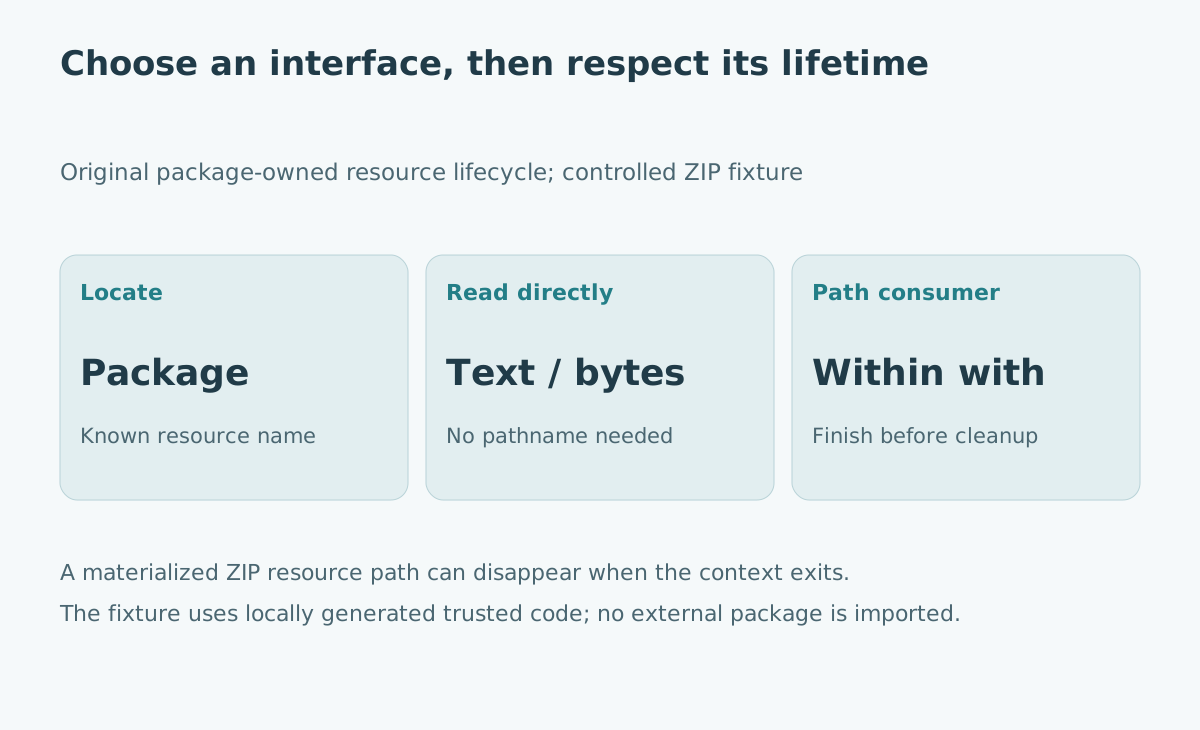
When a consumer needs text, use the resource's text-reading interface with an explicit encoding. When it needs bytes, keep the boundary binary. Converting a resource object to a string and handing that string to open() is not a portable substitute for reading the resource.
For a real project, expose a small function such as “load the default template” rather than making every caller reconstruct the package's internal directory arrangement. This gives a later package reorganization one place to update.
Run a tiny ZIP-backed fixture
The zipimport documentation explains that Python's normal import machinery can use ZIP entries on sys.path. Here that capability creates a controlled packaging condition. The package initializer is deliberately empty.
import importlib
from importlib.resources import as_file, files
from pathlib import Path
import sys
from tempfile import TemporaryDirectory
from zipfile import ZipFile

name = "noetrion_resource_fixture_oct31"
with TemporaryDirectory() as folder:
    archive = Path(folder) / "bundle.zip"
    with ZipFile(archive, "w") as bundle:
        bundle.writestr(f"{name}/__init__.py", "")
        bundle.writestr(f"{name}/rules.txt", "mode=demo\n")

    sys.path.insert(0, str(archive))
    importlib.invalidate_caches()
    try:
        package = importlib.import_module(name)
        resource = files(package).joinpath("rules.txt")
        assert resource.read_text(encoding="utf-8") == "mode=demo\n"
        with as_file(resource) as materialized:
            assert materialized.is_file()
            assert materialized.read_text(encoding="utf-8") == "mode=demo\n"
            extracted_path = materialized
        assert not extracted_path.exists()  # This ZIP fixture was extracted.
    finally:
        sys.path.remove(str(archive))
        sys.modules.pop(name, None)
        importlib.invalidate_caches()

print("Direct resource read and ZIP-backed path lifetime passed")
Both readings return the same original payload. The second requires a real path only while the context is active. The final assertion describes this executed ZIP fixture; it is not a promise that every as_file() call creates or deletes a physical file.
Keep the consumer inside the context
Suppose a report renderer accepts only a pathname. Call the renderer and finish its use of that path before leaving with as_file(resource). Returning the temporary path from a helper and using it later can pass tests on a source checkout while failing for archive-backed resources.
The importlib reference specifies that leaving the context cleans up temporary materialization when one was required. If the original resource already exists as a regular file, the implementation may provide that existing location instead. Application logic should rely on the context's lifetime contract rather than on observing which storage case happened today.
A background worker makes this especially easy to get wrong. Starting work inside the context is insufficient if the worker opens the file only after the context exits. Either complete the consumption within the lifetime or transfer the needed contents through a suitable owned interface.
Copy deliberately when the application needs ownership
Sometimes the consumer truly needs a longer-lived file. Make that an explicit copy into an application-controlled location, with clear ownership, cleanup and permissions. The copied file has a new lifecycle; it should not be described as the original package resource's permanent path.
Decide whether changes to the copy should survive a package upgrade. For example, a user-customized template might be initialized from a bundled default once, then maintained separately. Replacing it blindly whenever the package version changes could erase the user's edits.
Keep the resource read-only from the application's perspective unless the package explicitly defines another contract. An installed resource is not an appropriate implicit destination for runtime output.
Test the installed artifact, not only the checkout
The resource API cannot retrieve data that was omitted from the distribution. Test the actual installation artifact in an isolated environment, then exercise the resource-loading function from a working directory outside the source tree.
For the application's own tests, include direct text reading, the pathname-only integration and the consumer's completion before cleanup. A missing resource should produce an error naming the package and intended resource, without silently falling back to an unrelated file found in the working directory.
The demonstration above tests archive-backed access and lifetime. It does not build a wheel or prove that a particular build configuration includes package data. Those are separate checks for the real project's packaging process.
Keep resource selection narrow
If users can select among bundled templates, map supported names to known resource names. Avoid treating arbitrary input as permission to browse every exposed package resource or import any named package.
Resource access also does not make importing an untrusted package safe. The fixture uses a locally generated package with an empty initializer precisely to keep that issue outside this example. The ZIP import and resource-limit guide covers a different boundary involving untrusted archives.
The reliable pattern is to locate data through its actual owner, choose the interface the consumer needs and keep any temporary path within its documented lifetime. This removes the launch-directory assumption without replacing it with an equally fragile pathname assumption.
Sources and scope
- Python 3.12 importlib.resources reference, checked 31 October 2026: resource containers, direct reads and
as_file()context lifetime. - Python 3.12 zipimport reference, checked 31 October 2026: importable packages in ZIP archives.
The fixture, payload and application examples are original. No third-party package, distribution builder or asynchronous consumer was tested by this small standard-library demonstration.