Python SpooledTemporaryFile: A Rollover Threshold Is Not a Memory Budget
Learn when Python spooled temporary files move to disk, why fileno changes storage, and how to enforce separate chunk and total-size limits.
A service accepts small reports, assembles them in memory and hands a file-like object to a parser. Most reports are tiny. Occasionally, one is hundreds of megabytes. SpooledTemporaryFile looks like a convenient middle ground: keep small content in memory and move larger content into a temporary file.
The trap is treating its rollover threshold as a complete resource policy. It is a storage-switching rule. It does not independently limit incoming chunks, total accepted content, concurrent requests or filesystem consumption.
This guide uses established Python 3.12 interfaces, checked on 28 October 2026. The example was executed with Python 3.12.14. It is an evergreen implementation guide, not an announcement of a newly released feature.
What the spool actually promises
The Python tempfile documentation defines two automatic triggers: exceeding max_size, or requesting fileno(). Calling rollover() explicitly also moves the contents into a filesystem-backed temporary file. The default binary mode accepts bytes.
A downstream library can therefore change the storage behavior without adding content. If it asks for an operating-system file descriptor, a small spool must become a real temporary file. That can introduce filesystem latency or a storage error at a point that otherwise looks like a read-only integration step.
Plan around the documented interface rather than assuming “small file” means “never touches the filesystem.” A temporary directory may itself reside on a memory-backed filesystem, so rollover is also not proof that physical RAM consumption has disappeared.
Separate three different sizes
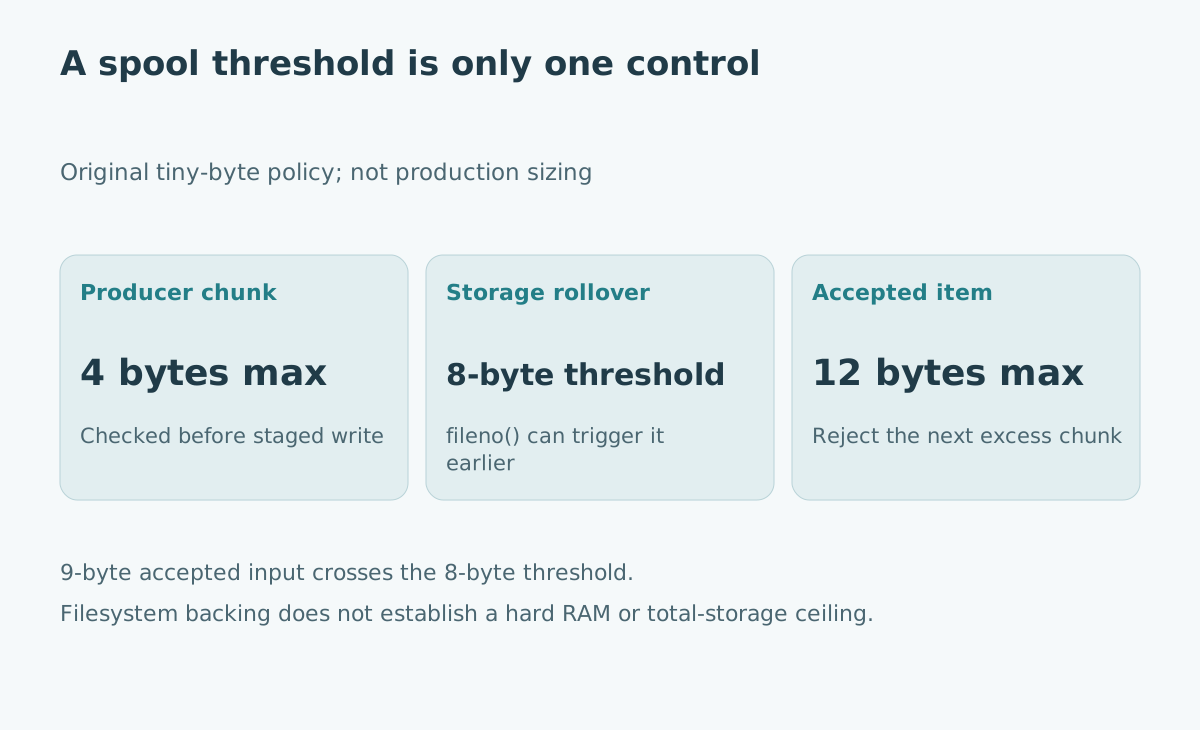
Consider a deliberately tiny policy:
| Control | Example value | Question it answers |
|---|---|---|
| Maximum incoming chunk | 4 bytes | How much content may one producer step hand over? |
| Rollover threshold | 8 bytes | When should the spool switch its backing store? |
| Maximum accepted content | 12 bytes | How large may this complete item become? |
These controls are independent. A 13-byte item must be rejected even if the filesystem has ample capacity. A 9-byte chunk violates this producer contract even when the total limit would allow it. A call to fileno() may switch storage when only 4 bytes have arrived.
The chunk check occurs after a producer has created the chunk. To constrain upstream allocation, configure the producer's read size and relevant transport limits too. Checking a giant bytes object cannot undo its allocation.
Build a bounded acceptance example
The following standard-library program deliberately does not expose partially accepted content to a final consumer. It stages the item, checks every chunk and returns a digest only after acceptance. This is a tiny illustration of a boundary, not an upload server.
import hashlib
from tempfile import SpooledTemporaryFile


def accepted_digest(chunks, *, max_chunk=4, max_total=12, spool_at=8):
    if not (0 < max_chunk <= max_total and spool_at > 0):
        raise ValueError("Invalid size policy")
    total = 0
    with SpooledTemporaryFile(max_size=spool_at, mode="w+b") as staged:
        for chunk in chunks:
            if not isinstance(chunk, bytes):
                raise TypeError("Chunks must be bytes")
            if len(chunk) > max_chunk:
                raise ValueError("Chunk exceeds producer contract")
            if len(chunk) > max_total - total:
                raise ValueError("Item exceeds accepted size")
            staged.write(chunk)
            total += len(chunk)
        staged.seek(0)
        digest = hashlib.sha256()
        while block := staged.read(max_chunk):
            digest.update(block)
        return total, digest.hexdigest()


size, digest = accepted_digest([b"abcd", b"efgh", b"i"])
assert size == 9
assert digest == hashlib.sha256(b"abcdefghi").hexdigest()

for invalid in ([b"abcde"], [b"abcd"] * 4):
    try:
        accepted_digest(invalid)
    except ValueError:
        pass
    else:
        raise AssertionError("Invalid content was accepted")

with SpooledTemporaryFile(max_size=8, mode="w+b") as small:
    small.write(b"abcd")
    descriptor = small.fileno()  # This requests a real file descriptor.
    assert isinstance(descriptor, int)
    small.seek(0)
    assert small.read() == b"abcd"

print("Accepted 9 bytes; oversized cases rejected; descriptor path passed")
The 9-byte accepted item crosses the 8-byte threshold. The invalid cases test different failures: one chunk is too large; the other item becomes too large across individually valid chunks. The final block verifies that requesting a descriptor preserves the small payload.
Understand what the example does not cap
The program enforces accepted payload length, not a process-memory ceiling. Python objects, the incoming chunk, spool buffers, parser allocations and other requests all require resources. In CPython 3.12.14, inspection of the local implementation shows a write happens before its threshold check; a threshold is therefore unsuitable as a hard peak-memory guarantee.
The io documentation also distinguishes binary streams from text streams. Keep this boundary in bytes when the policy is expressed in bytes. Character counts are a different measurement, and encoding can change the number of bytes required.
A decompressed or parsed representation may be much larger than the staged input. Apply separate limits to expanded content and parsing complexity rather than assuming a bounded compressed upload makes every later stage bounded.
Make downstream requirements explicit
Before choosing this abstraction, list the consumer's needs. Does it require seeking, an actual descriptor, a persistent pathname or repeated reads? A file-like API does not imply all of those contracts are interchangeable.
If the consumer requires a pathname that another process can reopen, select and test a suitable named-file workflow. Do not assume the spool's name is a portable path. The tempfile documentation specifically warns against relying on a temporary file having a visible filesystem name on every platform.
Likewise, a returned descriptor remains owned by the open file object. A consumer that closes it unexpectedly can break subsequent work. Establish ownership and lifetime conventions at the integration boundary.
Treat filesystem failure as an ordinary path
Rollover can fail when the selected filesystem is full, unavailable or subject to a quota. Test the deployment's temporary directory and permissions. If its location matters, supply an explicit directory whose lifecycle and capacity the application controls.
Use the context manager to close resources on normal completion and exceptions. However, cleanup is not a transaction that publishes the output safely, nor does it erase every possible copy of sensitive content. Keep staging separate from durable publication; the atomic JSON replacement guide covers a different, later boundary.
For a web service, add bounded concurrency and request deadlines. Twelve accepted bytes per request becomes a different operational problem when thousands of requests can remain open together.
Test boundaries instead of private implementation fields
Useful acceptance cases include empty input, exactly the total limit, one byte over it, an oversized first chunk, a non-bytes chunk and a generator that raises after yielding valid content. Confirm that failures do not trigger final publication.
Test a consumer that calls fileno() even for a small file. Exercise filesystem errors in an isolated test environment. Application logic should not depend on private fields such as _rolled, which can change across implementations.
Choose the spool because its storage transition matches a real workload. Then document the independent limits that make that workload affordable. That produces a resource policy another engineer can inspect rather than a reassuring number attached to the wrong parameter.
Sources and scope
- Python 3.12 tempfile documentation: official API behavior, rollover triggers, cleanup and platform differences; checked 28 October 2026.
- Python 3.12 io documentation: stream capabilities and the binary/text distinction; checked 28 October 2026.
The executable example and byte policies are original. Local CPython 3.12.14 implementation inspection supports the write-before-check observation; it is not presented as a public compatibility promise for every Python implementation.