Python zip(strict=True) Catches Length Mismatches—but Only When You Consume It
Prevent silent truncation with Python zip(strict=True), then handle lazy errors, duplicate keys and positional mismatches before writing results to another system.
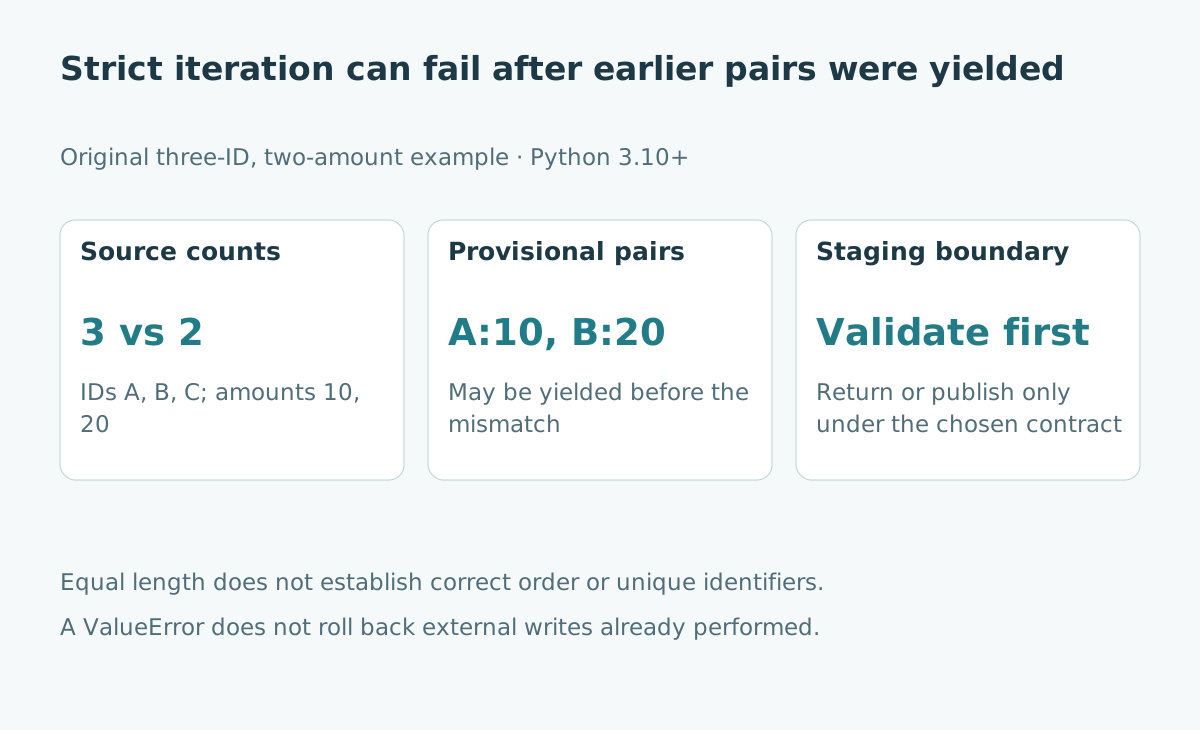
Three invoice identifiers arrive with two amounts. An ordinary zip produces two pairs and stops. The program may complete without an exception, leaving the third invoice unaccounted for. A clean exit is not evidence that every source record was processed.
Python provides zip(..., strict=True) for cases in which the inputs must have equal lengths. The feature was introduced in Python 3.10; it remains useful in current Python and is not a new 3.15 feature. The subtle part is that the check belongs to iteration, so earlier pairs may already have been produced before a mismatch is discovered.
The built-in function documentation and PEP 618 define this behavior. The examples below use only the standard library and can run on Python 3.10 or later.
Know the default contract
Ordinary zip stops when the shortest input is exhausted. That can be appropriate when truncation is intentional, for example pairing a finite sequence with an indefinitely generated counter. It is dangerous when equal cardinality is a data requirement that nobody checked.
Do not replace every zip call mechanically. First state whether the intended result should stop at the shortest input, require equal lengths or retain unmatched positions. These are three different contracts.
| Requirement | Candidate operation | Decision still needed |
|---|---|---|
| Stop at shortest | zip(a, b) |
Is dropping a tail intentional? |
| Require equal lengths | zip(a, b, strict=True) |
When is it fully consumed? |
| Keep unmatched positions | itertools.zip_longest |
What does the fill value mean? |
A fill value should not silently become a real zero or an empty identifier. Missingness needs a meaning appropriate to the application.
Watch the error arrive
This executable example shows both the default truncation and the strict iterator's partial progress. The exception is caught so the script can demonstrate the expected failure.
ids = ["A", "B", "C"]
amounts = [10, 20]
assert list(zip(ids, amounts)) == [("A", 10), ("B", 20)]

pairs = zip(ids, amounts, strict=True)
assert next(pairs) == ("A", 10)
assert next(pairs) == ("B", 20)
try:
    next(pairs)
except ValueError:
    print("Mismatch detected after two provisional pairs")
else:
    raise AssertionError("A length mismatch should have failed")
Creating pairs does not validate all input. Taking the first item does not validate the rest. The mismatch appears when consumption reaches the inconsistent boundary.
That is especially important when inputs are generators. A function can return an iterator successfully while the eventual consumer encounters the error later. Record which layer owns full consumption and failure reporting.
Keep side effects outside provisional iteration
Imagine writing each pair directly to a remote system. Two writes could succeed before strict zip raises. Catching the exception does not remove those writes. The application needs a publication or transaction design consistent with its failure requirements.
For a bounded small batch, materialize and validate the pairs before publishing. For large streams, choose a durable staging process or an explicit partial-commit protocol. A list is not a safe substitute for resource planning on unbounded input.
This complete function demonstrates a small-batch contract:
def stage_pairs(ids, amounts):
    rows = list(zip(ids, amounts, strict=True))
    keys = [key for key, _ in rows]
    if any(not isinstance(key, str) or not key for key in keys):
        raise ValueError("IDs must be nonempty strings")
    if len(keys) != len(set(keys)):
        raise ValueError("IDs must be unique")
    return rows

assert stage_pairs(["A", "B"], [10, 20]) == [("A", 10), ("B", 20)]
for keys, values in [(["A", "B"], [10]), (["A", "A"], [10, 20])]:
    try:
        stage_pairs(keys, values)
    except ValueError:
        pass
    else:
        raise AssertionError("Invalid batch was accepted")
The function does not validate amounts, authorize writes or guarantee a remote transaction. Its useful promise is narrower: no rows are returned unless pairing completes and the stated ID checks pass.
Equal length does not establish identity
Two lists can have the same length and the wrong order. If identifiers are A, B and C while values were independently sorted into C, A and B order, strict zip sees no cardinality error. It has no evidence about the lost relationship.
Prefer keyed records when values come from independent sources. Join on stable identifiers and validate uniqueness and match coverage. Positional pairing is appropriate only when the input contract establishes corresponding order.
Record that assumption near the boundary. A later refactor that sorts only one list can preserve lengths while corrupting every relationship.
Duplicate keys are another independent problem
Passing strict pairs into a dictionary does not preserve duplicate identifiers as separate records. Later values for the same key replace earlier ones. Equal length cannot detect that semantic loss.
result = dict(zip(["A", "A"], [10, 20], strict=True))
assert result == {"A": 20}
assert len(result) == 1
This behavior is normal for a dictionary. The error would be assuming that a normal container operation also enforces the application's unique-record requirement. Check uniqueness before collapsing records into a keyed structure when duplicates are invalid.
Avoid reusing consumed inputs
An iterator is a stateful source. A validation pass can consume it, leaving no records for the processing pass. Calling zip twice on the same generator does not automatically replay the original data.
For small input, stage once and reuse the staged result. For repeatable larger input, reopen a versioned source under an explicit policy. For one-shot streams, design validation and storage together rather than assuming you can rewind.
Also remember that discovering a length mismatch can consume input while checking for exhaustion. Do not use the remaining iterator state as an exact error-recovery ledger without understanding the consumption path.
A practical self-check
A strict zip is created and passed to a function that reads only its first item. Has the equal-length requirement been established? No. The inconsistent tail may never be consumed.
Before publishing paired data, ask four questions: are the counts compatible, is the order meaningful, are identities unique and are the values valid? Each is a separate contract.
For keyed pairing instead of positional pairing, read pandas merge validation. The shared skill is preserving every intended record and making unmatched work visible.
Sources and limits
- Python built-in functions: zip: default, strict and lazy behavior.
- PEP 618: equal-length checking and the point of failure.
Checked October 23, 2026. Examples are original and executed during publication checks. The staging example assumes a bounded batch and does not implement an external transaction.