Python 3.15 Lazy Imports: Faster Startup Needs a Failure Plan
Use Python 3.15 lazy imports selectively, measure startup and first-use latency, and test delayed dependency failures before deploying.
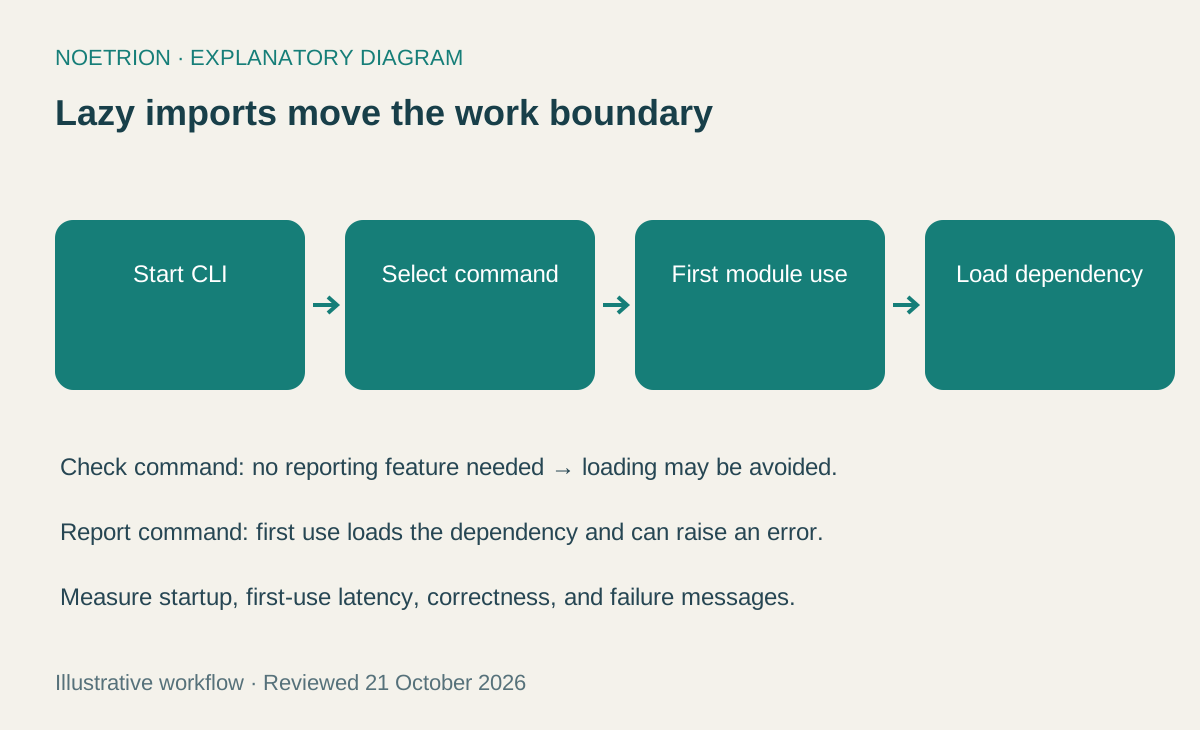
A command-line tool should not need its plotting stack just to print a help message. Yet a small entry point can import a reporting module, which imports a chart library, which initializes dependencies before the user has chosen a command. Python 3.15 offers a direct way to defer that work. The engineering question is where the work should happen instead.
Python 3.15 was released on October 9, 2026. Its official release overview includes explicit lazy imports among the major changes. This article focuses on one adoption problem: preserving understandable startup, first-use latency, and failure handling. It does not assume that switching imports automatically makes an application faster.
What a lazy import actually changes
An eager import loads a module when the import statement runs. With the new syntax, an imported name can remain a proxy until it is used. That makes it possible to retain an organized import section while postponing initialization. The language reference documents the important boundary: loading errors appear at first use, rather than necessarily at the import statement.
# Requires Python 3.15 or later.
lazy import statistics


def summarize(values):
    return statistics.mean(values)
The example is deliberately small. It demonstrates the syntax without suggesting that deferring this particular standard-library module delivers a meaningful saving. In a real project, choose a candidate from measurements, not from a list of supposedly heavy package names.
A useful mental model is a restaurant that prepares a rarely ordered dish only when someone orders it. Less food is prepared unnecessarily, but the first customer still waits for preparation. You have changed the schedule of work, not abolished it.
Choose a dependency with a real boundary
Start with the application’s command map. Which commands need charts? Which need cloud credentials? Which simply validate a local file? A dependency used by every command is a weaker candidate than a dependency used only by an optional export path.
PEP 810 explains the opt-in design and the behavioral shifts associated with delayed loading. Read it as a design rationale; use the released language reference for the implemented contract. One especially useful review question is whether importing a module is currently being used to register plugins or initialize shared state. Deferral can change when that initialization happens.
| Candidate | Why consider deferral? | What to verify first |
|---|---|---|
| Optional chart export | Most invocations may never render a chart | First export latency and missing dependency message |
| Always-used configuration | Little unused work may be avoided | Whether early validation is required |
| Plugin registration module | Registration may depend on import side effects | Explicit initialization and discovery order |
| Health-check dependency | Readiness should reflect actual availability | Which dependencies the check really exercises |
This table is an editorial decision aid. It is not a universal recommendation to mark these categories lazy. Application architecture determines the answer.
Build a two-command experiment
Imagine a tool called ledger_tool with check and report commands. The check path reads a compact file and validates records; the report path additionally builds a chart. Your experiment should compare both paths before and after a narrowly scoped change.
Create a fresh environment for each supported interpreter. Record the Python version, package versions, operating system, command, input file size, and whether the process is fresh. Keep the same fixtures across variants. The CPython command-line documentation describes -X importtime, which can help locate import-time work. It is a diagnostic instrument, not a substitute for end-to-end timing.
python -X importtime -m ledger_tool --help
python -X importtime -m ledger_tool check sample.csv
python -X importtime -m ledger_tool report sample.csv
For each command, collect several fresh-process observations and report a median plus an indication of spread. Separate a cold first report from subsequent operations inside an already running process. Otherwise, an attractive startup result can conceal an unacceptable delay when a user finally requests the feature.
The result you want is a decision statement: “This change avoids initializing the reporting dependency for validation-only invocations, while the report path remains within our latency target.” Attach actual measurements when you have them. No benchmark numbers are supplied here because they would depend on a workload that has not been measured.
Keep optional-dependency failures close to the feature
A delayed import can move a broken environment into a less obvious part of the user journey. A service may appear to start successfully, then fail on its first export request. Treat that as a readiness-design issue.
For an optional feature, a local eager import can still be the clearest solution. The importlib documentation also provides dynamic import facilities when the module name is chosen at runtime. New syntax does not make those tools obsolete.
def export_chart(rows):
    try:
        import matplotlib.pyplot as plt
    except ModuleNotFoundError as exc:
        if exc.name not in {"matplotlib", "matplotlib.pyplot"}:
            raise
        raise RuntimeError(
            "Chart export requires the reporting dependencies."
        ) from exc
    values = [row["amount"] for row in rows]
    fig, ax = plt.subplots()
    try:
        ax.plot(values)
        fig.savefig("report.png")
    finally:
        plt.close(fig)
This example deliberately uses an ordinary function-local import. It gives the feature an explicit failure boundary, and it avoids disguising an unrelated missing dependency inside a generic installation message. The plotting package is illustrative, not part of Python’s standard library. A production exporter should also define output ownership, overwrite behavior, and validation of rows.
Test behavior, not only successful startup
Write an acceptance checklist before editing imports. The help command should succeed in the minimal supported installation. The report command should succeed in a fully provisioned installation. If reporting is optional, removing that extra should produce the intended feature-specific error. If it is mandatory, the readiness check should exercise it before the service accepts traffic.
Add a fixture that depends on initialization order if the application uses plugin discovery. Compare the registered command list and output artifacts. A process that exits with status zero but silently loses a command is not a successful migration.
Also review observability. Record whether a failure happened during startup, first feature use, or normal operation. That context is more useful to an operator than the phrase “import failed.” Keep exception causes available in diagnostic logs while showing users a concise explanation.
Compatibility and limitations
The new lazy statement requires Python 3.15 syntax support. It cannot be hidden inside a runtime version check to make an older parser accept it. The released reference also limits where explicit lazy syntax can appear: it is a module-scope feature, with restrictions including function bodies, class bodies, and try blocks. Do not mechanically insert lazy into an existing optional-import handler.
For code supporting older Python versions, review the documented __lazy_modules__ alternative carefully, or retain ordinary local imports. Declare interpreter support honestly in project metadata and test the oldest supported version. A package that imports successfully on your development machine can still fail before execution on an unsupported interpreter.
Finally, lazy imports are not a general solution to slow data processing. If loading is a tiny fraction of total runtime, optimizing it may have little practical value. Keep the change only when its measured benefit exceeds its complexity and delayed-failure cost.
Frequently asked questions
Does lazy importing make every operation faster? No. It can avoid work on paths that never use a dependency. A path that does use it still pays the loading cost, potentially at a more visible moment.
Should every optional dependency use the new syntax? No. A local eager import may provide a clearer exception boundary and broader interpreter compatibility.
What should a team do first? Measure a real command, choose one optional boundary, and compare startup, first use, output correctness, and failure messages before expanding the change.
Sources and review scope
Python 3.15 syntax was reviewed against the released documentation; it was not executed because the available interpreter was Python 3.12.14.
Primary references checked October 21, 2026: Python 3.15 release overview, lazy import language reference, PEP 810, CPython command-line options, and importlib. The migration experiment, command names, and operational checklist are original illustrative recommendations; no measured speedup is claimed.