A Faster Robot Demo Does Not Automatically Make a Faster Production Line
Evaluate robotics announcements with line throughput, availability and good output. Work a three-station example before converting a faster demonstration into ROI.
A robot completes a picking motion in twenty seconds instead of thirty. The demonstration is impressive. Whether it improves the factory's output depends on what happens before the pick, after it and when the robot encounters a case it cannot handle.
The question is timely after NVIDIA's October 21, 2026 expansion of its Isaac robotics platform. The announcement describes a reference humanoid, simulation and learning tools, and partner activity. These are vendor descriptions of capabilities and plans, not independent proof of throughput in a buyer's production line.
This article develops an original three-station example. The aim is to connect a local cycle-time claim with the complete service the machine must provide.
Define the output before timing the motion
Is the required output a picked object, a correctly placed object, an inspected assembly or a packaged unit accepted by the next process? A motion can succeed locally while the work item still needs correction.
Write the start and finish conditions. Include presentation of the item, recognition, handling, placement and any required checks where they belong in the task. If a demonstration begins with a perfectly positioned object, say so when comparing it with an uncontrolled incoming stream.
| Measure | Useful question | Missing context to check |
|---|---|---|
| Motion time | How long does a movement take? | Preparation and completion work |
| Cycle time | How long between completed cycles? | Downtime and exceptions |
| Line throughput | How many units leave the full process? | Bottlenecks and buffers |
| Good-output rate | How many accepted units are produced? | Rework and inspection criteria |
| Recovery time | How long until useful operation resumes? | Human intervention and restart checks |
Find the line's ideal constraint
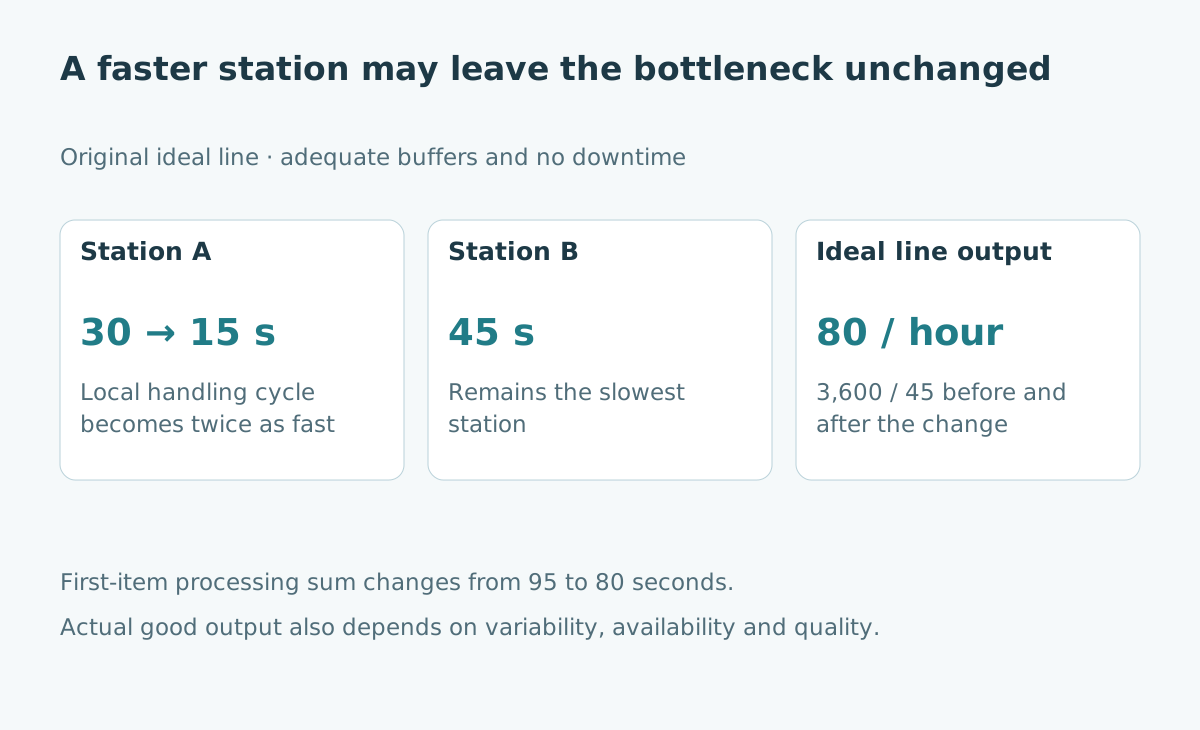
Suppose three stations have cycle times of 30, 45 and 20 seconds. Under the stated ideal assumptions, the slowest station limits steady-state throughput. One unit every 45 seconds is 3,600 / 45 = 80 units per hour.
If the first station improves from 30 to 15 seconds, the 45-second station remains the bottleneck. The line's ideal steady-state rate remains 80 per hour. The faster station may still have other benefits, but the local speedup alone does not raise this model's output.
| Original station | Before | After local robot improvement | Ideal capacity after change |
|---|---|---|---|
| A: handling | 30 s | 15 s | 240 units/hour |
| B: processing | 45 s | 45 s | 80 units/hour |
| C: inspection | 20 s | 20 s | 180 units/hour |
These are station capacities, not three quantities to add together. The same work item passes through the line. Actual throughput can be lower when variability, blocking, starvation or other constraints are present.
Separate first-item time from steady-state rate
The sum of 30 + 45 + 20 = 95 seconds describes a simplified first item's processing time when the stations begin empty and transfer is instantaneous. It is not the time between all later outputs once work overlaps.
After the first station is accelerated, that sum becomes 80 seconds. So the change can improve this first-item measure while leaving the bottleneck's steady-state rate unchanged. A clear evaluation reports which metric matters to the customer.
For short batches, setup and first-item timing can be important. For long runs, steady-state flow and interruptions may dominate. Do not carry a conclusion from one workload into the other without checking.
Add downtime and quality carefully
Suppose the line's ideal rate is 80 units per hour, it operates for 90% of a scheduled eight-hour shift, and 95% of the resulting units are accepted. A simplified expected good-output calculation is 80 × 8 × 0.90 × 0.95 = 547.2 units.
The fractional value is a planning expectation, not a possible observed count for a single shift. The model assumes that the availability factor applies to the whole line and that the quality fraction is defined consistently. It does not model the sequence of failures or rework loops.
An attractive speed claim can be offset by frequent recovery. Conversely, a robot with a slower nominal motion may produce more accepted output if it runs reliably in the intended conditions. Collect the evidence rather than assuming either relationship.
Give exceptions their own record
Record failed grasps, uncertain perception, jams, damaged items and required human intervention. Count the time to detect, respond, recover and verify readiness. An operator's involvement is part of the workflow even when it is brief.
Do not classify every excluded item as outside scope after the trial. Define the supported item population in advance. Preserve the share of incoming work that the system cannot handle, because someone still needs to process it.
Test whether one recovery blocks upstream and downstream work. Buffer design and safe operating rules can make the same component failure have different effects on line output.
Treat simulation as evidence for a defined question
Simulation can support design exploration and training, but its usefulness depends on whether its assumptions represent the target environment. Object variability, contact behavior, sensing, latency and human activity can all matter.
The 2026 smart manufacturing roadmap hosted by NIST identifies integration, heterogeneous sensing and control, reliability and safety among industrial AI challenges. It is a research roadmap, not certification of a vendor's system.
Ask which claims were demonstrated in simulation, on physical hardware and in a production-like setting. Keep the test conditions with the result so that a later reader can judge what transferred.
Build an acceptance trial around good output
Choose representative items and operating conditions, a baseline process, the output definition and the observation period. Record cycle distributions, exceptions, recovery effort and accepted output, including inconvenient cases.
Then calculate the effect on the full line and on costs. Include integration, maintenance, staffing and any work shifted to another station. A faster robot can be a good investment, but its business case should follow the actual constraint.
As a self-check, station A becomes twice as fast while B remains at 45 seconds. What evidence would justify a claim of higher line throughput? A changed line model or measured full-process results showing why the former constraint no longer governs output.
For a related measurement problem, read predictive maintenance and inspection value. Both require connecting a local technical result to an operational decision.
Sources and limits
- NVIDIA Isaac platform announcement, October 21, 2026: current industry context.
- NIST-hosted 2026 smart manufacturing roadmap, July 2026: integration and reliability challenges.
Checked October 23, 2026. Every cycle time and output estimate is synthetic. The article does not validate any robot's performance or replace site-specific engineering and safety assessment.