Robotic Blood Collection: An Evidence Appraisal Worksheet
Evaluate a robotic blood-collection claim with explicit denominators, laboratory acceptance, staff workload, patient experience, and matched comparison conditions.
This guide explains research and technology. It does not provide diagnosis or treatment, and regulatory status should be checked with the relevant authority.
“Successful blood draw” sounds like a single outcome. In practice, a service can count success after finding a vein, completing a collection, or producing a specimen the laboratory accepts. Those denominators can produce very different percentages. An evidence appraisal should state which outcome the number measures before interpreting it.
On August 19, 2026, the FDA authorized Aletta for adults in outpatient settings under supervision by a person trained in phlebotomy. The announcement says one phlebotomist can oversee up to three devices and that the device does not attempt a procedure when it cannot find an appropriate vein. Those details make both supervision and non-attempts important to an operational evaluation. They do not establish that every clinic can triple throughput.
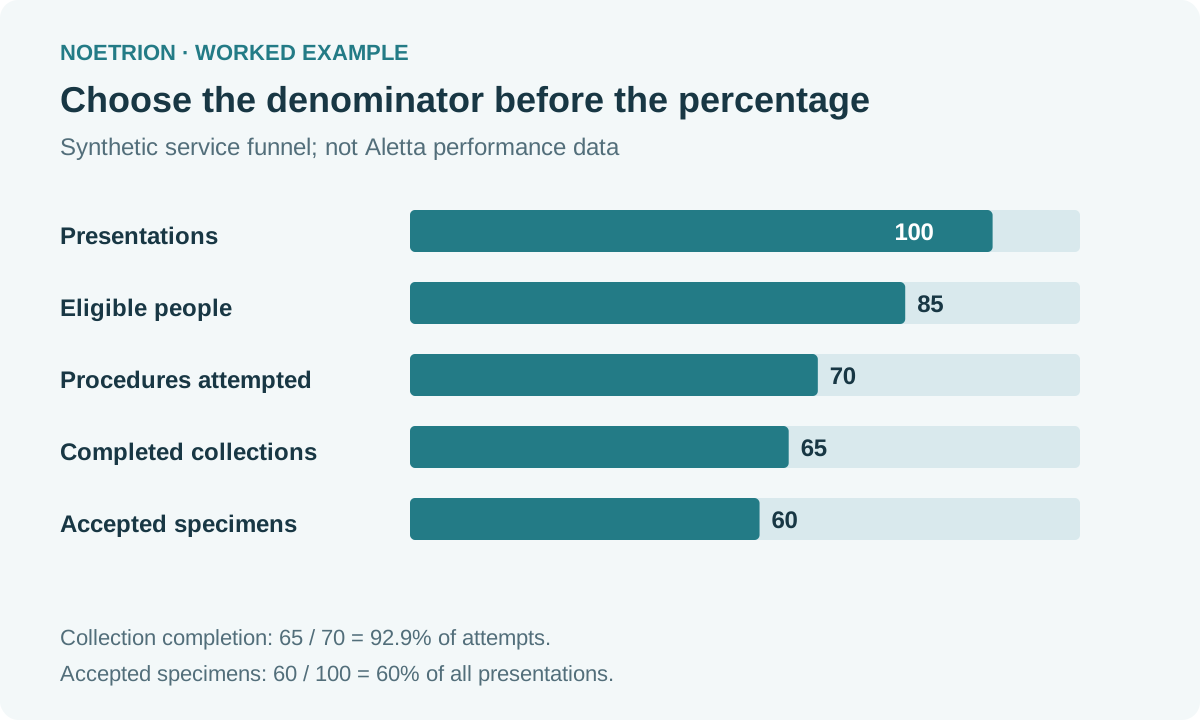
Map the pathway and its denominators
| Stage | Question | Denominator to document |
|---|---|---|
| Presentation | Who arrived for the service? | All people entering the defined pathway. |
| Eligibility | Who met the applicable intended-use conditions? | People assessed for eligibility. |
| Attempt | For whom did the device proceed? | Eligible people evaluated by the device. |
| Collection | Which attempts produced the specified sample? | Procedures attempted. |
| Usable specimen | Which samples met laboratory acceptance requirements? | Completed collections and, separately, all presentations. |
Record exclusions and withdrawals rather than quietly deleting them. An appropriate decision not to attempt a procedure may be a safety feature, while still creating a need for another collection route. The appraisal should reflect both facts.
Calculate a synthetic example
Suppose 100 people enter a fictional device pathway. Fifteen are ineligible, and the device does not proceed for 15 of the 85 eligible people. It attempts collection for 70, completes collection for 65, and produces 60 laboratory-accepted specimens. These numbers are invented teaching data, not Aletta trial results.
| Measure | Calculation | Result |
|---|---|---|
| Completed among attempted | 65 / 70 | 92.86% |
| Accepted among completed | 60 / 65 | 92.31% |
| Accepted among eligible | 60 / 85 | 70.59% |
| Accepted among all presentations | 60 / 100 | 60.00% |
The figures are compatible because they measure different parts of the pathway. Reporting only 92.86% would not reveal the 15 eligible non-attempts or the five completed collections that failed laboratory acceptance. Reporting only 60% would hide the effect of eligibility. Keep the stage counts beside the headline measure.
Check what the comparison actually compares
Request the study population, setting, comparator, sample size, outcome definitions, exclusions, follow-up, and uncertainty intervals. Determine whether participants, equipment, and staffing resemble the proposed service. Compare like denominators and document any manual rescue pathway. A device-only outcome cannot automatically be compared with a complete staff-led service outcome.
The FDA announcement describes successful draw performance when the device proceeds with a stick. Read that qualification literally. Use the regulatory record and current labeling for product-specific limits; do not reconstruct clinical rules from a promotional headline or this worksheet.
Include work surrounding the procedure
Observe patient identification, setup, cleaning, consumables, supervision, exception handling, specimen labeling, transport, and downtime. Record patient-reported experience alongside operational measures, using the service’s appropriate consent and governance processes. “Hands-on operator intervention” and “no human work” are different descriptions.
For a simple cost exercise, assume a synthetic evaluation day uses $320 in staff cost, $200 in consumables, and $180 in allocated equipment cost. Total modeled cost is $700. Dividing by 60 accepted specimens gives approximately $11.67 per accepted specimen, before any omitted rescue, transport, or overhead costs. Dividing by 70 attempts gives $10 per attempt—a different measure. State which you use.
Turn gaps into evidence requests
Finish the appraisal with three columns: documented finding, unresolved question, and decision affected. A missing downtime measure might change the staffing plan; an unclear specimen-acceptance definition might invalidate a throughput comparison. Assign those questions to the responsible clinical, laboratory, technical, or procurement team.
The worksheet’s role is to improve evidence reading. It gives no instructions for performing a blood draw and sets no clinical acceptance thresholds. The practical decision should rest on applicable labeling, qualified oversight, and evidence covering the actual service pathway.