A Salary Range Is Only the Start: Compare the Offer Behind the Number
Understand EU pay transparency timing, compare guaranteed and variable compensation, and negotiate a job offer using a practical worksheet and example.
A vacancy advertises a salary range of €48,000–€60,000. That is more useful than “competitive pay,” but it still leaves important questions unanswered. Is the range for this location? Is it base salary or includes a target bonus? What determines where a candidate lands? Is a higher first-year offer hiding a payment that disappears in year two?
Pay transparency is a live policy issue in 2026, especially after the European Union's June transposition deadline. It is also a practical career skill: making two offers comparable without treating uncertain incentives, retirement contributions, and monthly cash as the same thing.
This guide explains the timing distinction, builds an original offer comparison, and gives candidates a worksheet for a more useful negotiation. The calculations are illustrative, not a wage benchmark or personal tax estimate.
What the EU deadline does—and does not establish
Directive (EU) 2023/970 required member states to transpose its provisions into national law by June 7, 2026. Its recruitment provisions cover information about initial pay or its range, based on objective, gender-neutral criteria, and prohibit asking applicants about pay history. The Council's explanation summarizes these aims.
The distinction matters: a transposition deadline is a deadline for national implementation. It does not prove that identical recruitment rules, procedures, and enforcement mechanisms became operational everywhere on that day. Nor does it turn EU rules into a worldwide entitlement for every remote applicant.
As a concrete counterexample, the Netherlands Enterprise Agency's official business guidance, checked October 14, 2026, describes January 1, 2027 as the expected effective date and expressly says that date is not final, subject to parliamentary passage. Its prominent date header should be read together with that qualification.
For a real application, identify the employing entity and applicable national law, then check the relevant government's current implementation guidance. This article explains the directive's framework and a documented Dutch timing example; it does not assert the implementation status of all 27 member states or resolve an individual legal claim.
Ask what the range measures before anchoring on it
The first useful question is about the compensation unit. Annual gross base salary is different from annual on-target earnings. A range combining multiple seniority levels is different from the budget for one defined position.
A short clarification can save a long, unsuitable interview process: “Could you confirm the gross annual base range for this role, the location and level it covers, and which elements are variable?” Then ask how the employer places candidates within the range.
Good placement criteria describe the work: relevant experience, responsibilities, specialist skills, and the job's level. A vague promise that “strong candidates get the top” gives you little evidence for preparation. Ask what distinguishes a person hired at the midpoint from someone hired near the upper bound.
Even a precise range does not ensure that the top is available to every applicant. Treat it as information about the position and pay-setting process, rather than a commitment that your initial request will be accepted.
Separate four compensation buckets
Begin with what the contract guarantees. Then identify payments requiring performance, continued employment, or future vesting. Benefits may matter greatly, but their value is not always spendable cash.
| Bucket | Examples | Main question |
|---|---|---|
| Recurring guaranteed cash | Base salary, contractual fixed allowance | What is paid each normal year? |
| One-time or conditional cash | Signing payment, retention award | When is it paid, and can it be reclaimed? |
| Variable cash | Performance bonus, sales commission | What triggers payment, and what can be zero? |
| Deferred or noncash value | Employer pension contribution, equity, insurance | When can I use it, and what restrictions apply? |
A pension contribution is not an extra monthly salary payment. Equity is not a bank balance. An insurance benefit is not automatically worth its employer cost to you. Keeping the categories separate avoids making the offer look larger by adding incompatible quantities.
Paid leave, schedule flexibility, commuting requirements, and learning support deserve their own comparison. Their importance depends on your circumstances. Do not force everything into a single euro figure when doing so would obscure the actual trade-off.
Worked example: the higher target is not the higher guarantee
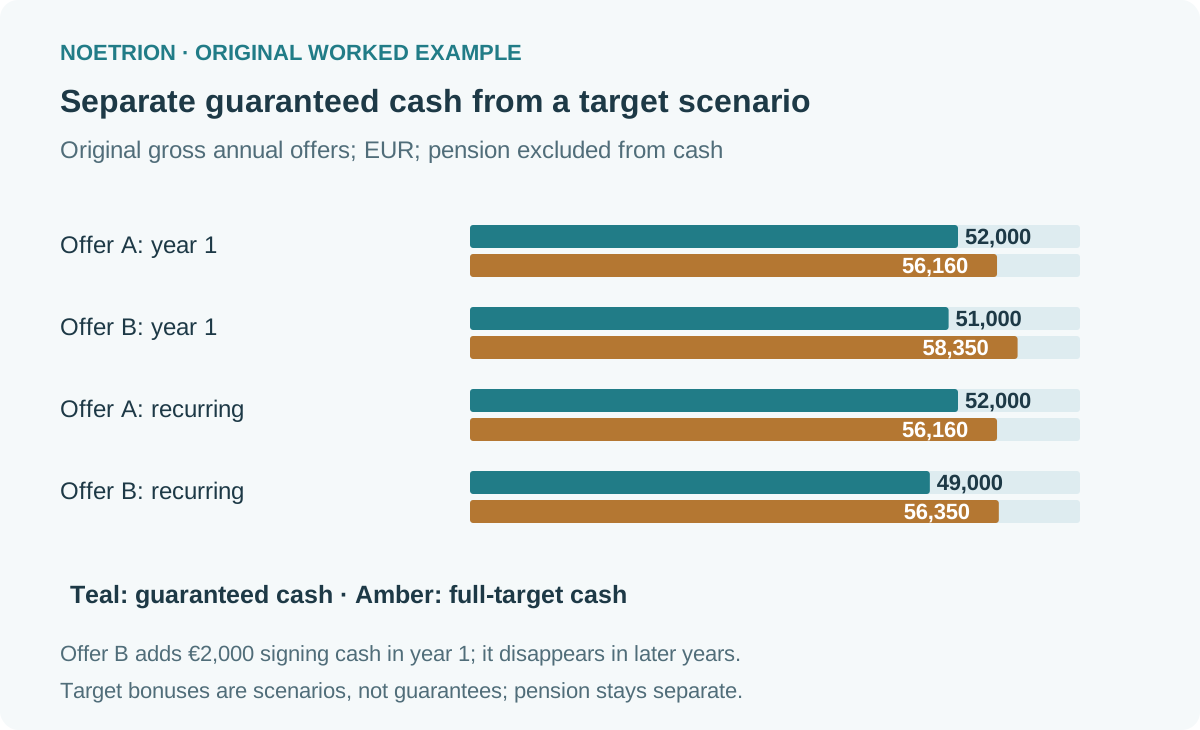
Consider two fictional offers for the same currency and assessment year. All amounts are annual gross figures. Neither offer includes equity. Ignore taxes, statutory deductions, and differences in eligibility to isolate the comparison.
| Component | Offer A | Offer B |
|---|---|---|
| Base salary | €52,000 | €49,000 |
| Guaranteed signing payment, year one only | €0 | €2,000 |
| Target bonus | 8% of base = €4,160 | 15% of base = €7,350 |
| Employer pension contribution | 5% of base = €2,600 | 8% of base = €3,920 |
| First-year guaranteed cash | €52,000 | €51,000 |
| First-year cash at full target bonus | €56,160 | €58,350 |
| Recurring cash at full target bonus | €56,160 | €56,350 |
Offer B has €2,190 more first-year cash at full target, but €1,000 less guaranteed first-year cash. After the signing payment disappears, its target cash advantage shrinks to €190. These are different comparisons, and all three can be true.
Now stress-test the bonus. Suppose A pays 75% of target and B pays 40% of target. A's cash becomes €52,000 + €3,120 = €55,120. B's first-year cash becomes €49,000 + €2,000 + €2,940 = €53,940; its recurring cash is €51,940. This scenario favors A for cash even though B's headline target is larger.
The payout percentages are assumptions for testing, not estimates of either employer's performance. Ask for the bonus rules and reliable historical payout information where available. Past payouts still do not guarantee the next one.
Calculate the uncertainty threshold
A threshold can make the discussion more concrete. Hold A at the illustrative 75%-of-target payout, giving €55,120 cash. What fraction of B's target bonus would match it?
In year one, B needs €55,120 − €49,000 − €2,000 = €4,120 bonus. Divide by its €7,350 target: 56.1% of target, rounded. In a later year without the signing payment, it needs €6,120, or 83.3% of target.
This does not predict a payout. It tells you how much the decision relies on one uncertain assumption. If you need reliable monthly cash for rent or family support, the recurring base difference may matter more than a favorable target scenario.
Avoid adding both target bonus and a separately calculated probability-weighted bonus to the same total. That double counts one payment. If you lack defensible probability estimates, a low/base/high scenario table is more honest than a precise-looking expected value.
Read the conditions that can reverse the comparison
A signing payment may require repayment if you leave before a specified date. The example assumed it was guaranteed for the first year, but a real clawback clause could make that assumption inappropriate. Request the written terms and check whether repayment concerns the gross or net amount under the applicable rules.
Bonus timing also matters. A payment made after year-end does not solve a monthly cash shortage. Eligibility may depend on being employed on the payment date, completing probation, or satisfying both company and individual targets.
For pension contributions, verify contribution basis, vesting or access conditions, and what happens when you leave. For equity, inspect the award type, vesting schedule, exercise costs where relevant, liquidity restrictions, and tax treatment. A quoted grant value can differ substantially from realizable proceeds.
Record unanswered questions as unanswered. Replacing them with optimistic assumptions makes the spreadsheet cleaner while making the decision weaker.
Negotiate using the role and the comparison
Prepare a request linked to responsibilities and evidence. For example: “The role includes ownership of the reporting pipeline and stakeholder reviews. Based on that scope and my relevant project work, could we discuss a €53,000 base?” Use authentic evidence you can explain; do not invent competing offers or inflated responsibilities.
If base cannot change, ask about a smaller number of useful alternatives: a guaranteed allowance, a documented review date with clear criteria, additional leave, or an agreed working pattern. A review date alone does not guarantee a raise. Distinguish a commitment to hold a review from a commitment to increase pay.
You can redirect a salary-history discussion toward the current role: “I would prefer to focus on this position's scope and budget. My expectation for the base is X, subject to the full package.” Whether a particular question is prohibited depends on the applicable law and implementation; the practical wording is not a legal determination.
A reusable offer worksheet
Create one row per component, with columns for amount, frequency, guarantee, conditions, payment date, written source, and unresolved question. Then produce three outputs: first-year guaranteed cash, recurring guaranteed cash, and separately labeled variable scenarios.
Add a nonfinancial section covering actual working hours, commuting days, manager expectations, probation, leave, and development opportunities. These can outweigh a modest target-cash difference. Keep evidence next to each entry: contract clause, benefit document, or a named question awaiting confirmation.
For practice, remove Offer B's signing payment from the table and set both bonuses to zero. The recurring guaranteed cash gap is €3,000 in A's favor. Next, calculate B's full-target bonus cash: €56,350. Explain why that favorable scenario still does not remove the €3,000 guarantee gap.
A strong decision need not choose the highest base. It should make clear which benefits you value, which risks you accept, and which assumptions would change your choice. A salary range helps start that process; the written package and its conditions let you finish it.
The workplace task audit can help describe role scope and responsibility when preparing a compensation discussion.
Primary sources and scope
- Directive (EU) 2023/970, adopted May 10, 2023: legal framework, including recruitment information and June 7, 2026 transposition deadline. The directive is not used here as proof of uniform national implementation.
- Council of the EU, Pay transparency in the EU and gender pay gap context, checked October 14, 2026. No raw gender-pay-gap statistic is interpreted as the pay difference for identical jobs in this article.
- Netherlands Enterprise Agency, Employers must prevent wage differences between men and women, checked October 14, 2026: expected January 1, 2027 implementation expressly subject to parliamentary passage. All offers and negotiation examples above are fictional editorial examples.