Selling Services Across Borders: Calculate the Entry Cost Before the Opportunity
Use the IMF's October 2026 services-trade analysis to build a practical market-entry worksheet, test fixed costs, and avoid mistaking GDP gains for your revenue.
A design studio can deliver a file overseas in seconds. That does not mean it can enter the customer's market at almost no cost. Contracts, professional permissions, data handling, support hours, and the ability to collect payment can matter more than the internet connection.
The opportunity is real enough to examine seriously. But the useful business question is specific: how much contribution can this particular service earn after the costs of serving this particular market? A regional growth estimate cannot answer it. A modest worksheet, built from verified requirements and realistic capacity, can.
What the new IMF analysis does—and does not—establish
The IMF published its October 2026 Asia-Pacific Regional Economic Outlook on October 15. Its services-trade chapter models a regional integration scenario that could lift the long-term level of regional GDP by close to 1%. That is a modeled change in the output level, not an extra percentage point of growth every year or a forecast for an individual exporter.
The chapter itself identifies licensing, competition restrictions, data rules, and local-presence requirements among relevant barriers. It also recognizes legitimate public-policy objectives behind regulation. The practical response is to identify applicable requirements accurately, rather than assume that every rule is pointless friction.
The publication is current, but its charts draw on different historical years, including 2022 regional integration measures, 2023 trade shares, and 2025 estimates of trade costs. A release date does not turn all underlying observations into October 2026 measurements.
Define the service before defining the market
“International consulting” is too broad to cost. A two-hour software review, ongoing payroll processing, and regulated investment advice can have very different obligations. Even within one business, advice, implementation, hosting, and customer support may raise different questions.
Write a one-sentence offer: who receives what deliverable, where it is supplied, what data is used, and what the customer may rely on. For example, a fictional studio offers a fixed-scope dashboard layout review using anonymized sample data, followed by one remote revision. That description is narrow enough to investigate.
| Offer detail | Question to resolve | Evidence to retain |
|---|---|---|
| Deliverable | What is included and excluded? | Written scope and acceptance criteria |
| Customer | Business, consumer, or regulated institution? | Customer classification and contracting entity |
| Delivery | Fully remote or involving local activity? | Actual work location and delivery process |
| Data | What information crosses which border? | Data inventory and approved handling plan |
| Responsibility | What decisions may rely on the output? | Contractual limits and applicable professional rules |
| Support | Who handles problems and in what time zone? | Service window and escalation owner |
The worksheet is a research organizer, not a substitute for local professional advice where licensing, tax, employment, or data law applies. Record unresolved requirements as unresolved. A blank cell should block an assumption, rather than quietly become a zero cost.
Separate entry costs from the cost of each contract
A fixed cost is incurred to enter or maintain the market, even if sales are weak. A variable cost changes with delivered work. Mixed costs need an explicit allocation. A monthly platform subscription, for example, might serve several markets and should not be charged in full to each one.
Use a defined period. In a first-year decision, include one-time setup and the coming year's recurring fixed costs. In a renewal decision, a setup payment already made may be sunk, but future obligations still matter. Do not mix the two questions and conclude that the market is attractive simply because a past payment cannot be recovered.
For a small service business, staff time deserves a cost even if the founder is not drawing an additional wage for it. Hours spent on repeated onboarding, translation, or late-night support have an opportunity cost. If the same hours could deliver another contract, omitting them overstates the new market's contribution.
The original calculation below uses fictional US-dollar accounting units for readability. It does not quote current exchange rates, supplier prices, or a real jurisdiction's compliance charges.
Work through a realistic-looking entry calculation
Suppose a studio charges $1,200 per project. Delivery labor costs $540, payment and currency conversion cost $36, and market-specific support costs $84. Variable cost is $660 and contribution before fixed market costs is $540 per project.
First-year setup costs $3,600. Recurring market administration costs another $2,400 for the year. The first-year fixed commitment is therefore $6,000. At a constant contribution of $540, the studio needs 12 whole completed, paid projects to cover it: $6,000 divided by $540 is 11.11, which must be rounded upward for indivisible projects.
| Completed paid projects | Revenue | Variable costs | Contribution | First-year result after $6,000 fixed cost |
|---|---|---|---|---|
| 6 | $7,200 | $3,960 | $3,240 | −$2,760 |
| 12 | $14,400 | $7,920 | $6,480 | $480 |
| 18 | $21,600 | $11,880 | $9,720 | $3,720 |
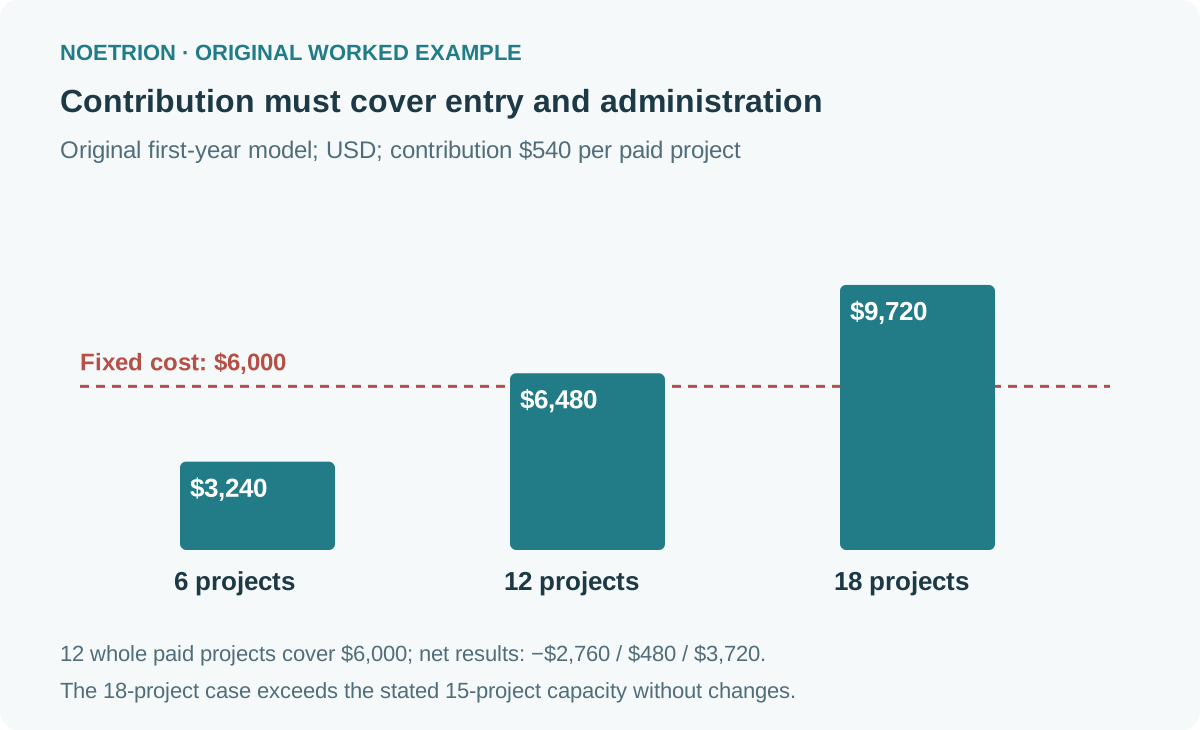
A positive result is not necessarily enough. The studio must still judge whether the return justifies risk and the use of scarce staff time. The table also assumes all projects have the same scope, are paid in full, and can be delivered within capacity.
Test the constraint that can actually break the plan
Suppose the studio can allocate only 300 delivery hours to this market during the year. At 20 hours per project, it can complete 15 projects. The maximum modeled first-year result is $2,100: 15 times $540, less $6,000. A sales target of 18 would exceed that capacity unless staffing or scope changes.
Now suppose additional support raises variable cost by $120 per project. Contribution falls to $420. The first-year break-even point rises to 15 projects, leaving only $300 at full 15-project capacity. The original opportunity has become a thin-margin commitment.
Alternatively, a 10% price discount cuts the price to $1,080. If the assumed variable costs remain $660, contribution is $420 again. Do not reuse that calculation automatically if payment fees are percentage based: recalculate the fee on the discounted price. Here the unchanged cost is an explicit simplifying assumption.
These checks reveal what deserves investigation first. Improving a website may help sales, but it will not solve a delivery-capacity limit or an underestimated support burden. Ask the question most likely to change the decision before paying for broad market expansion.
Treat a pilot as a measurement exercise
A pilot is useful when it resolves uncertainty at a bounded cost. Specify which assumptions it should test: time spent on contracting, support contacts per project, revision hours, payment delays, and the share of inquiries that become suitable paid work.
Do not treat expressions of interest as completed contracts. Record the funnel separately. A potential buyer who likes a proposal may still lack procurement approval, budget, or permission to use an overseas supplier. A pilot can expose these barriers without pretending that the entire market is accessible.
| Assumption | Pilot measurement | Decision that the measurement informs |
|---|---|---|
| Delivery requires 20 hours | Actual hours, including revisions | Price, scope, and annual capacity |
| Support costs $84 | Contacts, handling time, and staff cost | Service window and contribution |
| Setup is a one-time $3,600 | Actual paid items and recurring obligations | First-year versus renewal economics |
| Customer can contract remotely | Procurement and legal review outcome | Whether the offer is feasible |
| Customer will pay as agreed | Paid amount and actual receipt date | Exposure and contract terms |
A pilot is not an exemption from applicable requirements. Resolve mandatory permissions before performing work that requires them. When a requirement cannot be satisfied economically, documenting a no-go decision is a useful result.
Do not import a regional GDP estimate into the sales forecast
The IMF's model considers interactions across sectors and economies. A particular business faces its own competitors, customers, and bottlenecks. Even if reforms make imported services cheaper, an exporter could face stronger competition at the same time.
For that reason, “regional GDP rises by 1%, so our revenue rises by 1%” is not a defensible forecasting rule. Neither is assuming that any proposed reform will take effect on your preferred schedule. A model scenario is not a notice that a licensing or data requirement has already changed.
Keep a reform watchlist with an official source, the rule's status, the affected activity, and the effective date. Distinguish a consultation, an agreement, implementing legislation, and an operational procedure. Only change the market-entry worksheet when the relevant assumption actually changes or when you deliberately run a clearly labeled hypothetical case.
This also improves communication with partners. Instead of saying that “Asia is opening up,” state which customer activity becomes feasible, which cost falls, and which evidence supports that conclusion. A precise small opportunity is more actionable than an unsupported large one.
A useful next step for a small team
Choose one offer and one destination market. Fill in the service definition, obtain evidence for the unresolved requirements, and estimate fixed cost, variable cost, and delivery capacity for a common period. Then calculate the whole-project break-even point and one adverse support-cost case.
Assign each uncertain input an owner and a date for review. If the conclusion depends on completing 15 projects but the team can deliver only 15, there is little room for mistakes. Consider changing scope, pricing, capacity, or the size of the pilot before committing.
The final decision may be to enter, delay, narrow the offer, or decline the market. The worksheet earns its value by making those choices explicit. It cannot remove uncertainty, but it can stop a promising macroeconomic story from substituting for the economics of the work you will actually perform.
The cross-border payment comparison can help make the collection-cost assumption explicit.
Sources and verification notes
- IMF, Asia-Pacific Regional Economic Outlook, October 15, 2026: publication context and chapter overview.
- IMF, Chapter 4: Asia-Pacific's Next Integration Frontier—Services Trade: modeled long-term GDP-level effect, regulatory mechanisms, and dates underlying its figures.
Checked October 20, 2026. All company figures are original synthetic assumptions, independently recomputed. The worksheet is editorial business analysis, not a jurisdiction-specific legal or tax determination.