Spectrum Auctions: When Economics Has to Design the Market
Learn why radio licenses are interdependent, how simultaneous multi-round auctions reveal information, and why revenue is not the only policy objective.
Reviewed October 12, 2026.
Learn why radio licenses are interdependent, how simultaneous multi-round auctions reveal information, and why revenue is not the only policy objective.
| Concept | What it means | Important limit |
|---|---|---|
| Private value | Benefit particular to one bidder | Still depends on strategy and alternatives |
| Common value | Uncertain value shared across bidders | Creates winner’s-curse risk |
| Simultaneous rounds | Related licenses remain open together | Rules must discourage delay and gaming |
| Assignment stage | Determines exact frequencies or positions | Interference and contiguity affect value |
1. Spectrum is valuable because interference must be coordinated
Radio frequencies can support mobile service, broadcasting, satellites, public safety, and other uses, but transmissions can interfere when rights are unclear. Regulators define bands, geographic areas, power limits, license terms, and obligations. An auction then assigns some of those rights. The object is not a physical block sitting in a warehouse; it is a regulated permission whose value depends on technology, neighboring frequencies, coverage, existing networks, and what complementary licenses a bidder obtains.
2. Values contain both private and common components
A bidder may have private advantages such as existing towers, customers, or equipment. The license also has uncertain common value related to future demand, deployment cost, or market conditions. If the winner tends to be the bidder with the most optimistic estimate, rational participants shade bids to avoid the winner’s curse. Auction design can reveal information gradually and provide common data about the asset. Better information may increase efficiency and revenue by reducing the discount bidders apply for uncertainty.
3. Separate sequential auctions can trap bidders
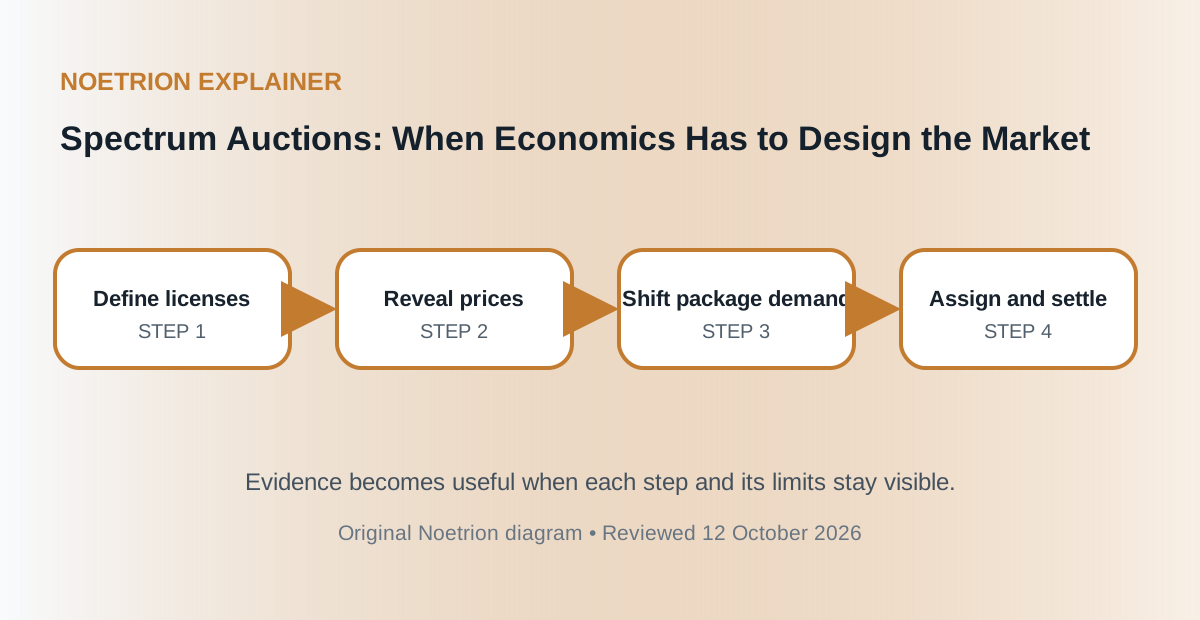
Suppose a network needs licenses in several neighboring regions. If they are sold one at a time, a bidder may win the first and then lose the complement, leaving a stranded asset. Or it may skip an early license because it cannot know later prices. Simultaneous auctions keep related licenses available across rounds so bidders can compare emerging prices and shift demand. This flexibility helps the market discover packages, though it does not eliminate exposure risk when bidders cannot submit fully conditional package bids.
4. Activity rules make price discovery possible
Without constraints, bidders could wait through early rounds, observe competitors, and enter only at the end. Activity rules require meaningful participation to preserve eligibility for later bidding. Minimum increments, stopping rules, information disclosure, and withdrawal policies shape behavior. Too much transparency can facilitate signaling or tacit coordination; too little can impair price discovery. Auction design therefore specifies an information environment and strategic game, not merely a website that accepts numbers.
5. Packages can reduce exposure and create computation problems
Combinatorial bidding lets participants express values for bundles, avoiding wins of unusable fragments. But determining the value-maximizing set of non-overlapping bids can become computationally difficult, and pricing must preserve incentives and revenue properties. Clock auctions simplify discovery through rising prices for categories, sometimes followed by supplementary bids and an assignment stage. No format dominates for every setting. Designers match complexity to complementarities, bidder sophistication, and the regulator’s ability to explain and implement the rules.
6. Revenue is one objective among several
Governments may value proceeds, but spectrum policy also concerns efficient use, competition, coverage, innovation, public safety, and opportunities for smaller providers. A reserve price can protect against an implausibly low sale, while spectrum caps or set-asides can influence market structure. Coverage obligations change both social value and bidder cost. A high auction total is not proof of success if prices impair deployment, licenses remain unused, or the market becomes less competitive. Evaluation needs outcomes after assignment.
7. Incentive auctions coordinate two sides of reallocation
Repacking spectrum can require incumbent users to relinquish rights while new users compete to acquire them. A two-sided design links a reverse auction, where incumbents state the compensation needed to exit or move, with a forward auction for new licenses. Feasibility depends on interference constraints and remaining assignments. This illustrates market design as engineering: economic incentives, optimization algorithms, legal rights, and radio physics must work together. A failure in any layer can prevent a feasible transition.
8. Audit an auction with process and outcome data
Before comparing auctions, record what was sold, reserve prices, eligibility, bidding credits, obligations, number of qualified bidders, rounds, and assignment rules. Gross bids may differ from net payments after discounts. Winning prices should be normalized carefully by population and bandwidth when useful, without ignoring license-specific conditions. Afterward, examine build-out, service quality, competition, transfers, and unused spectrum. The allocation is a beginning of public value, not the final product.
Conclusion
Spectrum auctions show why markets sometimes have to be designed before they can operate. Interdependent licenses, uncertain values, strategic timing, and engineering constraints make simple highest-bid rules inadequate. Successful formats create credible price discovery and usable assignments while serving policy goals broader than a large headline revenue number.