Stablecoin Payments: A Merchant Reconciliation and Redemption Worksheet
Trace an invoice through token receipt, conversion, fees, cash availability, and a redemption stress case before testing a payment route.
Educational analysis, not a personal investment or payment recommendation. Check the dated sources and the rules that apply in your jurisdiction.
A customer sends a token payment and the wallet shows the expected balance. Your invoice is not fully reconciled yet. You still need to establish which network carried it, which token contract you received, whether it can be converted through your approved route, and how much usable cash reaches the business after fees. Treat those as separate steps in a payment record.
The BIS’s June 2026 discussion emphasizes weaknesses involving redemption, interoperability, and trust in stablecoin arrangements. The FSB’s recommendations likewise address claims, reserves, risk management, and redemption. Neither document certifies a token or gives your business a redemption right. That right must be checked against the actual arrangement and applicable rules.
Build one record for each invoice
| Field | Evidence to retain | Why it matters |
|---|---|---|
| Commercial amount | Invoice currency, amount, and agreed payment method. | A token quantity may not equal the invoice value. |
| Asset identity | Issuer, network, contract identifier, and receiving address. | A familiar ticker is insufficient identification. |
| Transfer receipt | Transaction reference, time, quantity, and confirmation policy. | Reconciles the customer’s action with the wallet receipt. |
| Conversion route | Eligible account, executable quote, limits, and charges. | An advertised peg is not necessarily an available sale price. |
| Cash receipt | Bank or payment-account reference and value date. | Establishes when funds can meet ordinary obligations. |
Keep identifiers in a private business record rather than publishing customer wallet histories. Give the finance team a way to connect the invoice, transfer, conversion, and cash entry without depending on someone’s personal browser bookmarks.
Reconcile a synthetic $1,200 invoice
Assume the agreement calls for 1,200 tokens, each targeting one dollar. The merchant receives all 1,200 tokens, sells them at an executable price of $0.998 each, and separately pays $2 of network expense and a $3 conversion charge. These invented amounts illustrate the cash bridge; they are not current fees or terms of any issuer.
| Step | Calculation | Amount |
|---|---|---|
| Invoice | Agreed commercial amount | $1,200.00 |
| Gross conversion proceeds | 1,200 × $0.998 | $1,197.60 |
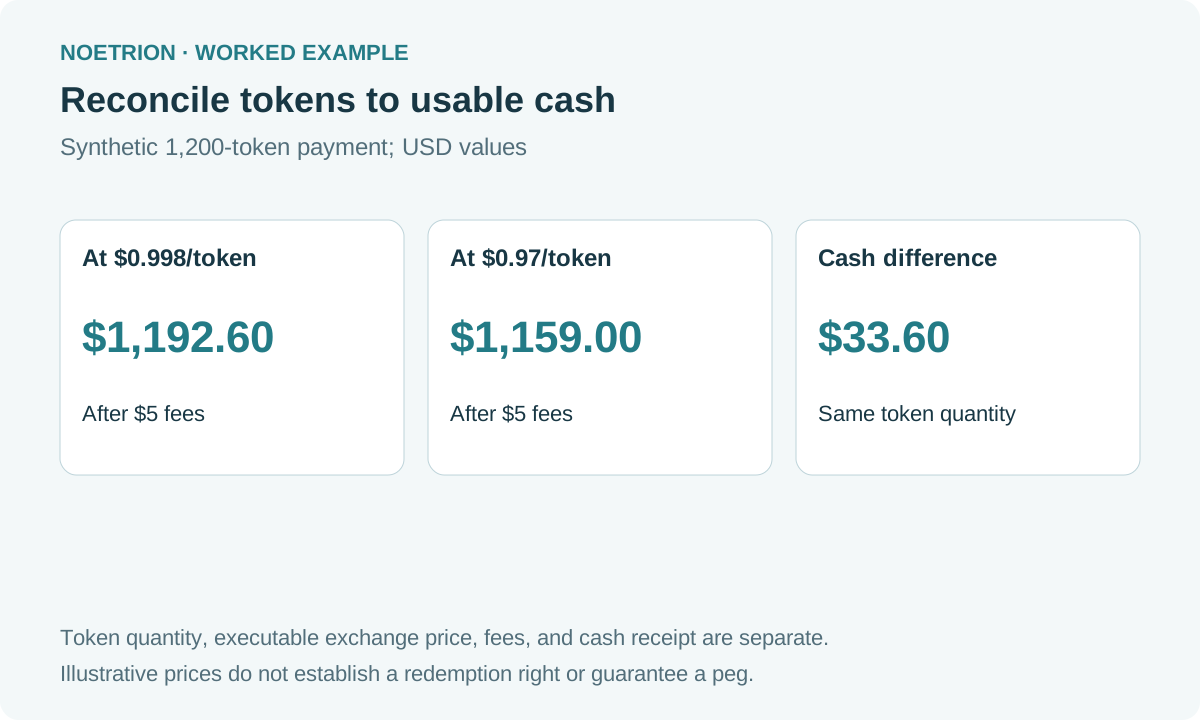
| Net proceeds after modeled charges | $1,197.60 − $2 − $3 | $1,192.60 |
| Difference from invoice amount | $1,200 − $1,192.60 | $7.40 |
The modeled difference is about 0.62% of the invoice. It combines price slippage and charges; it does not automatically mean the customer underpaid. The agreement determines what quantity the customer owed, while accounting policy determines how subsequent conversion effects are recorded. Keep those questions separate.
Stress the exit, not just the transfer
Change the executable price to $0.97 while holding the modeled charges fixed. Gross proceeds become $1,164 and net proceeds become $1,159, which is $33.60 below the baseline net amount. A quoted target price does not remove this scenario. Direct issuer redemption and selling through an exchange can have different eligibility requirements, processing times, and counterparty exposures.
Also simulate a three-day cash delay. If the business normally converts $4,000 of daily receipts, three days represent $12,000 awaiting conversion or settlement. That arithmetic describes delayed receipts, not a recommended liquidity buffer. Compare the timing with the actual payroll, supplier, and refund obligations that fall due during the period.
Use a go/no-go checklist for a small trial
- Confirm the accepted asset and network in writing.
- Document who bears transfer charges, conversion changes, and refund costs.
- Verify your business can use the proposed redemption or sale route.
- Check account access, approval controls, limits, and incident contacts.
- Reconcile one small payment all the way to usable cash.
- Rehearse a refund without assuming the original transfer is reversible.
- Record what happens if the issuer, network, wallet provider, or exchange becomes unavailable.
Define stop conditions before increasing volume: unexplained differences, an unavailable exit route, missing customer records, or funds arriving too late for obligations. The final comparison should show total cost, time to usable cash, and exception workload alongside the existing payment method. Faster transfer alone cannot answer those business questions.