Stablecoins Compete with Deposits. That Does Not Mean Every Token Drains a Bank.
Understand the BIS October 2026 deposit-rate study, distinguish asset substitution from deposit destruction, and compare a payment balance with a savings balance.
Educational analysis, not a personal investment or payment recommendation. Check the dated sources and the rules that apply in your jurisdiction.
A business holds a dollar stablecoin because a supplier accepts it. A saver holds a dollar bank deposit because it earns interest. Both balances look like cash on a dashboard, but the reasons for holding them differ. That distinction matters when a headline says banks can slow stablecoin growth by paying depositors more.
On October 13, 2026, the BIS published Working Paper 1382. Its authors find evidence that stablecoins and bank deposits are partial substitutes. Their analysis uses weekly US data from January 2019 through June 2025; higher deposit rates are followed by slower stablecoin growth, with a stronger relationship for USDC than USDT. This is useful evidence about incentives, rather than a universal rule about where every dollar ends up.
Start with the question the study actually asks
The research investigates whether deposit pricing affects the allocation of money between competing assets. The authors control for several broader financial and cryptocurrency-market conditions and address potential two-way causality using nonlinear deposit-rate pass-through. They also explicitly caution that the findings do not establish that stablecoin growth necessarily reduces aggregate bank deposits or lending. These are authors' research findings, not a BIS policy prescription.
A helpful reading habit is to write two separate sentences: “The paper finds evidence of substitution in its historical sample” and “My proposed business decision is to reduce an idle payment balance.” The second sentence requires additional facts about your own costs. It cannot be borrowed from the paper's conclusion.
Trace the balance sheet before saying money disappeared
Consider a deliberately simplified bookkeeping example. Maya transfers $1,000 from a bank account to a stablecoin issuer and receives 1,000 newly issued tokens. If the issuer initially keeps the funds in a bank account, Maya's deposit has moved to the issuer's account. Her personally held deposit falls, but that step alone does not show a $1,000 decline in banking-system deposits.
Next, suppose the issuer purchases a Treasury security from another investor. The resulting bank-account changes depend on the transaction's counterparties and settlement route. A headline about token issuance cannot substitute for tracing those entries. This example omits intermediaries, settlement timing, leverage, and other real-world complications; its purpose is to expose the missing step in an argument.
The practical question for a bank is whose deposits it loses, where replacement funding comes from, and what it costs. The practical question for a user is what claim they hold, how it can be redeemed, and when they need it. Those questions overlap without being identical.
Calculate the opportunity cost of an idle payment balance
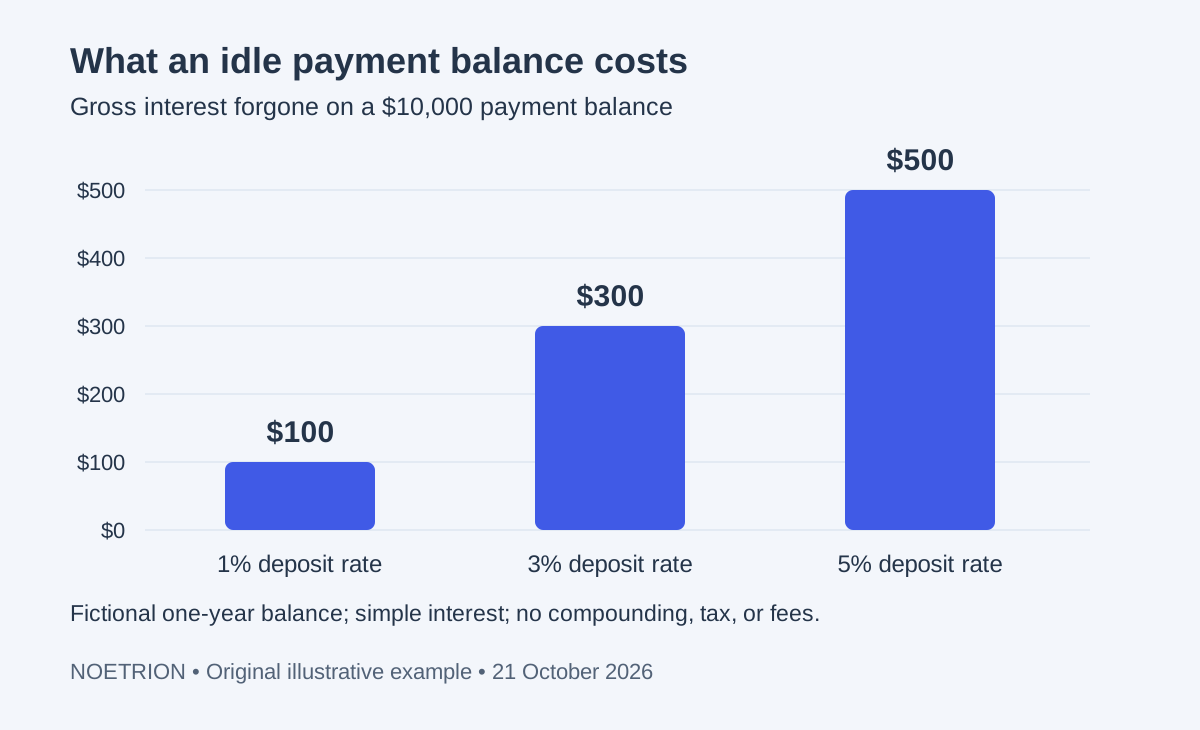
Here is a fictional decision worksheet, unrelated to any specific provider. A small importer keeps $10,000 in a non-interest-paying token balance for a full year. Assume an otherwise suitable deposit account would pay a constant simple annual rate, with no compounding or account fees.
| Hypothetical annual deposit rate | Gross annual deposit interest | Interest on assumed token balance | Gross interest forgone |
|---|---|---|---|
| 1% | $100 | $0 | $100 |
| 3% | $300 | $0 | $300 |
| 5% | $500 | $0 | $500 |
The arithmetic is balance multiplied by rate multiplied by time in years. It is not a valuation of all stablecoins. If the importer needs only $2,000 continuously and can replenish it reliably, the opportunity cost at 5% falls to $100 on that smaller average balance. The remaining $8,000 could earn a hypothetical $400 gross over a year in the alternative account.
Now include replenishment. If reducing the balance creates forty extra transfers costing $12 each, the additional $480 transfer cost outweighs that $400 gross interest benefit. The right average balance depends on transaction frequency and dependable access, as well as the quoted annual yield.
Keep payment utility separate from savings utility
A product may be useful for one job and unsuitable for another. A token can be accepted by a particular counterparty while a bank account provides direct access to payroll. The relevant comparison begins with the task, then the available rails, then the claim and costs.
For a payment balance, estimate the largest realistic near-term obligation, the time needed to replenish, and a small explicitly chosen operational buffer. For a savings balance, ask about the legal product, credit exposure, access conditions, fees, and protection. Avoid combining those tasks into a single “best cash product” ranking.
A yield displayed inside a wallet may come from a separate lending or investment arrangement. Do not assume it has the same issuer, redemption terms, or risk as the underlying token. Read the actual product documents before placing it in your comparison sheet.
Compare protections in the correct jurisdiction
Words such as “dollar,” “cash,” and “reserve-backed” do not by themselves establish deposit-insurance coverage. The Financial Consumer Agency of Canada's deposit-insurance guide, for example, distinguishes eligible deposits at member institutions from uncovered cryptocurrencies. That is a Canadian example; it does not establish rules for another country or every product marketed through a bank.
The FSB's October 12, 2026 monitoring note emphasizes that global stablecoin arrangements cross jurisdictions and sectors, complicating oversight and monitoring. For a user, that supports a concrete diligence question: which entity owes me money, under which terms, and through which route can I recover it?
Create separate rows for token issuer, wallet or exchange, bank on-ramp, blockchain, and off-ramp. Record a source document and contact route for each. A logo shared between services does not prove they have the same obligations.
What this research cannot tell you
The sample ends in June 2025, before the publication date. Changes in regulation, market participants, product design, and payment use can limit how directly historical results apply. An estimated relationship across a market does not predict the behavior of one importer or guarantee a future token price.
Likewise, slower growth is not automatically a shrinking market. A series that grows from 100 to 110 rather than 115 still increases. If a headline compares percentage changes, check whether it means percentage points, percent, or a change in the level. Those measures can tell different stories with the same underlying numbers.
A useful operating decision this week
Measure seven to thirty days of actual balance usage. Mark the amount required for payments, the portion idle between payments, and the longest observed replenishment delay. Then test one adverse but plausible interruption: a weekend off-ramp delay or unavailable provider, for example.
Reduce idle balances only if the alternative preserves the ability to meet obligations at acceptable cost. Document assumptions and review after a material change in rates, fees, or provider terms. The defensible decision is a balance policy connected to a real task, not an attempt to turn a research headline into a trading signal.
Questions readers ask
Does paying higher deposit interest make stablecoins obsolete? No. The study finds partial substitution in a particular historical setting. Different users may value payment access or other services differently.
Does a stablecoin yield equal bank interest? Not necessarily. Identify the contract and the source of the yield rather than treating the interface label as a legal description.
Should I move all of my money because of this paper? The paper cannot answer that personal question. Its useful lesson is to include opportunity cost and trace the actual financial claim.
Sources and review boundaries
- BIS, Are stablecoins and bank deposits substitutes?, October 13, 2026. Historical empirical findings; sample January 2019–June 2025.
- FSB, Global Stablecoin Arrangements: Cross-border vulnerabilities and financial stability monitoring, October 12, 2026. Cross-border monitoring context.
- Financial Consumer Agency of Canada, Deposit insurance, October 17, 2025. Jurisdiction-specific protection example.
Reviewed October 21, 2026. All household and company calculations are original illustrative examples, not observed market data or personalized financial advice.